


Anchors:
• CRIME HUNTER: BULLETS OF RAGE
• NEO-CHINPIRA: ZOOM GOES THE BULLET
• CONCLUSION


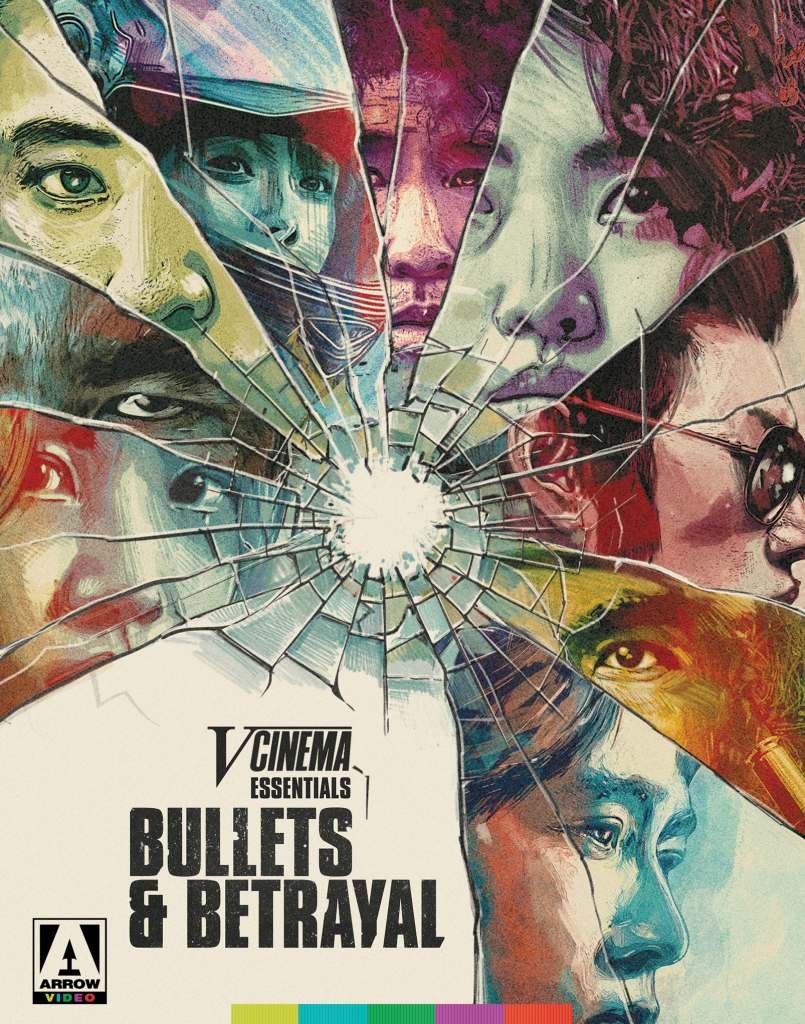
Just shy of regurgitating passages from earlier articles, I’m thrilled to finally get my feet wet in covering V-Cinema. It’s a market that I’ve hardly tapped in the twelve years I’ve been on this platform, which makes getting to cover Arrow Video’s V-Cinema Essentials: Bullets & Betrayal, all the more rewarding.
The bundle spotlights nine-titles that signals some of the best of the V-Cinema brand. Another aspect of the boxset is the history of Japan’s home video market with respect to Toei Video and its birth of V-Cinema in response to consumer demand; A core part of that reception by moviegoers at the time who preferred to fast-forward to the “good parts”.
Effectively, Shundo Okawa’s 1989 directorial effort, Crime Hunter: Bullets Of Rage, heeded the call. Crowning V-Cinema’s launch with the start of an action trilogy, the film chronicles the travails of a Little Tokyo detective on a mission to avenge his partner – murdered by a mysterious gang whilst the two lawmen were apprehending a murderous thief.
The cast is led by Masanori Sera in the role of Joe who dons a suitably cool look with some charisma to boot. He is joined by actress Minako Tanaka who plays Lily, a beautiful and mysterious nun who is more than she lets up. Seiji Matano is the elusive criminal, Bruce, who is initially caught but haphazardly freed by the gang of armed gunmen donning clown make-up.
Okawa’s simplistic story is nimbly told with a story sequencing various transitions that condense a lot of exposition to help get viewers into the next phase of the film. It’s an otherwise brilliant approach he takes to keep the story incisive as he brings touches of nuance and intrigue to a few of the characters, including crucial moments where we need to learn a little more about a few of these characters and their motivations.
Speaking of which, I should also add how cool it is to see actor Riki Takeuchi in something much earlier than Okawa’s 1999 gangster thriller, The Yakuza Way. That was the first time I’d seen a film starring Takeuchi as he’d grow on me since then, even though The Yakuza Way was a much different film than I anticipated and didn’t really enjoy it as much. I think nowadays and through much older eyes, that will probably change.
The action in Crime Hunter: Bullets Of Rage is fantastic with plenty of by-the-book explosive gunplay to whet the appetite. The film is also as macho as it gets at times with Joker taking charge whenever he and Lily are infiltrating dangerous terrain. There’s always that implied element of unease with the spontaneity of seeing a female character wandering about in a desolate area with a gun before shit starts popping off. There’s a hilarity to it – the kind of antecedent chauvinism that cosigns the halcyon days of action films in a way all fans of the genre can appreciate, that is, with some degree of concurrent wisdom.
Smaller guns eventually become bigger, as do the kills, with Okawa and his crew resorting to practical effect applications using artificial skin and hair to encase carefully-coated squibs upon principal photography. Suspending disbelief is also a must here, mainly with seeing how an action film protagonist can go from being shot a dozen times to practically shaking the dust off and revving up with some pain pills before pounding the pavement. Indeed, you get the idea Okawa was going for.
This is just a tidbit of some of the trivia the first disc offers in the film’s presentation aside from a trailer; The movie also comes with an optional introduction by Japanese film critic Masaki Tanioka. The core interview with Okawa has the director discussing his involvement with V-Cinema along with writing the movie, and sharing some interesting and even funny moments about the production, including how actress Tanaka was genuinely enjoying herself on set despite his own apprehension. The extras continue with a video essay narrated by Tom Mes who is host to one of the foremost, studious perspectives on Japanese cinema, specifically here about VHS manufacture and production, and Japan’s influential role in the world market during the home video boom.
This journey into the education and enjoyment of V-Cinema continues on the first disc with the second feature of the boxset, Neo-Chinpira: Zoom Goes The Bullet. The film was directed by Banmei Takahashi whose work I’ve only been able to see at least once in the last few years on my own time – the 1988 psychological thriller, Door, about a homemaker forced to confront a deranged salesman who’s become obsessed with her with her husband away at work. It’s with Door that Takahashi became a director to keep in mind for future consumption, as well as coverage, which makes getting to watch his 1990 satirical crime drama about an aspirant yakuza soldier contend with the pros and cons of killing a rival at his boss’s behest all the more rewarding.
That yakuza, named Junko, is played by Show Aikawa who is also behind the songs in the soundtrack. Aikawa is charismatic in the lead role as we follow his introspective tale of beleaguerment as a yakuza whose boss, Yoshikawa (Toru Minegishi) pulls a Brando on him, making an offer he pretty much couldn’t refuse. That offer takes evolution in a rather darkly comedic twist that finds Junko in the tightest spot he’s ever been, now with the only gun in the mix, and the de facto pointman forced to act independently to kill his boss’s target, or risk “zoom” and betray his boss.
Neo-Chinpira: Zoom Goes The Bullet presents a fascinating framework that compels the viewer to analyze nature-versus-nurture through male idolatry, and gender roles and norms. The film tells us that Junko’s only examples of who real, successful men are in his life, are gangsters, which stand in contrast to his genuine nature. At best, he’s a servant and takes a lot of shit from his superiors, especially by his uncle – played by venerated screen legend Joe Shisido – who weaves in and out of the story at times as Junko’s only voice of reason.
Junko’s crisis of conscious is made heavier when Yoshikawa loans him his car for the evening as a reward. While at a bar, the car is mysteriously stolen “borrowed” by a woman named Yumeko – played by Chikako Aoyama. Yumeko is a free-spirited runaway who begins having an effect on Junko whose wannabe tough guy yakuza mannerisms fade at nearly every moment of vulnerability. One example of this is when he’s inspired to observe one of Yoshikawa’s tenets to keep Yumeko in line, only for him to grow red-faced when she giggles at him. Moreover, Junko’s initial efforts to have his way with her often flounder, be it through distractions, or Yumeko’s narcolepsy.
There’s another scene that follows the underlying build-up with Yumeko’s fascination with Junko’s gun and its affect on her, causing her body to throb whenever she wanders into her own headspace and fires it. When that happens, she gets horny, and the two end up having sex, and this is every time she fires the gun; even when he’s preoccupied with other things, it’s Yumeko who calls the shots instead of the other way around. The sex is wild, rough, wet, and hot. The sex is on a bed, outdoors, in a basement, in soap-sudsy bathtub…it’s a lot of sex.
More to the point though, it certainly contributes to a key aspect of the dichotomy Junko has to confront while struggling with whether or not he should actually go through it. For what it’s worth, nevertheless, there really is no preliminary answer to rectify Junko’s dilemma at this juncture. He’s already made the choice to go through with the job, and with a promising figure waiting for him on the other end of a likely prison sentence. How director Takahashi explores this is with an extenuant look into how someone like Junko can truly grow into manhood, pointing out that this element of personal growth comes with understanding the choices we make as we go.
Tanioka, in his intro to Neo-Chinpira: Zoom Goes The Bullet, contextualizes this a good deal with a scene shown in one of the entries of a Kinji Fukasaku classic, which reminds me that I still need to watch the Battles Without Honor And Humanity saga. Alas, I really hope to make that money so I can afford that boxset at some point. One other interesting thing about the film that Tanioka points out is the mood of the film – the liberating allure of its characters compared to the more tangible and uncertain vibe of the world.
The disc’s relative feature to the movie also includes a trailer for the movie, as well as an interview with Takahashi who shares more on his career, working with Aikawa who effectively became the V-Cinema star of his time, and working with Toei’s home video shingle as the environment shifted with smaller budgets over time. He talked about the creative freedom there was in making films for the V-Cinema line, and also details into how engaged Aikawa was in the movie, from the music, to creating the character of Junko right down to the wardrobe, namely with two of the jackets Junko wears throughout the film, and the expressionistic touch the actor applies on one of them near the end. Takahashi even shares his appreciation for co-star Shishido, an action star of his heyday whose cheeks were as lasting a feature of his screen image as his choice to wear two sets of glasses for his role in this movie, which spoke to the helmer’s vision.
That outline is conveyed as a poignant comedy sprinkled with eroticism and violence to showcase a compelling drama that inspires the viewer as a reflection of what manhood means, with Aikawa as Takahashi’s model avenue to illustrate just what that means. It’s an enlivening tale with Aoyama leaving an equally indelible mark as someone who is more than the average woman with feminine wiles putting her survivalist instincts to work in a predominantly man’s criminal underworld.

This really is the first time I’ve gotten to cover Okawa and Takahashi on this site. I’m almost compelled to review Door when I can, and watch The Yakuza Way for my own analysis if it ever comes my way. It’s possible, whether it’s here or on my Instagram page, less so on Letterboxd as I don’t really have the bandwidth to spread myself thinner than I already have in my writing and my SMS activity. At any rate, this wraps up my first piece on Arrow Video’s V-Cinema Essentials: Bullets & Betrayal, with seven more titles to watch and hammer away at in this series of articles.
If you enjoyed this article, please consider donating to my Buy Me A Coffee page.