


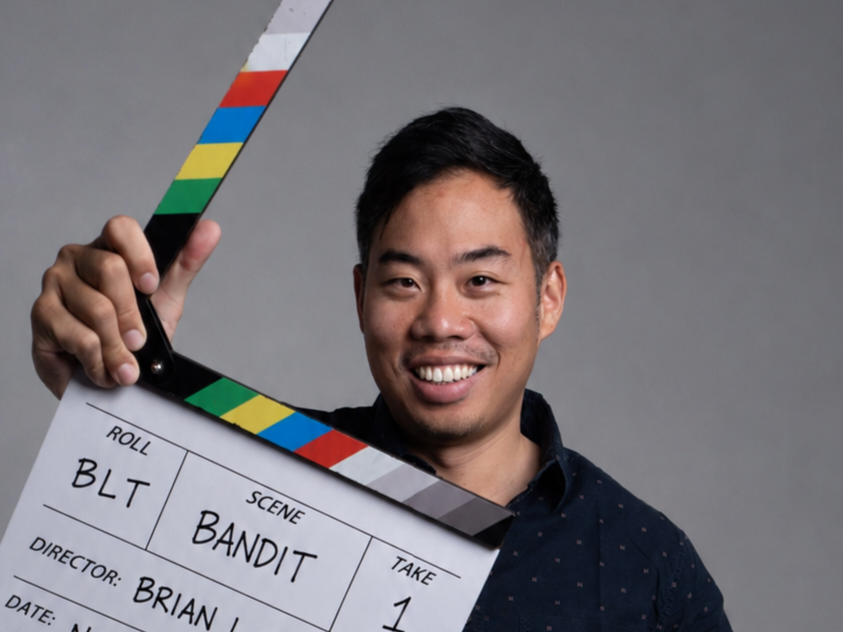
The last thirteen years have seen me try and network with hundreds of people in time as an indie journo. Filmmaker Brian L. Tan and I have been friends on Facebook for ten of those years and as I write this intro, I don’t think we’ve ever corresponded up until this point. So, to be able to finally do just that as the film festivals present his latest crime thriller, Bandit, is pretty amazing.
The same can also be said for the movie which stats Wafda Saifan and Roy Sungkono in the story of two friends in a drunken stupor whose actions come back to haunt them in the worst way when they steal the wrong person’s car. The film also stars Claresta Taufan, as well as Rifnu Wikana who I just realized plays a small role in the Mo’ Brothers’ 2016 actioner, Headshot.
Tan and I go into Wikana’s role in Bandit, the cast, the locations, and more in our debut interview, which – agreeably – has been a long time coming. I also reviewed Bandit earlier this month and you can tap into that analysis via this link.
As for Bandit, I’ll provide in due time on this film’s pending releases and a hopeful trailer; The only promotional teaser that’s available is the one embedded at the film’s official website. while Tan permits us to learn more about the project in our following discussion. Enjoy!


You’ve been in the industry for a while now. Talk about your journey into filmmaking and what led you to this craft.
I’m a traveler by nature, and filmmaking is an extension of that curiosity. I grew up with a lot of duality, moving between spaces, faces, and places, and I’ve always wondered what life would look like if I’d taken a different path. What if I’d grown up somewhere else, spoken another language, or done a completely different job? I like getting outside my own comfort zone and finding out how other people live. That curiosity drives me to make films about people; because people are fascinating and cannot ever be quite fully figured out.
Filmmaking gives me an excuse to do that constantly. You get to explore different professions, communities, and ways of thinking, and you have to understand enough about them to make the story believable. Then there’s the work itself: writing, working with actors, figuring out a technical problem, or finding a way to make something happen with the resources you have. I enjoy wearing all those hats because I’m constantly engaged and in a ‘flow state’. Maybe I have ADHD?
My own path has included visual effects on studio films, starting a business, and directing my own projects. Those might seem like detours, but they all feed into the work. I don’t think I’d be happy doing exactly the same thing for the rest of my life. Filmmaking gives me a way to keep exploring without having to start an entirely new career every few years. It’s one hell of a rollercoaster ride, but I wouldn’t have it any other way!
You worked behind the scenes on films like Tron: Legacy and X-Men: First Class earlier in your career. What are some of the biggest draws for you having worked on these major studio projects?
The experience, the people you meet, and the amount you learn are the biggest draws for me. On films that size, you’re surrounded by people who are exceptionally good at very specific things. Seeing how their contributions come together is an education in itself. You also make connections with people whose approaches to the work can really expand your own.
My background was in visual effects, so I learned to think about how a decision made at one stage of production affects everything downstream. A seemingly small choice can create a huge amount of work later. You develop an appreciation for planning, clear communication, and understanding what the other departments actually need from you. On a huge set where there’s hundreds of people, you learn what NOT to do as you learn what to do properly.
Those lessons are useful on a small film, too. In some ways, they’re even more useful because you have less room to recover from a mistake. You can apply the same care to preparing a shot, communicating an idea, or deciding where effects will help. The resources change, but a lot of the thinking carries over. That’s what I wanted to take from those experiences into my own directing.
I’m curious about some of your own film favorites that motivated you to become a director. Are there any familiar or obscure gems you’ve enjoyed that my readers and I should watch?
Saving Private Ryan is a big one for me. It’s a very different film from Bandit, obviously, but the way it puts you into an experience is extraordinary. You’re absorbed in the story, and at the same time you’re confronted with how frightening, chaotic, and costly violence is. It makes those lives (and the sacrifices they make) feel painfully specific.
Oldboy and No Country for Old Men are also films I keep coming back to specifically for this project. They’re compelling to watch, but they leave you with difficult questions about revenge, morality, and the kind of world these characters inhabit. The feeling doesn’t end when the plot does.
That’s the combination I respond to: entertainment and enlightenment. I want to be completely caught up in a movie, then come out with something to think about, or a better understanding of an experience I’ve never had. Those films remind me how much you can communicate when you’ve really got an audience’s attention.
Your newest film, Bandit, is making the festival rounds and I first caught wind of it last year when it hit the Jogja-NETPAC Film Fest. Talk about that project and how you came up with the idea.
The idea actually started with our writer, Husein M. Atmodjo, whom we call Monji. He wrote the script after being robbed in Jakarta about ten years ago. I’ve personally been robbed as well, so there was something about the fear and vulnerability behind it that I immediately understood.
The script then spent roughly a decade in development before he pitched it to me. The moment I heard the pitch, I knew we had to make it. It was love at first pitch: Two desperate friends steal a car, discover a body in the back, and suddenly have a much bigger problem than the one they were trying to solve. I could immediately see the movie unfold in my head visually.
What made me want to spend the time making it was the human situation underneath. Gatra is trying to help his pregnant wife, and you understand why he’s desperate even as he’s making terrible decisions. Setting that story in Bali also lets us show a side of the island that gets much less attention: the people trying to make a living in a place everyone else comes to enjoy.


I love that Gatra and Maya came from different backgrounds, both culturally and spiritually. How important was this for you in telling their story? And did you always see Gatra taking on an evolution in this sense despite his own beliefs?
It was very deliberate. Indonesia is incredibly diverse, and I wanted some of that complexity to be part of the relationship. People sometimes talk about Indonesian culture as though it’s one thing, but Gatra is Javanese and Maya is Balinese. They come into their marriage with different cultural and religious backgrounds, and those differences have real consequences for the decisions they’re trying to make.
For Gatra, moving is a practical option. He’s already left Java to build a life elsewhere, so picking up and trying again somewhere else makes sense to him. For Maya, leaving Bali means something much bigger. Her father is there. Her religion, community, and the daily experience of being Balinese are rooted there. There’s nowhere else that can give her that same life. She can physically move, but she can’t take all of that with her.
That’s why I wanted an interfaith couple from different ethnic backgrounds. They can love each other and still struggle to understand what the other person is being asked to give up. Gatra’s evolution matters because he has to start taking her perspective seriously, even where it doesn’t fit his own beliefs. I wanted the audience to understand why she can’t simply say, “Fine, let’s go.”
The fight scene in the club was a great feature, as it shows a different side to Gatra while his friend Tiar is outside. Talk about preparing and filming for that particular scene for Saifan’s performance.
We wanted it to look like an ordinary person getting into a real fight. It’s not John Wick, The Raid, or The Night Comes for Us. Those films have their own approach to action. Gatra is in a brawl, and we wanted the audience to feel how ugly and exhausting that is.
That meant making room for sloppy punches, people losing their balance, and moments where they’re tired and need to catch their breath. For Wafda, the performance had to include all of that. Gatra can hurt somebody, but he also gets worn out. He’s reacting under pressure, and his body doesn’t suddenly become infinitely capable because he’s the protagonist.
We wanted to show it in an unbroken take so you have to stay with the whole experience, including the awkwardness and exhaustion. Preparing that means coordinating the action and camera carefully while still making the fight feel messy. The result should feel brutal rather than stylish. Violence isn’t a dance, and that was the point of the scene.
Rifnu, actor who plays Beni in your film, was incredible. How easy or difficult would you say it is to create a character as menacing and equally complex as his is?
Rifnu has an amazing voice, for a start. There’s so much authority in it that he can make a fairly quiet exchange feel threatening. That immediately gives you something to work with.
But creating that character is a balance. A lot of Beni’s worldview was inspired by Anton Chigurh in No Country for Old Men: that aloofness, the sense that other people’s rules don’t really apply to him. Beni also takes a sadistic pleasure in having power over people. He enjoys making someone feel small and knowing they can’t do much about it. That’s his fetish, so to speak.
The difficult part is keeping that believable. If he’s constantly announcing how evil he is, you lose the menace. Rifnu can let the cruelty come through in his voice, his pauses, and how comfortable he is with somebody else’s discomfort. Action speaks louder than words and in his head, Beni doesn’t think he’s a bad guy. He is simply doing what he has to do to get ahead, and very much enjoying the process of wielding power over others.


There’s a poetic resonance to the amount of devastation and violence that our characters leave behind in Bandit that really weighs heavy, especially by the ending. Is there an emotional toll that you share as the director in this regard when crafting these stories?
Yes. I get attached to the characters, and it’s upsetting to think about how much they lose. Gatra begins with something very ordinary: he wants to take care of his wife and have a future with his family. Knowing that makes the damage that follows harder to shrug off, even when I’m the person putting it on screen.
That’s the part that stays with me when I’m working on the story: how little it can take for a life to go badly wrong, and how much suffering can follow a decision made in a moment of desperation. By the ending, I want you to feel some sadness about what could have been.
At the end of the day, we like to think that hard work and persistence will pay off no matter what, but we often forget that luck is often the deciding factor. And boy are Gatra and Tiar really damn unlucky!
What are some of the reactions you’ve gotten thusfar from screening Bandit?
The response has been really encouraging. We’ve had sold-out screenings, with people sitting on the floor because they still wanted to watch. When someone is willing to do that for your film, you take it as a pretty good sign.
The Grand Jury Prize at Dances With Films and Best Foreign Film at Burbank have helped us build momentum, and seeing Bandit mentioned in publications like Variety and Deadline has been exciting. For an independent film made in Bali, that attention makes a real difference in getting people to give it a chance.
What I appreciate is that the film seems to be connecting beyond its immediate setting. We made something very specific to this place and these characters, and people elsewhere around the planet are coming along for the ride. That’s encouraging for all of us!
I’ve never been to Indonesia, so what appealed to me the most as a film fan was the wave of cinema that’s emerged in the last fifteen years-plus. You’re from there, and you’ve staked yourself in the region as of late with this project. What stands out to you the most about filming in the country, or in Bali, specifically? What notes should other directors and producers be taking?
Honestly, the willingness to help. That’s been one of the biggest differences for me. I made films in LA for almost fifteen years, and it can be a pain in the ass. Sometimes it feels as though every step brings another obstacle, another fee, or another person explaining why you can’t do something. The endless bureaucracy, rules, and red tape mean that smaller indie movies are often shafted. I’m looking at you, FilmLA.
My experience in Bali has been much more supportive. People are excited that you’re making a film. They want to be involved, and the conversation is often, “What can we do to help?” as opposed to, “What can we do to hinder?” in Hollywood. There’s less cynicism. You don’t feel quite so much like every person you approach is looking for a way to turn your problem into their payday.
That “can do” attitude makes an enormous difference on an independent film, where you depend on people being willing to work through problems with you. Of course there are practical challenges here, but starting from a place of goodwill makes them much easier to deal with. For directors and producers considering Bali, I’d pay attention to that. The people and their willingness to make something happen are a huge part of what makes filming here not only dynamic, but also much more pleasant.
What would you say have been the most challenging aspects of filmmaking so far up to now? And, what do you see as potential or viable solutions for these issues?
Budget, because budget determines how much time you have. It affects how long you can rehearse, how many shooting days you get, whether you can try another approach, and whether you have to move on from a scene before you’re happy with it. Those decisions end up on screen.
The frustrating part is knowing what you want to do and spending so much of your energy figuring out how much of it you can afford. I’d love to reach a point where I can give more of my attention to the creative work. Sometimes you need time to discover something with an actor or work through an idea that isn’t quite landing yet. That gets difficult when every extra hour creates a financial problem.
I don’t think there’s a clever workaround for all of that. Preparation helps, and so does writing for the resources you have, but sometimes the honest answer is that the film needs more time and money. Constraints can produce good ideas. They can also mean accepting a smaller version of what you know the film could be. I’d like to spend less time doing the latter.
How soon can other folks expect to see a commercial release for Bandit?
We’re continuing the festival run with Catalina Film Festival, Dili Film Festival, and then FilmQuest, where we’re in the running for seven awards. It’s been great to see the film keep finding new audiences.
For the Indonesian commercial release, we’re still in the queue for a wide-release slot with Cinema XXI. So I can’t give you a firm date yet, but that’s what we’re working toward. We’ll put the details on bandit.film and @bandit.film as soon as we have something definite.

What’s next for “BLT”?
I’m open to seeing what comes along. I’d love to direct for other people as well as continue developing our own material. A good script doesn’t have to originate with me for me to get excited about making it. Bandit is a pretty good example of that.
I’m looking for projects that sit somewhere between entertainment and enlightenment: something people want to watch that also gives them an experience or perspective they might not otherwise have. We’re developing some original projects in-house, but I’m also leaving room for the unexpected. I’d hate to be so fixed on a plan that I missed a great film sitting right in front of me.
I want to thank you for taking the time to share your story for this Q&A, and congratulations with your current festival movement with Bandit. Is there anything you’d like to throw at our readers as we make our exit?
Independent filmmaking is hard, and you can spend years waiting for enough money, the right opportunity, or someone to take a chance on you. But every once in a while, a project comes along that makes you want to find a way through all of that. Bandit was that project for me. Once I heard the pitch, I wanted to get it made.
I think we need more bandits in the world in that sense. People willing to seize the initiative, get a few people together, and actually make something. There’s a vulnerability to putting your work out there, because now everyone can see its imperfections. It’s much more comfortable to keep talking about the brilliant thing you’re going to make someday.
I have a lot of respect for anyone who takes that chance. Your film might have flaws. You might look back and wish you’d done things differently. I certainly do. But something you made could still mean a great deal to somebody else. It doesn’t have to be perfect to be worth making, and you won’t find out what you’re capable of by waiting forever.
So don’t only watch Bandit, get out there and be a bandit too!