


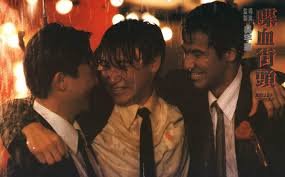
The journey so far that has been Shout! Studios’ slate of a selection of John Woo’s heyday filmography via Hong Kong Cinema Classics has been one full of milestones. His 1990 crime drama epic, Bullet In The Head, remains one of them, and for reasons better than its storied past.
Bullet In The Head was a flop at the Hong Kong box office at the time of its release, and in no way shape or form does this speak to the film’s merits. It’s a visually gripping and powerful tale of friendship and betrayal, one that plays on some of Woo’s familiar and oft-revisited themes of friendship, brotherhood, and honor. These aspects are set against a thick backdrop with plentiful scope and depth to compliment Woo’s ambition.
Penned by Woo and by Patrick Leung and Janet Chun, Bullet In The Head is set in the late 1960s and chronicles the explosive saga of childhood friends, Ben (Tony Leung Chiu-Wai), Franky (Jacky Cheung), and Paul (Waise Lee), who are thrust into survival mode after evading Hong Kong law enforcement following a gangland killing. Ben, at the cost of losing his recent marriage to Jane (Fennie Yuen), is forced to stick with his friends, which lands the trio squarely in Vietnam during its own era of wartime turmoil, losing their luggage and witnessing the country’s brutal violence first hand.
In an effort to stay afloat, they convene with a hitman named Luke in another twist of fate that brings them at odds with the criminal locals – namely Luke’s boss. The plot thickens and the trio becomes a quartet when the bullets start flying and the boys are, again, forced on the run after a deal gone raw, making them targets of both the local cartel as well as the ruthless Vietnamese military.
More to the film’s core is the question of whether or not the longstanding friendship between Ben, Franky and Paul can stand its current test. Between the upheaval of war, a mounting bodycount and a trunk full of gold, it’s only a matter of time before temptation and tragedy set in, ultimately turning friend into foe.
Bullet In The Head is a classic crime flick through and through, playing plentily on its strengths through Woo’s vision. Leung is full of charisma and raw energy on screen, as is Cheung who turns in some of the most intense scenework as an underdog among the three, and Lee rounds out with a substantial performance as the turncoat of the bunch.
In large part though, it’s Cheung who makes the most out of his role, a flawed character whose actions set the tone accordingly for the rest of the film, including from the moment a local gangster smashes a bottle on his head within the film’s first fifteen minutes. Woo circles back to this plot piece several times which serves to the climatic ends of our characters as the finale approaches.
Adding to some of the intrigue and complexity is actress Yolinda Yang who plays a Hong Konger forced into prostitution by the local crime syndicate. Her character becomes central to their cause midway in the film as the plot thickens and the odds surmount our characters and ultimately, all they have is each other until betrayal sets in. There’s at least one key scene that preambles this facet of the film in a robbery scene that occurs just before the Vietnamese military arrive.

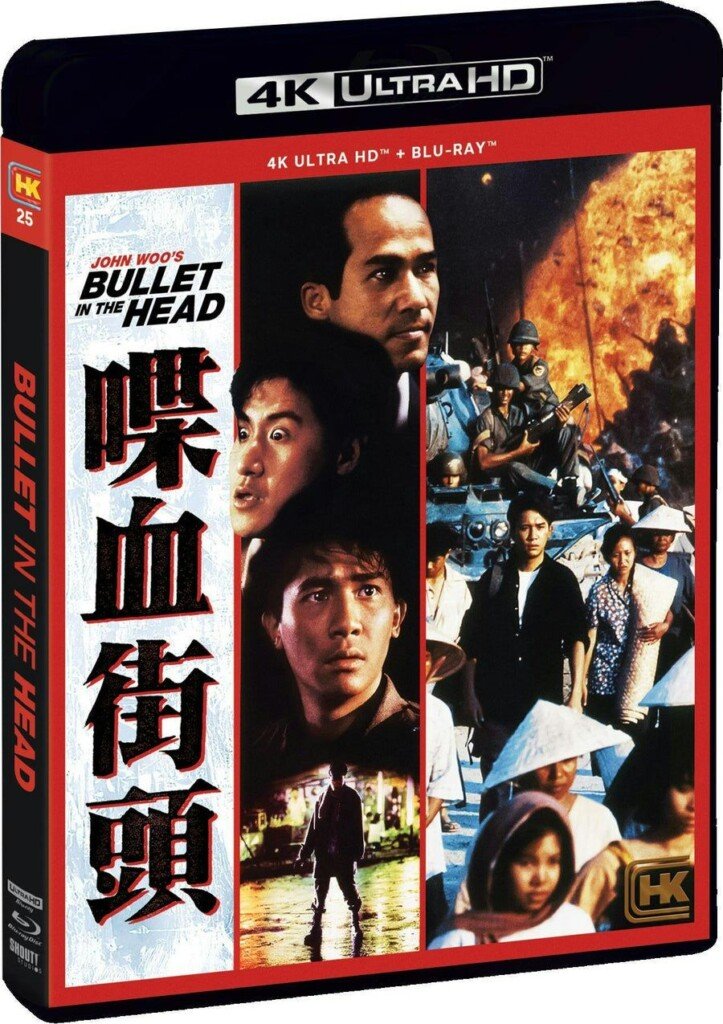
Fans of Woo’s work will especially take a liking to what Yam brings to the table. He’s as cool as ever, almost as effortlessly as is leading man Leung. There’s a fair bit of chatter about this as well in the extras of this disc release from Shout! which includes three discs, respectively: Disc One holds the film’s presentation in 4K, followed by Disc Two standard Blu-Ray presentation, whereas an international cut that adds several more minutes to the film’s theatrical cut can be seen on Disc Three, along with more than two hours of extras.
None of this counts for the commentary which I listened to, and really enjoyed. Contributing speaker Frank Djeng (NYAFF programmer, producer on Enter The Clones Of Bruce) dives right into all the factoids about this film and its impact on cinema, as well as his own personal memories of watching the film, as well as the conditions for why there are different versions of the film as well as a different ending. There are next to no pauses during this track so guaranteed, your ears will be plenty stimulated.
Disc Three extras otherwise proffer a five minute reel that showcases said aforementioned alternative ending which Djeng talks about, as well as “Brilliance With A Bullet,” a 43-minute interview in which Woo gets into all the nooks and crannies of the production, many of the themes and ideas that drove him, working with the cast, and what it took for him to push through.
The next interview, “Head Case,” runs for eighteen minutes with Waise Lee discussing his career and how he got into acting, pay issues, and getting to work with Woo for A Better Tomorrow. The following five-minute “Army Of One” brings back fellow Woo cohort Terence Chang for his own reflection on the film, followed by eight minutes with editor David Woo in “Apocalypse Woo,” as does producer Catherine Lau in “Tumultuous Times,” in which at one point she shares how she reacted to Woo’s undeterred ambitions despite budget issues. It’s kind of funny.
Grady Hendrix goes into even more detail at thirteen minutes with a Hong Kong Confidential featurette, highlighting the gravity of the production, Woo’s state of mind from start to finish, the impact it had on his career, and the grace he was given despite the film’s poor box office performance. Until you’ve seen this featurette, have fun guessing how many hours of footage Woo shot for this film.
The extras near their finish with Dr Lars Laaman weighing in for twenty-seven minutes in “Apocalypse How: The Period Provocations Of Bullet In The Head.” Afterwards, you get a pair of trailers at seven minutes and some change, followed by a three-minute slideshow with up to fourty-six images to feast your eyes on.
Conclusively, these features are a ton to get through, and totally worth it if you’ve seen the film and bought any versions of it on DVD that lacked the features this release has. The extras are fantastic with references to Alain Deleon and Leonard Bernstein, and even complimentary moments to the film as a far greater achievement of something he strived for on his 1986 war movie, Heroes Shed No Tears.
There’s also the fact that this film is a rework of a previous script that would’ve been a successor to Woo’s 1986 action classic, A Better Tomorrow, a film that made Chow Yun-Fat a household name. Namely, there are bits and pieces of Bullet In The Head that point to Tsui Hark’s 1989 threequel, A Better Tomorrow: Love And Death In Saigon in terms of where things were changed or possibly leapt off from between the two.
It’s just interesting to notice, especially with Waise Lee’s casting here as it reunites him with Woo after A Better Tomorrow given the scope of his character. Adding to the intrigue is watching the film, and then the extras and hearing all the stories from this film. It really gives you some perspective regarding fraught things were between Woo and Hark at the time, and Woo’s possible state of mind before, during, and after filming with post-production taking its toll. The only thing that remains missing here or in any of the Woo releases from Shout! is Hark’s word. Hm.
On top of an otherwise amazing film, you get one of the most multi-dimensional looks into the mind of a beloved director at his most beleagured, aiming for a story with a clear need to express his own pain and need for healing. It may have come at a cost, and thankfully, the price wasn’t so high that his investors wouldn’t grant him another chance…
That’s where Once A Thief comes in. In the meantime, I’d say as much that buying your copy of Bullet In The Head at Gruv.com will certainly fill a void if this 1990 gangland epic has been missing on your watchlist.
