

Arrow Video’s Samurai Revolution Trilogy is currently avaliable on Blu-Ray from MVDshop.

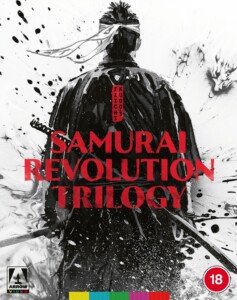
I haven’t had my eyes on Takashi Miike’s 13 Assassins in a long time. It’s high time for a rewatch, although Eiichi Kudo’s 1963 period drama will do all the same. It’s a well-noted bookmark in Japanese cinema, and with Arrow Video’s latest handling, I’m thrilled to have finally seen it.
Set in 1844, Kudo’s 13 Assassins follows the travails of Shinzaemon Shimada, a samurai entrusted with enlisting a band of worthy men to undertake the ultimate goal of assassinating Naritsugu, a tyrannical Lord whose incorrigible and unruly behavior, and abuse of power have cast a damning spotlight on the government. The mission begins as Shinzaemon starts enlisting the men he needs while clocking Naritsugu’s activities, all leading up to his annual trip to Edo, and cornering the Lord and his entourage in the town of Ochiai where the final battle commences.
13 Assassins is bookended across the board by some amazing performances by the cast. Chiezo Kataoka takes on Shinzaemon, a stoic widower who finds his calling with the assassination of Naritsugu, even as he faces a likely confrontation with former comrade and Naritsugu’s retainer, Hanbei, played by Ryohei Uchida. They have a scene together in which they share a respite dialogue acknowleging each other and the grim circumstances in which they find their proximity, which I thought brought some much-needed poignance and depth to the story.
Among Shinzaemon’s recruits also include Hirayama, played Ko Nishimura (Cruel Tale Of Bushido). Hirayama is a masterless samurai whose sole and regular focus has been on his training until the day Shizaemon came, having expected to pay his debt to the widower samurai after years of favor. He definitely leaves one of the stronger impressions of the bunch, particularly after a scene in which he kills two men, setting off caution in Hanbei’s mind as he knows full well how unscrupulous his Lord is and what could be coming.
Actor Kotaro Satomi, who recurs in all three titles of the Samurai Revolution Trilogy, plays Shinrokuro, Shinzaemon’s nephew who spends his days at a geisha house with the woman he loves. His enlightenment comes when Shinzaemon picks up where two men left off after failing to recruit Shinrokuro who, prior, was more devoted to learning the shamisen. It’s when he hands it to Shinzaemon and finds himself enraptured by his playing that Shinrokuro has a change of heart. The film also introduces Kanjuro Arashi who plays one of the thirteen, Kuranaga. I love that I’ve become as familiar as I have with him after seeing him in several other films, which is why he stood out so well along with his performance.
Kudo’s 13 Assassins is a story packed with melodrama, intensity and strategy as we follow our heroes on their quest to stopping Naritsugu’s entourage in its tracks. The climatic finale unfolds in exciting fashion, albeit unraveling in a complete burst of violence as the number of anyone living with a sword in hand dials down to a mere few, and bookends with a straightforward sign-off of how the “official” record notes Naritsugu’s passing.

The Great Killing, Kudo’s 1964 period drama, sits at number two in the Samurai Revolution Trilogy, and tackles a more subversive message about the samurai which echoes something similar from the work of Tadashi Imai. The story is set in 1678 when a new land tax devastates the people, the secretary of state is accused of political intrigue with the intent of assassinating Minister Sakai (Ryutaro Otomo), a corrupt Shogunate elder, and soldiers are sent to raid villages in pursuit of anyone suspected to be in connection with the plot.
As a man named Nakajima takes sanctuary at the home of friend and police guardsman Heishiro (Kotaro Satomi), the place is suddenly swarmed by soldiers. Amid the chaos, Heishiro is violently arrested as his beloved, Kayo, is cruelly murdered moments before he seizes the opportunity to escape detainment amidst a scrimmage. Heishiro soon finds shelter in a gambling den owned by Matanoshi, and is soon proffered the chance to join a cabal of rebels by the beautiful Miya (Nami Munataka), in which he also gets acquainted with Tomonojo, a family man and tradesman who has his reasons for joining the resistance.
Here is where The Great Killing balances between espionage procedural and character drama, as the film further explores the troubling dynamics of the movement and its members. There’s a thematic dichotomy that Kaneo Ikegami’s script gets into right from its latter exposition; While each character has their motivations for getting involved in the brewing assassination plot, not every character we meet along the way is someone who wants to get involved, and instead, would rather keep their head down and simply maintain their own peace through the calamity.
The more troubling aspects of these character layers, however, are more to do with select members of the group tasked with plotting the minister’s demise; As the film progresses, the group has five days until a Buddhist ceremony to prepare while Sakai stirs things up to assure the usurpation of the Shogunate to the Chancellor’s son to maintain his own power and privilege. In that same week, The Great Killing unravels a withering framework of morale that peels back the curtain on all the typical facets of samurai heroics for a few of hour protagonists, conveying their flawed essences in often vivid moments of often carnal weakness, sexual violence, shameless opportunism, brutal cowardice, and even bloodshed.
Kudo’s 17th century tale here does ample work at unfolding much of the interwoven espionage and danger throughout, contributing excellently to later events. The latter half of the film culminates with an explosive battle after Jinbo bumps into Matanoshi one last time – a moment that will surely carry over through to the film’s end. Swordfights spill into rivers, cramped corridors and streets as the men target the royal palanquins where they believe their target is, all leading up to a discerning conclusion that euphemizes not only recurring archetypes about heroic samurai, but human nature as a whole.

Less of a staunch referendum on samurai tropes, Kudo’s 1967 release, 11 Samurai, tackles another tale of burgeoning rebellion that ensues when the spoiled rotten and evil Lord Nariatsu (Kantaro Suga) trespasses from the Tatebayashi into Oshi fief while hunting, shoots and kills one of the Oshi clan’s vassals, before turning his bow and arrow moments later toward a Clan Lord who arrives to investigate. The Oshi clan’s Chamberlain, Tatewaki (Koji Nanbara), attempts to hold Nariatsu accountable with the Shogun elders – an effort that fails and ultimately results in abolishment against the Oshi clan in a summary judgement that the Elders agree to withhold for a month.
Desperate to seek justice one way or another, Tatewaki resolves to going covert and assassinating Nariatsu with the help of childhood friend Hayato (Isao Natsuyagi, Samurai Wolf films), who begins enlisting as many as ten more men along the way. What follows is a stoic tale of duty mired in political skullduggery and tragedy in a move that threatens to upend Hayato’s mission, but catapulting him and his band of samurai into a deadly final confrontation where the odds most certainly aren’t in their favor, and strategy is everything.
I must say that 11 Samurai is more my favorite among the trilogy. Indeed, it continues on many of the bleak overtones of its two predecessors and even antes up the tragedy a bit, but the story doesn’t feel as myopic. It definitely bodes as increasingly perpetual and momentus with each story and character development, and performances that lend weight and significance to the film and how it signifies Kudo’s shelflife as a director worth celebrating.
There are a lot of characters and moving pieces, but the movie doesn’t feel as scattered with so much to try and keep up with than the other two. To this end, the story focuses primarily on Hayato, his friendship with Tatewaki, his marriage to the beautiful Lady Orie (Junko Miyazono), and how all of these factors are affected by the mission – even some of the more problematic aspects of it, like trying to keep at least one of his men in line before they end up making a costly mistake. Chanbara fans will also see screen legend Ko Nishimura (Cruel Tale Of Bushido) in the role of a disgraced ronin named Ido who joins Hayato and his men for his own vengeful purposes, thus contributing to the titular undecuple.
The sword scenes are easy to watch as well, and the cinematography doesn’t feel as heavy on the eyes like with some of the handheld shots of the other films thusfar. The battles are spaced amply between the performers and the camera, allowing you to better consume what’s happening for a more digestible intake. Leaving out other aspects of the action here in this analysis, I’ll add that the final duel between Hayato and Nariatsu’s Chamberlain, Gyobu (Ryutaro Otomo) is an albeit safisfying conclusion to Kudo’s threequel, lending ample balance to the concordant themes and dreary aesthetics that settle in before the closing captions.

All three films come bundled in Arrow Video’s release of Kudo’s Samurai Revolution Trilogy, packed with individual commentaries from Tom Mes on 13 Assassins, and from David West on The Great Killing and 11 Samurai. They also feature hours of extras altogether with video essays discussing each film, spotlighting on the careers of Kudo, legendary composer Akira Ifukube (Zatoichi, Daimajin and Godzilla franchises), and cinematographer Osamu Furuya (Red Peony Gambler franchise), archival interviews with Kudo’s former assistant director Misao Arai, and filmmaker and author Dirty Kudo, and more. It’s a storied snapshot of Kudo’s career with a focus on the Japanese film industry in its evolution, and will all highlight some interesting facts that are tangible and essential to anyone curious about the cinema of the Far East, or old school samurai dramas in general.
At this point, I’m still consuming the extras, but it’s a rewarding package altogether if you’re fascinated by Japanese cinema of the 20th century in any capacity, let alone Kudo’s work.