


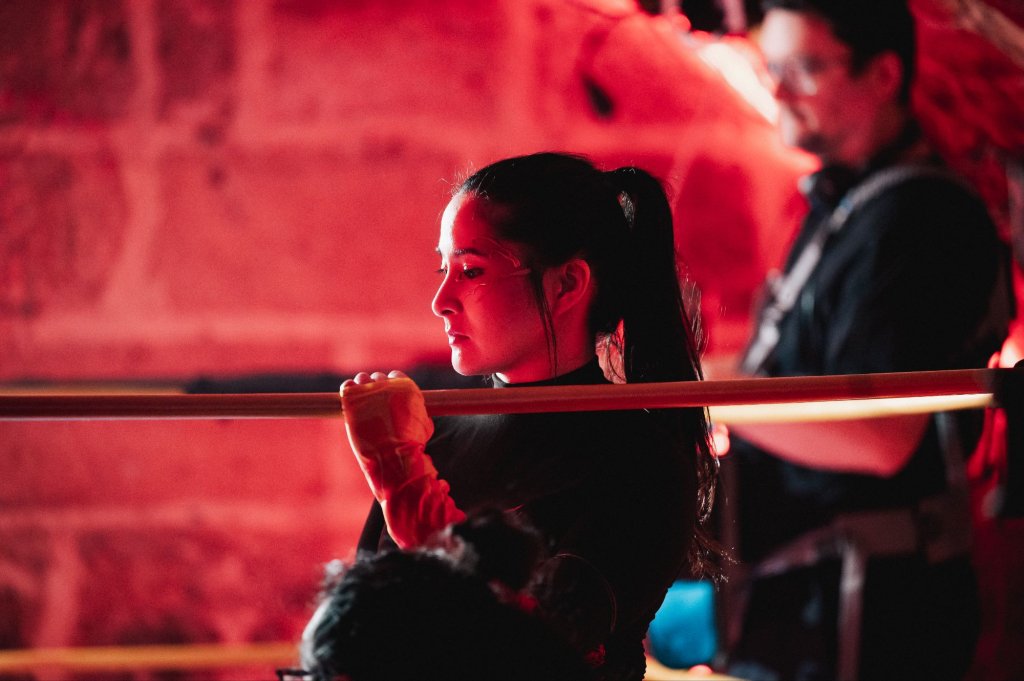
It’s been about two years or more since I got acquainted with actress and stuntwoman Maryline Vo. She’s one of the biggest fans of action cinema and Asian films I know, and someone who’s particularly fond of stars like Michelle Yeoh and Gong Li, and before I knew it, we were both trading viewing recommendations. I had a load of V-Cinema to throw at her, a lot of which I haven’t seen yet so needless to say, we both have homework to do!
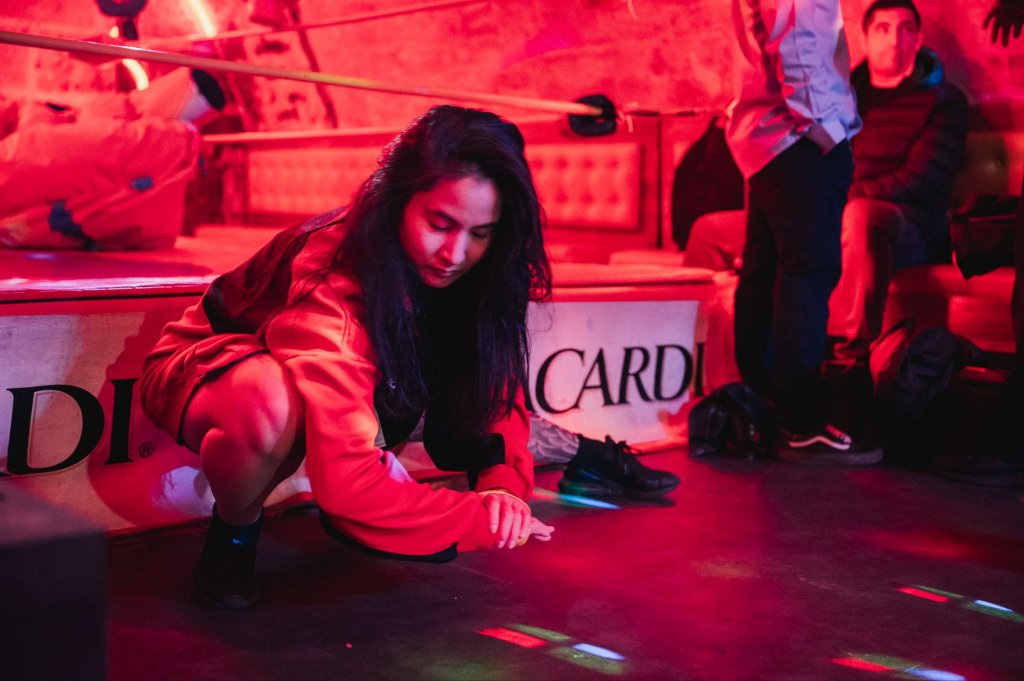
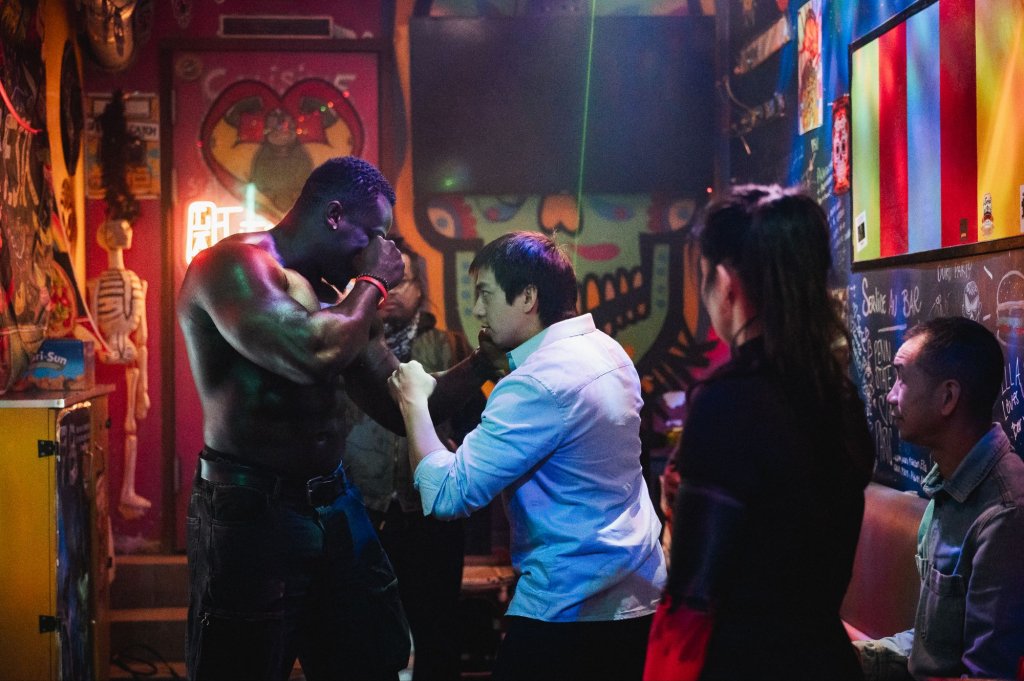
Needless to say, none of that should be encroaching in her current field of focus as a career stuntwoman and actress, stage performer, and as of late, director, having recently shared the helm with co-director Virak Thun on action comedy concept, Lost In Spice. Vo also stars in the short alongside leading man Romain Bloch who plays a man wandering in a bar and soon takes up a dare to try a rather spicy out-of-this-world ramen cup. The shortfilm immediately transports the viewer into an ethereal plane where action collides with the man’s fight to defend his tastebuds in a fighting ring, with Vo personifying the unrelenting “dragon breath” chilli flavor.
It’s been a while since Lost In Spice made its online debut and the movie is now being screened at festivals, namely the fourth edition of Big Bad Film Fest in Los Angeles, where the short will screen this Sunday next to new Japanese action comedy, Match Monde. In the meantime, this post marks two for two in interviews with filmmakers making their mark at this festival, and with Vo finally debuting her story for this platform. It thrills me to finally be able to share her story.
Read on, and follow Maryline Vo on Instagram @maryline_vo!
Congratulations on your recent successes this year with Lost In Spice. How has the year been for you thusfar?
This year has been quite incredible, and honestly, I didn’t expect to experience so much in such a short amount of time. Lost in Spice has opened a lot of doors. The film screened at Cannes, received awards, and has continued its festival journey since then. But beyond the selections and awards, what means the most to me are the people I’ve met through the film and the audiences who have discovered our little world.
This year has also allowed me to keep growing as a stunt performer, actress and director, and to better understand the direction I want to take with my career. I’m still building a lot of things. I’m training, experimenting, meeting new people, and trying to turn every experience into something that can feed into my next projects. So, I would say that 2026 has been a year of discovery, hard work and, above all, new possibilities. And I genuinely feel that this is only the beginning.
I want to help readers get a little more acquainted with seeing as you were a cascadeuse when I first met you. Talk about what motivated you to start this particular journey.
I think it all started very early, with my love for action cinema. There’s actually a funny coincidence: my family name literally means “martial arts” in Vietnamese. It’s quite strange, but looking back, I almost feel like it somehow guided me.
My father also passed that passion onto me through films by Jackie Chan, Bruce Lee, Sammo Hung and Donnie Yen. I grew up watching those movies and being fascinated by bodies in motion, fight scenes, and characters who could get back up no matter what happened to them. But for a long time, I had no idea that this could actually become a career.
When I discovered the world of stunt performance, I immediately felt that I had found something that suited me. There was the physical aspect, of course, but also the discipline, the challenge, the precision, and above all, the opportunity to actually contribute to the creation of an action scene.
What motivated me to start this journey was therefore both my love for cinema and my desire to push my own limits. I wanted to discover what my body was capable of and learn how to tell a story through movement.
What would you say was the most challenging stunt you’ve ever performed for a project?
The most challenging stunt I’ve ever performed was for a feature film shot in Germany. It involved a bicycle crash, with a long-distance projection onto the asphalt. The difficulty came from the speed and momentum of the fall, the impact, but above all, the precision required. I had to land exactly on a predetermined mark — literally a small Post-it on the ground.
That precision was essential because the fall was immediately followed by a human torch sequence. Molotov cocktails were going to be thrown at me from the bridge above, with my back as the target. My position therefore had to be absolutely precise so that the bottles could reach my back at exactly the right moment.
The next step was to remove my jacket while it was on fire, throw it to the ground, and then be extinguished myself. That movement was more challenging than it might sound because the jacket was very tight, making it harder to get out of quickly.
So the stunt required much more than physical commitment. It demanded precision, perfect communication with the team, complete body control, and constant awareness of the risks involved. I think that combination is what made it one of the most demanding stunts I’ve ever performed.
I’m curious about your take on fight choreography, because you’re adept to both Hong Kong-style as well as Japanese style with katanas. Who are some of your inspirations in this particular area?
My inspiration and love for Hong Kong-style action go all the way back to my childhood. My father wanted to raise me to become a warrior, someone who would never give up. A big part of his education came through action movies.
My film collection was filled with Jackie Chan, Sammo Hung, Bruce Lee and Donnie Yen. They were my introduction to action cinema, and that’s where I fell in love with this particular style: the rhythm, the clarity of the strikes, the impact, the physicality, but also the seemingly limitless creativity.
As for the katana, it had always been my dream weapon when I was a child. But I never had the opportunity to actually train with one until I became a stunt performer. It was during a workshop that I discovered Tenshinryu, and I was later fortunate enough to become part of a clan led in Japan by Kuwami Sensei.
Through this practice, I discovered a completely different approach to fighting. I learned that Japanese swordsmanship requires an incredible amount of precision and control, an economy of movement — using the minimum number of movements necessary — as well as a strong commitment of the entire body behind every action.
These two approaches to combat are very different, but they have become complementary for me. Hong Kong-style action taught me rhythm, energy and creativity, while Tenshinryu brought me greater precision, control and body awareness. Bringing these two perspectives together has allowed me to approach fight choreography with a much more refined eye.
In addition to film, you also perform on stage. Between both avenues, would you say are the differences in how you approach your craft as an actress?
I’ve really felt a difference between performing for the camera and performing on stage. For me, it’s a bit like comparing a marathon to a sprint: both require intense preparation, but the way you build your energy and commitment is very different.
The preparation has to be very specific and tailored to each medium. My first acting role was on stage, where I played a deceased woman who comes back to visit her family. On stage, the performance and focus have to remain extremely intense from beginning to end. There is no opportunity to redo the take — it’s a one-shot experience. You have to be completely present every second, and the direct connection with the audience is incredibly powerful.
With Lost in Spice, I discovered another dimension of my work: being both an actress and a stunt performer in front of the camera. It really made me understand what it means to be an action actress. This kind of role requires a great deal of preparation, both physically and artistically. You have to train your body, master the choreography, understand the character’s intentions, and still be able to convey emotion while performing highly physical and precise movements.
In front of the camera, the intensity is different but just as strong. Every take requires you to be proactive, precise and fully committed, because the camera captures every detail. You have to be able to immediately reconnect with your emotional state while also remaining open to adjustments from the director.
What I love about both is the adrenaline you have to maintain, but it flows differently. On stage, it builds through continuity and through the connection with the audience. In front of the camera, it becomes concentrated in the moment and in the precision of each take. And when you combine acting with action, that preparation becomes even more essential.
Lost In Spice was a terrific debut online when you released it at the time. What made you and Virak decide to take it to festivals?
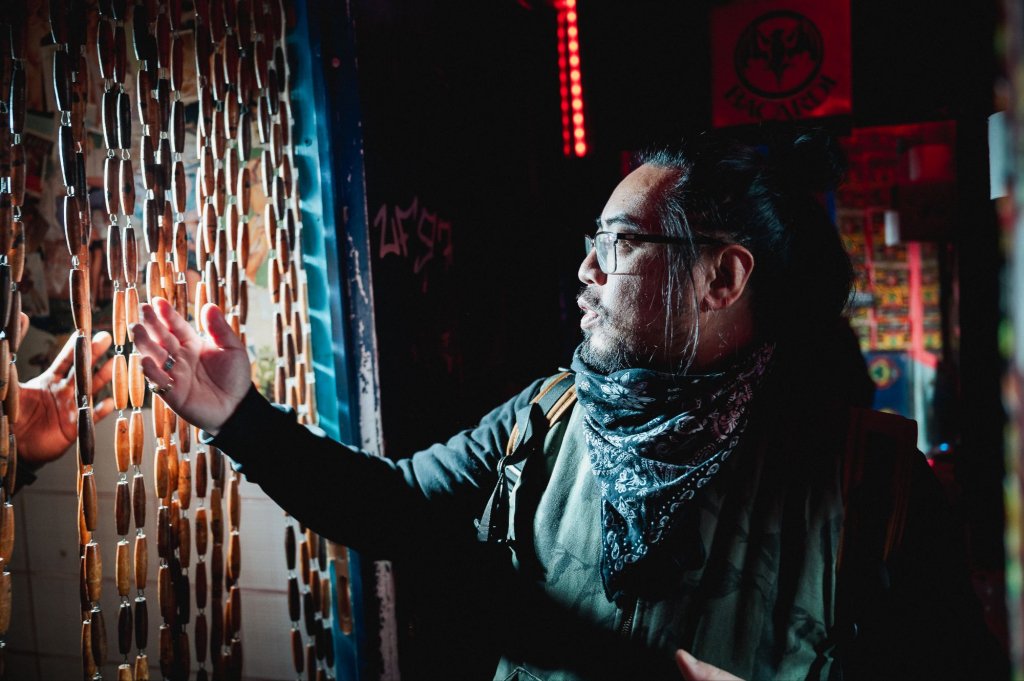
For Virak and I, taking Lost in Spice to festivals was first and foremost a way to challenge ourselves. We had created the film with a very personal vision, based on our own tastes, our sensibility, and our approach to action and storytelling. Once the film was finished, we started asking ourselves: how will this vision be received by people who don’t know us?
We wanted to see how audiences would respond to our world, our visual style, and our artistic choices. It was also a way to step outside our comfort zone and put our work in front of other filmmakers, artists, and industry professionals.
So for us, festivals were about much more than simply screening the film. They were a real experience: putting our work in front of an audience, listening to their reactions, and discovering whether what we had created could resonate with people beyond our own circle.
Tell us how you and Virak met, and how you both came up with this idea.
Virak and I first met through a humanitarian project focused on the memory of the Cambodian genocide. Even before we considered working together, we immediately connected. We’re both passionate about action cinema, but beyond that, we share the same values. I would say we both have this warrior spirit, but with good hearts — and, above all, a strong desire to tell stories and share them with others.
The idea for Lost in Spice actually came from a rather unexpected place. I wanted to tell a story around a Cup Noodles. When I went to Japan to attend an action camp and train with Kenji Tanigaki and his team, I brought back a Cup Noodles from the Cup Noodles Museum. I had the entire team sign it, and I kept it as a souvenir. I’m also a huge Cup Noodles fan! And after keeping this little signed cup, I started thinking that there might actually be a story to tell around it.
That’s how Lost in Spice was born — from a very simple object that had a real personal meaning for me, and that ultimately brought together many things I love: Japan, action, humor, and stories with a strong personality.
Was directing a project something you’ve always had in mind during your career?
Not at all. Throughout both my personal and professional life, I had always been trained to be a good project manager: to organize, anticipate, coordinate, and find solutions. But I had never imagined using those skills to direct a film.
The turning point came after I was injured during a stunt rehearsal. I ended up with a double nasal fracture and several stitches near my eye. During my recovery, I had a lot of time to reflect on why I had chosen this career in the first place.
Of course, I love action movies. But I realized that what I love even more is telling stories and sharing them with other people. So, on a bit of an impulse, I thought, “Why not? Let’s do it and see what happens.” And that’s ultimately how I started directing. I didn’t have all the answers, but I had a story I wanted to tell and the desire to bring it to life.


Talk about what it took to rehearse and prepare for a project like this, considering you also perform in the shortfilm.
For a project like this, you need two things: guts and a really good team. We literally had 21 days from writing the script to releasing the film. That was an incredibly short amount of time, especially for a project involving directing, action, choreography, acting, and all the logistics that come with it. So I chose to surround myself with people I already knew and trusted — people who could work very quickly and under pressure without losing their good energy or their team spirit.
Being in front of the camera myself made the preparation even more important. I had to arrive on set having already anticipated as much as possible: the choreography, the movements, the character’s intentions, the shots, and the technical constraints.
With only 21 days, there wasn’t really any room for hesitation. We had to be prepared, trust each other, and make decisions quickly. That was probably the most important lesson for me: a project like this is never built by one person alone. Even when you have a very personal vision, you need a strong team to bring that vision to life.
You also confided in me about this concept and had certain costume ideas in mind. Was it difficult to pick a specific look and design?
Yes, that was probably one of the most challenging aspects to define. I had a very specific idea for the world and the character, but I quickly realized how difficult it was to find a costume that matched the visual concept while also working for the fight choreography.
To be honest, looking back, I’m not completely satisfied with the costume for my fight character. It didn’t fully match the vision I had in mind. The costume needed to have a strong visual identity, while still allowing me to move freely, perform the stunts, and remain believable during the action sequences. Finding the right balance between all of those requirements was challenging.
That’s definitely something I would approach differently on my next project. I would spend more time researching references and testing different options. I would also test the materials and the costume directly with the choreography before shooting, to make sure it works both visually and physically.
That’s also one of the things I learned from Lost in Spice: in an action film, the costume has to be designed as much for the character as it is for movement.
You’ve had some tremendous milestones in the last few years, from directing, getting to meet and train with Kenji Tanigaki, going to Cannes, and even sharing a panel with a mutual of ours, Frederic Ambroisine, for a screening of The Heroic Trio. Looking back on all these amid the chapters of your life, what’s the most important lesson you have taken with you?
I believe life is full of surprises, if we give ourselves the chance to believe in them.
My father taught me from a very young age that you have to fight your way through life, because life is tough. And for a long time, one of my personal goals was almost to “defeat fate.” I was not destined to work in the action industry in any form. But I always felt this inner calling, almost like a whisper. The more I tried to rationalize it, the harder it became to find my way. And I think there were moments when I even lost myself trying to figure out what the right path was.
I’ve had very few role models I could look up to in this industry, and most of them were men. Michelle Yeoh has always been an exception for me. And the day she won the Oscar, something clicked for me. I realized that maybe there isn’t one perfect path, or one right answer that we have to find in order to know where we belong. I think I’m still finding mine.
Nonetheless, all of these experiences — meeting and training with Kenji Tanigaki, directing my first film, going to Cannes, and meeting people who inspire me — have taught me to trust that inner voice a little more.
I love action because it is raw and sincere. You can tell so much through a fight without saying a single word. You can reveal fear, anger, determination, vulnerability or hope simply through movement. And, I think that’s ultimately what I’m looking for: to tell stories in an honest way, even if the path to get there is not the one I originally imagined.
Do you see yourself directing more in the near future? And, if so, can you share what ideas you have in mind?

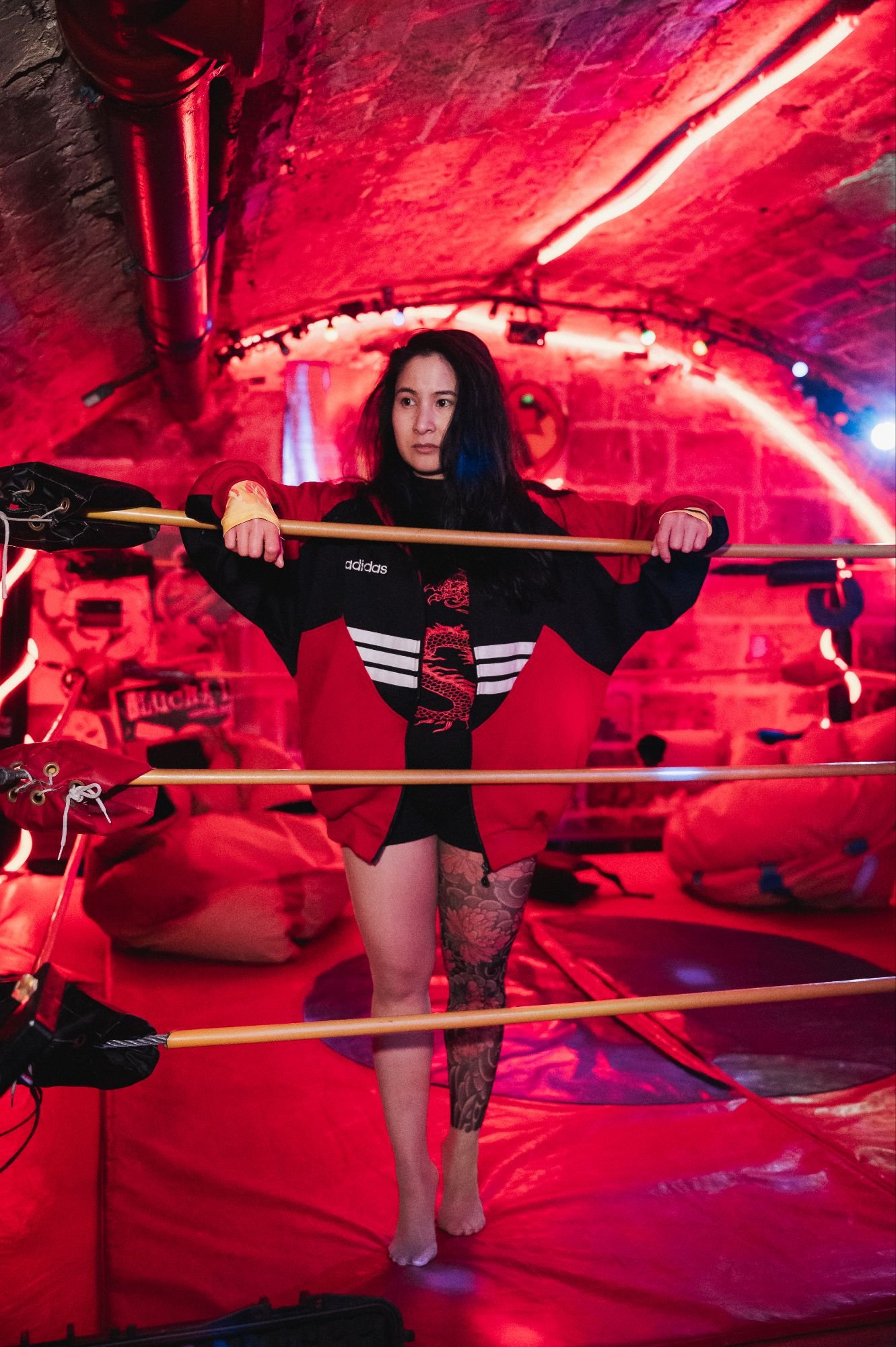
Yes, definitely! I really want to direct more, and most importantly, I want to become a better director. That’s actually one of the reasons why I enrolled in an MBA at a school specializing in audiovisual production. I want to develop a stronger understanding of the tools, the production process, and especially financing, so that I can develop my projects with greater control and confidence.
My ambition is to become a kind of “360-degree” director — someone who understands the work, challenges and needs of the different departments on a film set. I believe that having that broader understanding allows you to communicate better with your crew and have a stronger overall vision.
And I have another dream… I’d love to eventually storyboard my own action sequences, so I can work very precisely on the rhythm, movement and visual storytelling before we even get to the shoot. But… shhh. That’s still a little secret!
With the upcoming screening of Lost In Spice at the fourth Big Bad Film Fest this year, do you have a message you would like to share with readers and fans who will be in attendance?
I’m really happy that Lost in Spice is being screened at the Big Bad Film Fest this year. To me, this is exactly the kind of festival I dreamed of having the film be part of — almost like the G8 of action cinema!
It’s a real honor to see our little film joining a program that celebrates action cinema and the people who bring it to life. I really wish I could be there with you to share this moment in person. So to everyone attending: enjoy the festival, enjoy the films, and most importantly, enjoy this incredible community of action lovers. And, I hope Lost in Spice gives you a great time!