


Gozu enjoyed its World Premiere of New Wave Video’s New 4K Restoration of the film via Radiance Films for the 30th edition of Fantasia International Film Festival.
I think I’ve seen almost maybe two dozen films from director Takashi Miike. That’s not for a lack of trying as he’s directed more during his career, although Miike’s work came as more of an acquired taste when I discovered him with a DVD purchase Ichi The Killer, and looking up his filmography on various websites and seeing a film like Gozu listed. Granted, Gozu, much like Ichi The Killer and a lot of Miike’s other works, is an acquired taste if you’re more into commercial stuff. Miike is someone who goes against the grain on the creative end of things, diving full on into an all-you-can-eat buffet of some of the most bizarre and surreal concepts you’ll ever see and whipping it all together into some kind of a film, and depending on your tastes, his applications can either work you, or they won’t. Or, your sensibilities will share space in a bit of both.
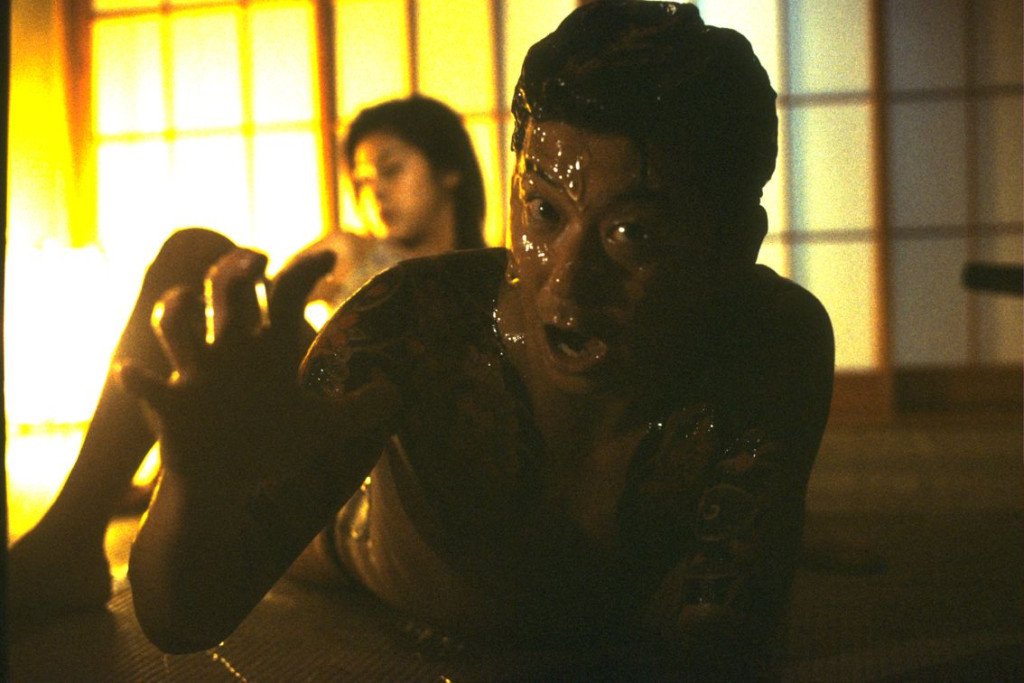
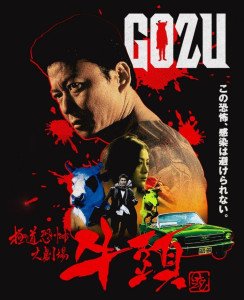
When it comes to a film like Gozu, regardless of whether or not you’re new to Miike, it’s definitely a film that will test you. From the poster alone, you’d gather as much that you’re about to set foot into a yakuza crime flick, cows notwithstanding. That’s mostly what Gozu is, and you have none other than Show Aikawa plastered with back tattoos and pompadour and all to allude to what Miike wants you to believe there is, provided you don’t know what Miike’s creative penchants typically are or what the title means. That Yakuza Aniki, Ozaki (Aikawa) gazing at something disturbing as he and his fellow cohorts await their boss’s arrival at a restaurant for an important meeting is the first thing we see, before Ozaki goes on a tangent to commit the unthinkable is the first in-your-face nudge he offers, signaling you that shit truly is about to get weird in this movie. How weird? Well, if you know me, you know I don’t generally give away fully detailed plot points so as to keep the experience fresh for anyone new to these films and reading what I have to share, but do keep reading.
The gist of Gozu mainly follows Minami (Yuta Sone), Ozaki’s underling who is secretly tasked with taking Ozaki to Nagoya to have him “gotten rid of” at the behest of their group’s Boss (Renji Ishibashi). At one point, the trip goes awry and the two are forced back into the nearest town just outside of Nagoya when suddenly, Ozaki disappears, leaving Minami desperately searching for his big brother. What follows is an odyssey of oddities that test boundaries and perceptions of all things “normal” and “natural,” trudging into the dark and surreal with an array of eccentric and colorful, and even intrusive characters: an innkeeper (Keiko Tomita) and her brother (Harumi Sone), a man who serves coffee at the inn (Sakichi Sato), a man with a dermatological issue that affects half of his face (Shohei Hino), a kafkaesque-looking man with a cow’s head in briefs, and a woman who is way more than she appears to be.

Characteristically, Gozu moves at the kind of arthouse pacing that makes a lot of the film feel as slow as it does. As much as the film compels you to think, it’s certainly more maddening than anything; a great deal of the film’s runtime is spent on Minami as he struggles to make sense of the people he’s surrounded by, and his environment. A few examples of this is what Minami spots after trying to call his Boss, and when the innkeeper imvites herself into the sauna to help bathe Minami. Another is when Minami settles in at the inn, and at one point he’s given twice as much diner and told the extra food is complimentary, and there’s a white substance that suddenly starts leaking from the ceiling. If it sounds inexplicable, that’s because that’s all I’m sharing to that end. It only makes sense if you watch it for yourself depending on how perceptive you are, although that also depends on how reliant you are without things being merely suggestive.
Well into the second hour of Gozu, just when you think you’ve seen all there is to possibly see, Miike bangs you on the head with a plot-twisting dildo that turns Gozu into the kind of mindbending genre piece meant to profile what defines sex and gender with an asterisk on perversions and kinks, if only as a sidebar to what his actual intentions are, allegories notwithstanding. A scene that starts off as an intimate encounter becomes vividly grotesque, almost firmly taking removing you from what the rest of the film was and putting you into something like a scene from “Friends”. If anything, it helps to listen to what Ozaki says in one of the film’s earlier scenes which comes across as a kind of foreshadowing, and that’s only if you’re not taken aback by the film’s opening.
Gozu celebrates its twenty-third anniversary this year, and undoubtedly, a lot has been said about this film. To this, even more has been said about Miike as a filmmaker, and for a film like Gozu to find its audience and remain relevant for as long as it has for fans of Asia Extreme. Thus, for what it’s worth, Miike has proven himself to be as impressive as he is controversial, able to direct different kinds of films while never losing sight of himself. Whatever your take is on a movie like Gozu, Miike gets the last laugh, which is all that matters.