


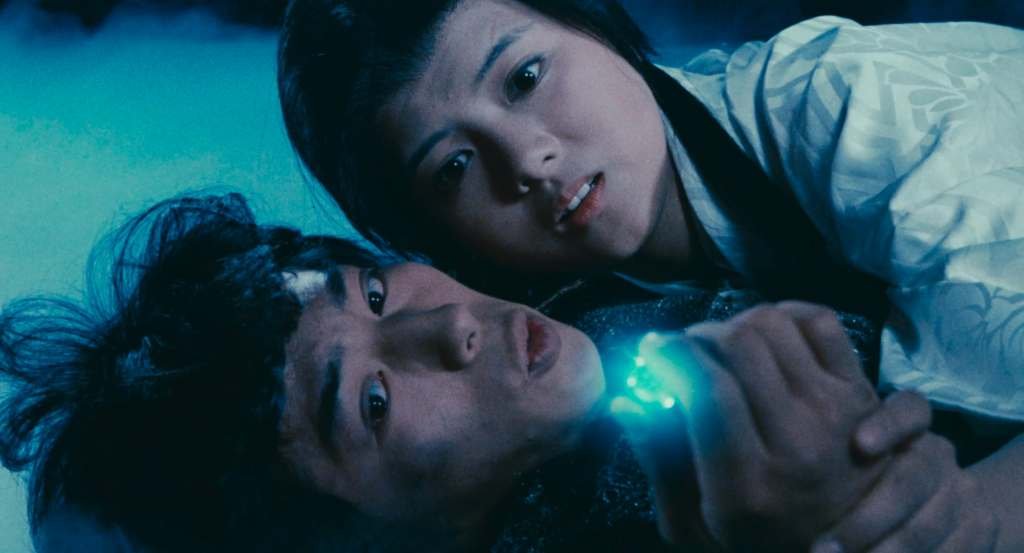



My latest viewing was a humbling, delightful reminder of just how far deep the Asian film rabbit hole goes for me. The focus hereto is Eureka Entertaimment’s Masters Of Cinema series installment of Kinji Fukasaku’s 1983 fantasy flick, Legend Of The Eight Samurai, based on Toshio Kamata’s 1982 revamp of Edo novelist Bakin Takizawa’s 15th century literary epic.
I’d only heard of Fukasaku a couple of days ago as his 2000 manga adaptation, Battle Royale, became a niche staple that launched the Asia Extreme subgenre into Western fruition. A lot of bygone Asian film titles remained in obscurity from me due to lack of posterity or out-of-print status, and that includes this film which popped on and off my radar through the years.
Admittedly though, one factor that stood out to me about some of these films back during the VHS era was the way they were marketed to folks like me. I knew what I wanted, and what I didn’t want was to be sold by some thrifty label like some uncultured westerner who thinks all things in Asian film are made of Bruce Lee and Karate but needed to sound English no matter what. The good news is that it’s 2025, and the kind folks over at Eureka Entertainment have long since made a number of these titles easier to appeal to and digest, including Legend Of The Eight Samurai.
Brimming with a ton of starpower and visual appeal out of the Toei catalogue, the film follows Princess Shizu (Hiroko Yakushimaru), the last surviving member of the Satomi clan, as she quests to unite eight warriors, bound by prophecy through an octet of glowing orbs connected to a century-old curse by immortal evil queen Tamasuza (Mari Natsuki) and her warlord son, Motofuji (Yuki Meguro).
Yakushimaru is in her prime here following one of her most celebrated roles to date in 1981’s Sailor Suit and Machine Gun. She leads a cast that brims with a handful of A-listers like Hiroyuki Sanada, Sonny Chiba, and Etsuko Shihomi, along with Minori Terada, Masaki Kyomoto, Takuya Fukuhara, Shunsuke Kariya, and Kenji Ohba, who each play one of the headlining samurai heroes as revealed in some capacity throughout the film.

My watchlist is ever-growing to this day, although I’d seen a fair number of Fukasaku throwbacks in the last few decades. Until then, he’d nominally directed yakuza flicks, which makes Legend Of The Eight Samurai something way different than even I expected. This film is a stunning, sexy, high-energy blend of the 80s sword-and-sorcery craze and synthwave, crafting an amalgam of elements that speak ardently to the average fan of all things George Lucas and John Milius. From the jidaigeki thrills and creature battles to the film’s explosive finale, this movie had me dancing in my seat with my heart racing all the way through the finish, and to be honest, I can’t remember the last time a movie did that for me.
I went into Legend Of The Eight Samurai largely blind of all visual knowledge – no trailer hardly, no clips, zip, nada, skadoosh. Alas, even at about two hours and sixteen minutes, it was a little concerning that a film which such a packed ensemble might suffer from a deficiency in character development. It does, in some senses, although that depends on the lens through which you’re viewing this particular iteration; Toshikazu Kono directed Sorceror’s Orb, a five-part series of films adapting the work for Toei back in 1954, which leads me to hope this IP has some kind of shelf life enough that we might see a more episodic rundown in the years to come if that is more your speed.
With Fukasaku’s film, you’re introduced to a band of protagonists that aren’t exactly squeaky-clean. Keno (Shihomi) is a cold-blooded assassin who has never known love, and with whom Shino (Kyomoto) bears a vengeful grudge. If that wasn’t bad enough, Dosetsu (Chiba) and Daikaku (Terada) are quick to eliminate anything they presume as a threat, including Shinbei (Sanada) later on in the film.
This makes up five of the band of would-be heroes through their largely abbreviated development, paving the way for some pretty wild swings at certain story moments. The plus side of this, however, is Fukasaku’s focus on making the film as propulsive and fun as possible at nearly each turn, from the performances and stunts to the music and visuals. There are plentiful avenues of growth and sympathy through which we get to cheer our characters on, nourishing the sense of esprit de corps intended in such a heroic, redemption-driven tale, and which makes what we see in the action packed finale so conclusive and fitting.
You get a narrative tale of love and vengeance fueled by fantasy and advenuture, lined with a derivative, albeit palatable cadre of protagonists who are flawed and complex but each designed to one specific purpose, and by this route, all the cinematic dots still connect. From the acting, energy and pace, to the production value, set pieces, visuals and music that each take a page from the en vogue heroic bloodshed and fantasy genre of the time, it shows through Fukasaku’s revamped, well-concentrated visage of the classic IP.
The film’s synthwave soundtrack topped by the thematic vocals of John O’Banion breathe the kind of life into Legend Of The Eight Samurai that I didn’t really expect, and it goes to show how important musical scoring really is when it comes to filmmaking. In the case of this film, specifically, I can’t think of a lot of Asian titles that feature English vocals the way this film does, while I do admire that regardless if it was intentional or accidental, Fukasaku totally nailed it.

An immediate cracking-open of the limited edition Blu-Ray also invites you to an insightful essay by Tom Mes of Midnight Eye. The limited edition booklet goes deep into the film’s layered inception motivated by the visible change in the filmgoing climate, all leading up to Fukasaku’s involvement, and actress Yakushimaru’s celebrity starpower at the time.
The disc itself features two Japanese tracks – one Mono and the other being DTS HD 5.1 – and an English audio track, and a commentary by Joe Hickenbottom who is sure to acclimate viewers to the version they’re watching, noting that O’Banion’s opening song is feared in the Japanese and English versions of the film. His commentary is a noteworthy listen, as is a viewing of Stuart Galbraith IV’s featured video essay, “The Trials Of The Eight Samurai,” which details the film’s production, critical and box office reception, expectations, and lasting legacy, and even some interesting tidbits and trivia about the cast, including Yakushimaru during her time on the film’s vast sets on the Toei lot.
The best feature of the lot, to be honest though, is “Always Looking For The New,” an interview with Fukasaku’s director, Kenta Fukasaku, who takes viewers on an enthusiastic ride down memory lane with his father’s involvement. He details how his father’s perceptions of the world and politics impacted him from his postwar youth and how that reflected much of his filmmaking. In addition, Kenta also talks about his father’s friendships with the producer and stars, as well as some of the film’s crew – mainly including assistants – and the enduring thread shared between them leading up to the auteur’s final film, Battle Royale, all presented in a culminating first-person point of view of his father and the memorable footprints he’s since left behind.
One other thing the younger Fukasaku elucidates during his interview about Legend Of The Eight Samurai is producer Haruki Kadokawa’s adherence to creative freedoms for directors adapting the novels under his publishing label. It’s an interesting bulletpoint amid the shared dialogue among cinephiles who today are more aware of moviegoers keen on seeing stories adapted closer to their source material – something to bear in mind when watching Fukasaku’s movie and minding many of the liberties he took in how his characters were developed. Undoubtedly, it contributes to Fukasaku’s methods which were, in many ways, subversive and non-conventional, making his work as memorable and timeless as ever.
There are a couple of versions already available for free ad-supported service depending on which platform you look at. There’s at least two available as of this write-up on Tubi, both of which are pretty low in resolution with one presented slightly sharper than the other, with discernible differences pertaining to scoring, a slight cut in runtime, and audio language. I personally avoided watching these in full, as I knew this film was something I wanted the freedom to watch in an audio of my choosing. Eureka Entertainment’s packaging of Legend Of The Eight Samurai promises that in its revisal from 4K resolution on Blu-Ray for their Masters Of Cinema series, and much more…

As an aside, Sori Fumihiko’s Hakkenden will certainly be something of a different beast once the rest of us far and way from its reach hopefully gets to see it. As such, I’ll be looking forward to that one as well. I’m loving the lore already, and I gladly, posthumously attribute that as Fukasaku’s doing.


Pre-order Legend Of The Eight Samurai on Limited Edition Blu-Ray from the MVD Shop.