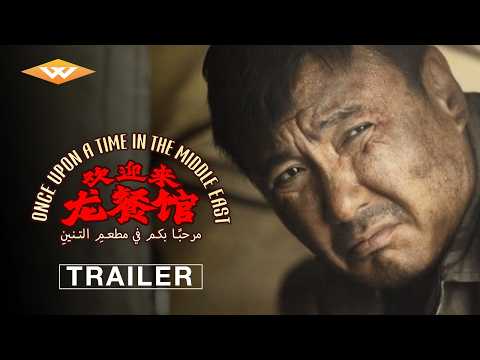
Once Upon A Time In The Middle East opens in theaters Friday, October 9 from Well Go USA.
The last quarter century has undoubtedly seen its share of transformative moments in human history. Director Wen Muye builds on this angle aptly with his latest war drama, Once Upon A Time In The Middle East, in which lead actor Shen Teng plays a debt-ridden chef and former restauranteur endeavoring to recoup personal losses with a cooking job in a Middle Eastern city.
It is here in said fictional city, Bahata, where we meet Xu Fu (Teng), dauntlessly braving the bureaucracy and business end as he does in the kitchen upon arriving at Loong Restaurant. It’s not long – even as business seems to take fruition – until Fu and restaurant manager, friend and translator, Ma Junsheng (Jiang Qiming) – land under siege when the city is attacked and subsequently invaded by U.S. soldiers.
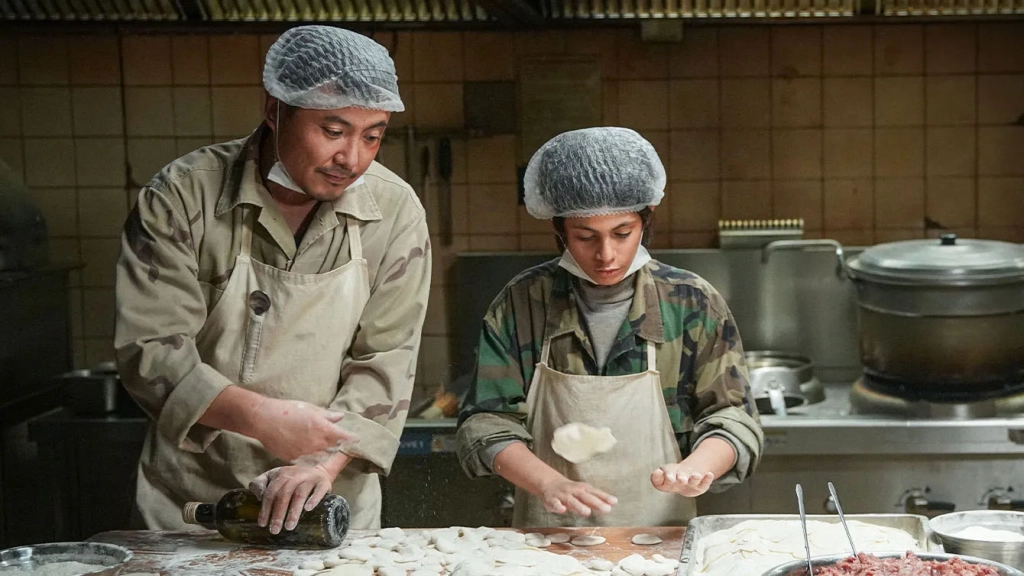
The movie soon takes its first of many stark twists, as Fu is forced to mitigate with the restaurant’s partnering businessman, Zaid (Sherif Sobhy), in order to acquire ingredients to sustain business during the conflict. Meanwhile, Fu has since taken on a young apprentice by the name of Saif (Omar Sherif), who also happens to be an orphan under the care of Ma’s fiancée, and who also proves to have his own potential as a cook.
Granted, Fu’s plan was only supposed to extend as long as two years, as badly as he wants to go home and reconnect with his family, including his daughter, Le (Zhang Xiwei) who supports him underneath her own disappointment dressed as indifference. Nonetheless, militarized occupation and escalating violence forces Fu and Junsheng to watch as they, along with Saif and the rest of his peers who’ve been working and living in the confines of the restaurant, are ripped from their prospective place of business by U.S. forces.
The rest of the film, told in an extensive flashback upon introduction from a much-aged Fu from the start, becomes a harrowing tale for our protagonist who is constantly chucked in from one perilous spell to another, surviving as best as he can on his wits and will, and a skillset that will only keep him alive for so long at times. Other characters are caught in the interim of the film’s often daunting profile in character assessments and developments that tend to become topical conversation chatter in matters of discourse, namely the racist perceptions of Middle Eastern children as terrorists by an American-born Chinese soldier named Tony (Aarif Lee), to the nightmaring machinations of a child soldier camp where children are robbed of their innocence and radicalized, manipulated as sacrificial pawns by some of the world’s terroristic worst.

The broader scale of this analysis, particularly in the film’s timeline from 2002 and onward, weaves in the occasional archival clip for acute affect. It’s a complementary addendum to the film’s culinary visual aides and cooking sequences that contribute to the film’s centerpiece, while adhering to palpable and lingering geopolitical tensions amid the film’s backdrop.
Teng is simply amazing in the role of Fu. His transition from stubborn, single-minded businessman to savior isn’t as simplistic as it sounds. Instead, it comes from witnessing the horrors around him, and then choosing to actively embrace his newfound role as the story progresses. We also see that evolution countered in equal with Sobhy’s character, Zaid, between his own personal and business dealings, and the impact that those things have on his family, and how that affects him directly.
Young actor Sherif is incredible as Saif, who slowly becomes the emotive center of Xu Fu’s story, as Saif’s apprenticeship under Xu Fu ultimately extends beyond the kitchen. He perfectly exemplifies what’s at stake as the embodiment of a generation foisted into war he didn’t ask for, and with a character whose stakes are multiplied by the presence of his peers. I was also impressed with how co-star Lee’s role was written, which I think is a keen reflection of kind of mindset that’s plagued the West regardless of ethnicity, and the trauma that gets entrenched as a result.
Wen’s latest lays out a gutting and brutal, and equally intersectional and humanistic portrait of concurrent history, one where even the smallest forces at work dare to lend positive influence. It is a foundational filmic effort from Wen and co-writers Lang Qunli and Wei Zhong, who craft deep introspection with their characters here, culminating a pretext for dialogue that’s often become so unavoidably lacking, mainly in media spaces where xenophobic feelings tend to dominate facts, specifically on topical matters pertinent to things like genocide and colonial influence.
Once Upon A Time In The Middle East is a consuming and captivating war drama that bolsters with vibrance and grit, and illuminates what courage truly means against all odds. Backed by fantastic performances and spectacle, and a script and dish selection that transcends linguistic and cultural boundaries, and appetites, Wen’s latest stands as precisely the type of film that warrants watching.