


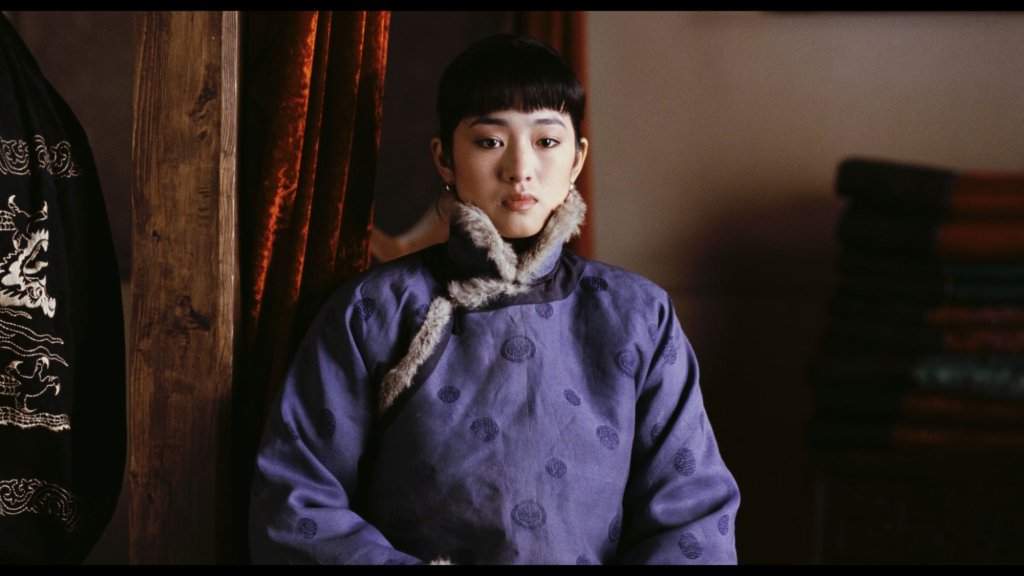
Raise The Red Lantern was remastered in 4K by the Udine Far East Film Festival on the occasion of its 26th edition. The original image and sound negatives were used under the supervision of Director Zhang Yimou. The vintage positive copy, presented at the 1991 Venice International Film Festival and preserved at the Venice Biennale’s Historical Archive of Contemporary Arts, was used for color reference. The restoration was made in 2024 at L’Immagine Ritrovata (Hong Kong – Bologna).
Film Movement Classics will release Raise The Red Lantern in select theaters on November 6 from to commemorate the film’s 35th anniversary.


Configuration and order are two of the more salient visual aspects of Zhang Yimou’s filmmaking. Everything is arranged with as much precision and taut as possible to a fault, even as things fluctuate in his stories. His 1991 drama, Raise The Red Lantern, is an affirming example of this, featuring one of the most definitive performances of Gong Li’s career.
One core aspect on immediate display here is the cinematography, which almost solely focuses on the women, specifically the lead role of former university student, nineteen year-old Songlian (Li). A cloud of insolubility hands over her as she comes to terms with having to marry into a rich family at the behest of her stepmother following her father’s death to save her family from bankruptcy.
Little does Songlian know, the moment she steps foot into the wealthy Chen household is where her imminent descent begins, and all the incumbent themes from the top of the film continue to cast a bleak shadow. Being married into a loveless household, she’s already attained a general perception of how unhappy she will be, and much of that happiness already comes to fruition.
We watch as Songlian has to acclimate to formalities in a home where the husband gets to attribute himself at the end of the day to either of his four wives, coveting each of his visits with an assembly of lanterns to illuminate the chosen dorm. This aspect of the Chen home’s many customs becomes a stern lynchpin issue for the wives as they’re forced to stand outside each time a dorm is chosen.
These rituals also exacerbate an already tense atmosphere between Songlian and other members of the family, namely the Master’s third and second wives, Meishan (He Saifei) and Zhouyun (Cao Cuifen). There’s also Yan (Kong Lin), a servant girl to the household whose feelings toward Songlian are immediately made known to the home’s newest addition earlier in the film.
With the cloud of bleakness that hangs over Songlian’s head from the start of Raise The Red Lantern, you can’t help but get the idea that things aren’t going to bode well. Notions of feminist subversion fall short of expectations with modest defiance in the form of expressions of fluster and frustration, and microaggression, and passive thoughts that manifest into actual harm.
We see this in the constant and daily politics put on display by Songlian and the others, with any hope of amiability nullified by petty rivalry and quiet malice. To add, as central as the women are to this story, you’ll also notice the volume of suffering they each are left to endure due to their own gridlock.
Screenwriter Ni Zhen, in his inspired take on Su Tong’s 1989 novella, “Wives And Concubines,” does a massive job at mindfully crafting these characters around one another, conveying depth and complexity around their Machiavellian intent. Front and center are some of the more overt and haphazard affronts from Songlian who still bares the brunt of disbelief that reality isn’t meeting her expectations, so much so that her true nature is often the catalyst to the home’s internal upheaval, the gravest moment being when she lets loose a secret affair that surfaces one of the darkest corners of the Chen home.
Matching the film’s thematic delivery is the cinematography by Lun Yang and Fei Zhao, which takes hold of you from the first shot of Songlian’s face, riddled with quiet despair. Zhang’s stringent focus on the film’s main characters is crucial here with exceptions made to some of the other supporting roles, as well as the specific placement of characters and certain areas of distance between subjects in each of the set pieces; Each shot is a reminder of the synchronous loneliness and disquiet of the household that Zhang compels you to feel in each scene no matter the vastness of each space.
The foremost male character, Chen, played on the peripherals by the late Ma Jingwu (1938-2023), is treated as a fixture of the film’s contained setting of the home’s inner corridors and rooms, all layered with vast intrigue and mystique. Zhang even extends these aesthetics atop of the Chen courtyard, notably the rooftops whereupon Songlian ventures a time or several throughout the film, including the snow-driven third act set during the winter.
From start to finish, Raise The Red Lantern lends one of the strongest rebukes of patriarchy ever told on screen. It visualizes and vocalizes the threat of male dominated norms and cultivation through a Confucian lens, and brilliantly so in a way that brings both redemption and condemnation to Songlian amid the fallout.
I love that Zhang revisited these ideas so many years later in Curse Of The Golden Flower, also starring Li, which I saw in theaters when it was released. It really lays out the kind of filmmaker Zhang became over the years which, upon now seeing Raise The Red Lantern, is something I’ve come to appreciate as I’ve become an older moviegoer.
What’s more, Li is an incredible actress joined by a phenomenal cast in a really well-made book adaptation, one that contributes aptly to one of the most important films any cinephile or fan of Asian films will see. Framed with filmic richness and allure, Raise The Red Lantern is as much of a cautionary tale as it is a rallying cry with message of topical relevance that will always deserve illuminating.
