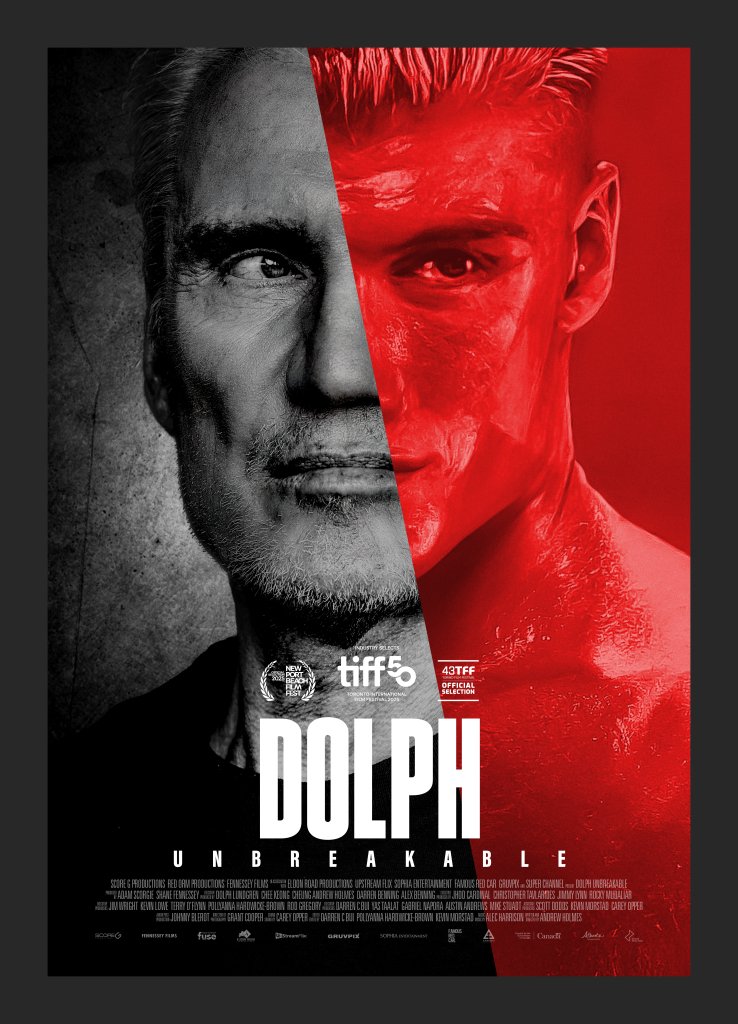
There was a time when action heroes weren’t created in post-production. In the 1980s, cinema screens were ruled by flesh-and-blood superheroes; muscular titans who put their own physical well-being on the line, risking their bodies in front of the cameras long before CGI and green screens did the dirty work for them. In that arena of giants, Dolph Lundgren rightfully earned a seat at the table alongside the icons who defined an entire era.
However, writer and director Andrew Holmes’ highly anticipated documentary, Dolph: Unbreakable —hitting digital and VOD platforms on October 6, 2026—does not seek to glorify that era with blind nostalgia. Instead, it offers a retrospective journey through his career framed around the greatest battle of his life: his grueling fight against cancer.
The greatest virtue of this documentary is its absolute, uncompromising honesty. In an industry prone to superficial image-cleaning, Lundgren refuses to construct a false mythology about his rise in the ruthless, wicked world of Hollywood. Far from adopting the posture of an invincible alpha male, the Swedish giant opens his heart without filters.
A clear example of this transparency comes when addressing his beginnings: Dolph has no qualms about crediting his high-profile romance with Grace Jones, back when he was a complete nobody, as the master key that swung open the tightly shut doors of Hollywood’s elite. This total lack of arrogance gives the film a rare, human authenticity that is hard to find in similar biopics.
The film perfectly balances the breakdown of his cinematic milestones—featuring brutal archival footage and anecdotes from fellow titans like Sylvester Stallone and Arnold Schwarzenegger—with the childhood trauma resulting from his father’s physical abuse. Holmes demonstrates that Lundgren’s relentless discipline in Kyokushin karate and his elite academic achievements (such as his master’s degree in chemical engineering) were ultimately a shield to protect a wounded child.
However, the most heartbreaking and powerful emotional counterpoint is provided by his immediate inner circle. His wife, Emma Krokdal, alongside his daughters, Ida Lundgren and Greta Lundgren, become the true pillar of the film. Through their eyes, the viewer leaves the glamour of movie sets to enter the raw, day-to-day reality of hospital rooms. They are the ones who expose the real Dolph: not the universal soldier who feels no pain, but a frightened father and husband fighting to scrape together just a few more months to spend with his loved ones. The contrast between the action-star camaraderie of friends like Randy Couture and the vulnerable testimonies of his nuclear family creates an emotional journey that will disarm anyone.
The film perfectly balances this array of powerful testimonials with a deep breakdown of his childhood trauma. Holmes demonstrates that Lundgren’s relentless discipline in Kyokushin karate was ultimately a protective shield designed to guard a child deeply scarred by his father’s physical abuse.
But the real gut-punch for the viewer arrives in the final act. Watching the colossus who nearly retired Rocky Balboa—Ivan Drago himself—showcase pure vulnerability, moved to tears by the possibility of not surviving to see this project finished, completely redefines the concept of a “tough guy.” His role as his own medical advocate and his spiritual resilience transform a traditional biopic into a powerful lesson in survival.
Dolph: Unbreakable more than delivers. It is a fantastic tribute for lovers of old-school action cinema, enriched by the deep respect of his eternal rivals and the unconditional love of his family. Above all, it is an intimate, disarming portrait of a man who, despite life’s heaviest blows, refused to be broken. A must-watch when it releases on October 6.