


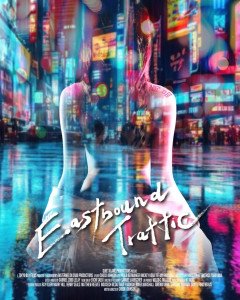
UPDATE (5.24): A previous version has been updated to share the first official teaser for Eastbound Traffic
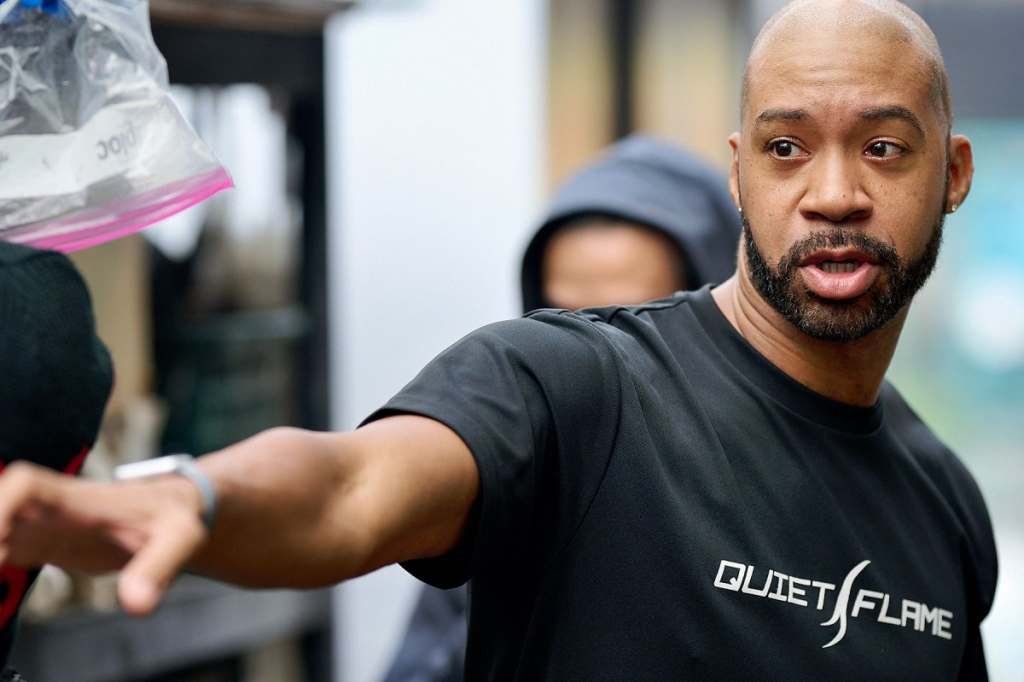
EARLIER (5.22): It’s been maybe almost twenty years since Chuck Johnson left a first impression on me appearing in Yuji Shimomura’s dark fantasy actioner, Death Trance, and he’s been staying the course ever since as an actor, stunt professional, instructor and independent filmmaker based in Japan where he’s been operating through his Quiet Flame Productions banner. Such credits partly include Masaharu Take’s In The Hero, action laureate Koichi Sakamoto’s Good Morning, Sleeping Lion, and Yoshihiro Nishimura’s upcoming Geisha War to name a few.
Nowadays, you’ll find him tinkering away at plans to screen his latest crime drama, Eastbound Traffic, which has come a ways since its inception and through production several years ago. WeI managed to cover the production a little bit back in 2024 as Johnson was still in post production, and as of March, that process is now complete with Johnson’s independently-produced freshman feature ready to present to the festival masses wherever applicable. To that end, I had the privilege of screening Johnson’s film remotely to provide him my own feedback in private, and while I didn’t immediately have time to review it, I did manage to make time to help profile Johnson in this, our first interview.
Regarding Eastbound Traffic, Johnson plays Baron, a pimp who manages a hostess club in Tokyo which unceremoniously becomes the landing point for a young traveler (Paula Berwanger) desperately searching for her sister. Tangentially, we also follow Baron’s ancillary journey of tenuous opportunity with little fruit for his business endeavors as he’s stares down a fated duel with a ghost from his violent past, and little chance of personal redemption.
Eastbound Traffic is a dark tale with blemishes of hope, and as it stands, is also a mark of success for Johnson who is aiming for more projects down the line. He tells all in our interview which you can read below. Follow Johnson’s exploits on Instagram as well via @chuck.n.action, and @quietflameproductions.

You had a small role in Death Trance many years ago which was where I first caught you, and you’ve kept it up ever since. Tell us about your career in acting and stunts, and what it took to maintain up to this point.
Wow, Death Trance feels like forever ago! Likewise, I really appreciate your keeping up with me through the years since then. I think the hardest part of lasting in any entertainment industry is surviving and staying relevant. This is particularly true in an industry like Japan’s where there is no union, no residuals, and generally no protections. For me, that meant constantly adapting, and staying flexible. I never really intended to be both an actor and stunt performer; but doing both of them at the same time (while challenging) allowed me to stay afloat, and pushed me to study like a madman. For most of my career, I’ve never spent less than $600 a month on learning new things that I thought would be useful in one or both; and trying to find ways to create new synergies.
For example, by learning how to do Kimono dressing, I could do the costume design for my second short film, Almost There, and because I also studied hair and make-up, I could help out the hair and make-up team on an action film I did in the UK a while back.
When more and more foreign actors and stunt performers started appearing here (outside of who I was teaching and producing at Quiet Flame), I moved into the motion capture space while it was growing and spent years focused on that. Now that I’m almost 50, I’m most focused on working behind the camera. I’m still working as a stunt performer and actor as well from time to time, but mainly I’m doing things like working as a writer, a stunt coordinator, and a theatrical fight director. In addition to just keeping things interesting, in general, the wider a net I can cast for work, the more on-the-ground know-now I have for future producing. Really, it’s all about understanding what the underlying form of what mastery entails. Once you have that, it’s easy to shift, move, learn fast and go anywhere.

Talk about Quiet Flame Productions and the challenges of flourishing as Japan’s first and primarily English-language stunt team in the country.
At present, Quiet Flame is more of an institution than a stunt team. Originally, I started it because when I was working with Japanese stunt coordinators, they keep asking if I knew of any other foreign stunt performers, and at the time I didn’t. I teach East Asian Fight Choreography at the International Stunt School in Seattle, and I had a few students who wanted to come out to Japan to work with me, so I invited them out. From there, it ended up growing into a team, but COVID more or less wiped that out, so I shifted to teaching new people locally as eventually that grew into what QF is now: a place where people come to to learn how to move well. The film production side started because when I didn’t have a space of my own, and I was just teaching martial arts on YouTube, and that taught me all about cameras, lighting, and editing. Since I learned those things from YouTube, I used the camera as the primary way to train action actors and stunt performers, and I started shooting fights for them for practice. In effect, that was how I learned how to direct people, which in turn led me to producing short films, which in turn led to our first feature.
More than a decade since launching Quiet Flame, you guys now have your first feature debut coming out with Eastbound Traffic. Talk about the extent it took to get the script perfect for this film.
From start to finish, it took 12 years to complete. Originally, I wrote it because at a time that I was really broke and hungry in my career. I started working as a stripper here, and I saw a lot of stuff. At the time, the language for it didn’t really exist, but what I was witnessing was sex trafficking. Girls would come to the club, fresh faced, young and full of hope for a better life, and within months, it would look like they aged years. I saw girls have their passports taken and being told “we will get you a visa later” only to have it held until their tourist visa expired, so that then they were in the country illegally, and they had nowhere else to go. This was before there was even social media, and you never even knew people’s real names, so when girls would disappear, no one would have any idea what happened to them. I had promised myself that when I was in a position that I could, I would tell their stories. That was the basis of the Eastbound’s script – I wanted it to be as accurate and as real of a portrayal of what this space actually looked like as it could be. But as action is the genre that I know, it needed to be in that context.
This was actually my fourth attempt at making the film. The first three times were as a short film; and every time I added depth to the characters and the world that they were living in. After the last time, I took it to a screenwriter friend in NY, and he said “At this point, this is just way way too much story for a short film. You just have to do this as a feature”. So I started writing it as a feature, and I reached out to the International Justice Mission to come on as script consultants. Once I had the first draft, I entered it into every screenwriting competition I could find that offered free feedback; and I kept doing it until I started winning the competitions. I think that took about 8 drafts. Once I was getting awards consistently, I knew I had something solid so I started pre-production.

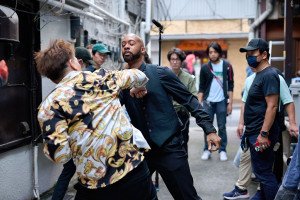
Barring your expectations of it at the time while you were working toward a shortfilm concept, what are some points of comparison and contrast that stand out to you with the finished product?
The biggest differences between the original concept and the final feature is just the depth. What came out as a feature in the end was still very much true to the original, but over time, the complexity of the story, and the number of characters, etc all grew. It’s hard to compare and contrast because it was just a continual growth and evolution. It’s kind of like comparing who you are as a kid with who you are as an adult. You are always you, just with more depth, richness and experience. If anything, the thing that I though was done well was that it’s always been a really dark story, but in the final version, there were a lot of lighthearted moments and warm moments that balanced it out too, because I think that’s life. It’s never all dark, and it’s never all sunshine and rainbows. It’s like yin and yang. The fullness of one always holds the seed of the other.
You’re welcome to correct or adjust my terminology here in my understanding of this in my questioning. Eastbound Traffic has some deep and poignant undertones throughout the story as it pertains to women working as red light district hostesses. Apart from this being an independent production, how personal was this for you? What stood out to you the most in crafting this story?
For me this was a deeply personal story. When I originally showed it to my acting coach Jim (who plays “Harry” in the film), the first thing he told me was, “I think you wrote this because you had to.” The story is filled with a lot of my own guilt; and to be honest, I cried a lot while I was writing it. Guilt for not being a better person when I was in that space or in my younger years, guilt for not being there enough for my mother before she passed, guilt for the ways that I wished I could be a better father for my son. When Rie says “Sometimes, as a parent, even your best decisions are the wrong ones” when Ken says “Sometimes girls just…disappear” quotes like that, came from personal gullt. All of the characters came from different parts of my soul; mixed with the personality of the actor I hand-picked for each role.
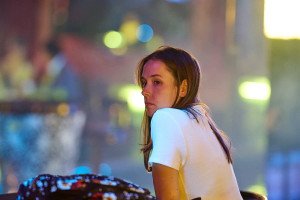
You have Paula Berwanger leading the cast for this film as a woman searching for her sister who finds herself working at this throughway in order to survive after losing her things. Tell us how you came about casting her for the main role and what she brings to the table as Adriana.
Actually, originally, Adrianna’s role was meant to be played by another Tokyo-based Russian actress. That was why it takes place in Hinodecho. That’s where the original actress’s mother had worked as a hostess. I pressed forward for five years with the intent of that role being for her and she ended up backing out two weeks before the shoot. I knew Paula because I had done fight direction for one of her theatre shows before, so once she signed on, we completely re-wrote Adrianna’s backstory so that she was Brazilian – which given the ties between Japan and Brazil actually worked just as well. Paula came in with basically only ten days to prepare for the role, and given that, I thought she killed it. The monologue she delivers at the end, she came up with, wrote, and memorized the morning of the shoot. For me that monologue encompasses everything that women in this space go through beautifully and was one of the most powerful parts of the film.
You play Baron in this film, who for the most part is a pretty bad person with few redeeming qualities left to go by. As it stands, his North Star comes in the form of a kind woman he meets at a graveyard played by Eri Fujiwara, and I freaking loved her role. Talk a bit about Baron from your perspective and who he was to you, and what you wanted to accomplish.
Baron was borne completely from everything I learned from having to survive for twenty years in Asia on my own; mixed with character research I did on Iceberg Slim. As Jim had mentioned, I wrote him the way I did at least partially for my own catharsis. I had to get him out of my head. By putting it all into a character I could play, I could release it. To a degree, morality is a luxury afforded to people who have food in their stomach. Once you get hungry enough, or desperate enough you can find yourself moving in and operating in spaces that good people don’t belong in… regardless of how you actually feel about it. And that was Baron. As Angel says at the end of the film, Baron never really wanted to be a bad person. He just was trying to survive. And he was in so deep, he didn’t know how to get out. What I wanted to accomplish with him as a character was to show that that more times than not, the people who do terrible things were victims of circumstance themselves.
As we saw in the story, he also felt deeply guilty for not being able to save his mother; in the backstory, she was regularly abused by his father, and he eventually stabs her. Baron kills him with a knife himself trying to protect her but she still dies in his arms, so he lost both of his parents on the same day. This was written out of the guilt I feel for not being there for my mother after my father died because I was out here. It’s something I still carry with me daily. When Baron cries in front of his mother’s tombstone, those were very real tears.
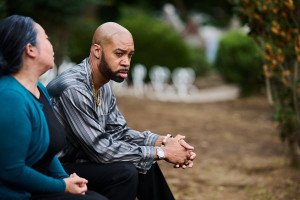
With Rie’s character, she represents the shortcomings that I have as a parent myself and that continual wish that I could do better for my son. In the end neither character could heal themselves, but they could heal each other.
You also have Tiffany Rossdale who plays a hostess named Angel, with whom your character has something of a business-oriented understanding. How important was it for you to include a transgender role as part of the forefront of this story?
It was really important for me to have a transgender character in this for a range of reasons. One of them is that sex trafficking happens to trans people too and they exist in this space as well. As such, they need to be represented. Beyond that, generally, trans women are always so stereotyped or sexualized that I just wanted to create a character that represented a trans woman as a whole human being, complete with feelings, shortcomings, hopes and dreams and in particular one that didn’t succumb to her circumstances.
I also wanted to write this role specifically for Tiffany because she is just a survivor. We’ve co-existed in Tokyo for our whole adult lives here and worked together multiple times. There has always been a quiet mutual respect and trust between us. I wanted to have similar chemistry between Angel and Baron. A lot of Angel’s experiences in the film are based on episodes that Tiffany went through and survived. Having her life threatened in a hotel room, having an angry and hateful person throwing things at her in a club, having clients like the one portrayed in the film, and even the scene of her having a crush on a boy in high school, but not being able to say anything. All of those things were very real experiences for her.
I told her I wanted to write this role for her years ago, and she had never acted before, so I invited her to Quiet Flame to learn and prepare. She studied consistently for almost four years to prepare. One of my great hopes for Eastbound is that it can give her the exposure she deserves, because she’s earned it. I have the same feeling towards Mami Sue who played Miran.
I particularly didn’t expect to see your stunt coordinator among the small roles since I’d only known him in stunts, and he stands out pretty well here in acting. What was working with Greg in these aspects like?
I’ve worked with Greg for years now out in Seattle at the International Stunt School and we are basically family. We are like brothers. Sometimes he drives me nuts in the same way, haha. Especially because he loves pranks. The character he played, was based off of a client Tiffany actually had that I had met. I thought that situation in and of itself was wildly ironic, and given the quirkiness of Greg’s personality, I thought he would put an even crazier spin on. I just told Greg I wanted him to play him and just said, “Do you.” We didn’t even provide any costumes. Those tracksuits were all his. I love him dearly, and deeply respect his sharp intelligence, his toughness, and how seriously he takes the mastery of his craft…even if that’s the only thing he takes seriously. [laughs]
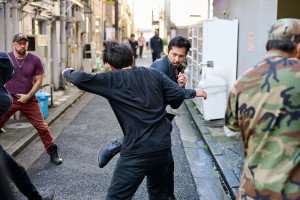
Undoubtedly you have Mickey Koga who is one of the strongest and more prominent actors in your cast. I first watched him in an adaptation of Cromartie High and then in Ten Shimoyama’s Shinobi: Heart Under Blade, and now you have him slicing and dicing his way through Baron’s underworld. Talk about Mickey-san and getting to work with him on this project.
Like a lot of the people in this film, I’ve known Mickey for years. We used to train in action together. As an actor, I think he’s incredible and I wasn’t sure he would be up for doing a smaller film like this one, so I’m so so thankful that he did.
The depth and multi-facetedness that he brought to his character, Ryo, was amazing. Ryo was meant to be a complete pyschopath. Mickey actually made him human…even likeable. Originally, the character was made to be played by Satoshi Hakuzen, another long time friend who made my first action demo reel for me. It was called Street Life, and was a narrative about two guys fighting over street turf. If you watch it you can see a VERY young Koji Kawamoto in it too! Back then, I thought “this would make a cool film”, and that dynamic was largely the inspiration for the character, Ryo. Unfortunately Hakuzen herniated his back several months before the shoot. I refused to do the film without him, but he couldn’t move too much, so my solution was to split the main antagonist into two different characters to take the primary load off of him. One was played by Hakuzen himself, and the other by Mickey. I think it worked out brilliantly. And they both killed it.
Do the last twelve years feel like a blur looking back on it or does it still feel just as long as it reads? Twelve years is quite long for an independent film project which can be a huge undertaking, especially amid a national recovery from a pandemic.
Oh believe me, it felt like a long time! [laughs] Especially since I failed the first three times. But I also think that if you are going to do something, you have to do it right, regardless of how much time it takes. Kind of like Christopher Nolan. He’s only made five or six films, but he takes his time to make each one a masterpiece. That’s a road I would like to walk myself.
The hardest part of this project was losing Brian Parker. When I wrote and produced my first major short film, Fists of Absinthe with Toei Studios and Google, Brian was the director who went out on a limb for a total stranger and came out here to shoot it. We won a ton of awards for it, and a distro deal. Eastbound was supposed to be our first feature, but unfortunately we lost him to cancer during the pandemic. It was heart-breaking. I promised him I wouldn’t give up on him while we were working on pre-production, but eventually he fell silent. I reached out to his wife to check up on him and she told me we had lost him. I had no intention of directing Eastbound, as I didn’t think I was qualified to, but I didn’t really have a choice. So I reached out to Sam, our DP from Fists of Absinthe to DP for Eastbound, to back me up as a co-director.
What’s the next step for Eastbound Traffic and for Chuck Johnson?

At this point, we have already secured a worldwide distribution deal for Eastbound and the next step is going to be getting the film out there. I really hope that the film does well enough that I have a platform for sharing all of the characters backstories too. Baron, Ryo, Angel, Ken, and Miran all have deep and rich backstories.
Beyond that, I’ve already started working on writing a feature version of Fists of Absinthe. Like the short, this movie will be an action comedy so it will be a much lighter film that Eastbound, [laughs] but it will still revolve around a social issue. While Eastbound focused on sex trafficking, Fists of Absinthe will focus on mental health. It will also have way way more action. The film I would like to make after that would be about war and the impact it has on soldiers. All in the context of martial arts action films. That’s my vision for the Quiet Flame style of filmmaking. Action cinema as a means to raise awareness of social issues.
Beyond that, who knows. Maybe some day I would like to experiment with things like breathing…catching up on sleep and heaven forbid actually sitting down to watch TV. We’ll see though. Still too much to do!
