


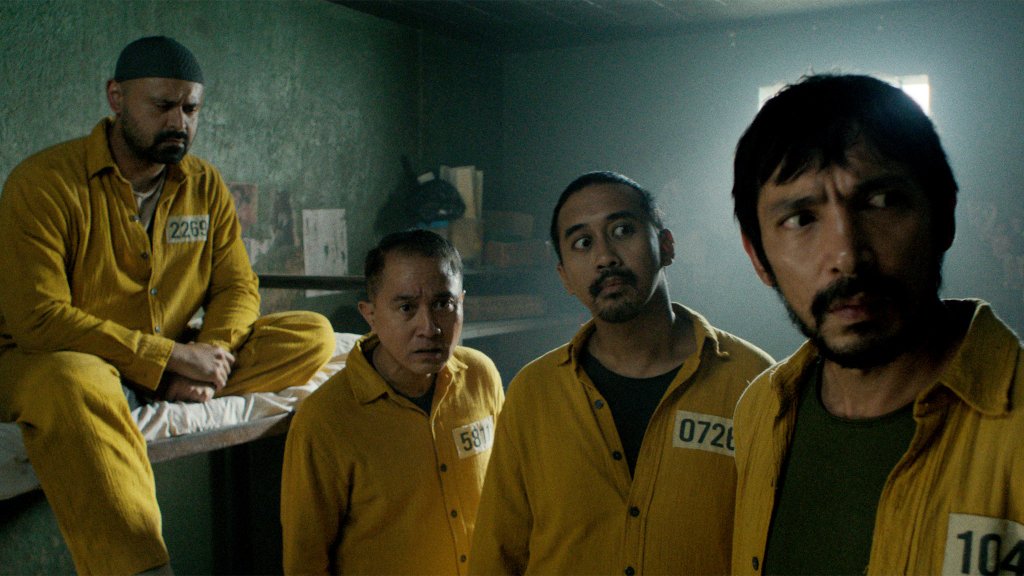
Ghost In The Cell enjoyed its North American premiere at the 21st edition of Fantastic Fest. The film opens in select theaters in the U.S. on October 2 from Well Go USA.
Director Joko Anwar remains on my purview as one of Indonesia’s favored directors. His specialty in horror notwithstanding, he got my attention with superhero thriller Gundala and his collaborative effort as writer for Upi Avianto’s stunning Sri Asih adaptation. Both were really the only two films I’ve seen on his resume, though, until having come across his latest stint in horror with Ghost In The Cell, currently making its way in festivals as its commercial release nears.
Thus, in no uncertain terms does Ghost In The Cell start as it should for pretty much any expectant horror fan; The first six minutes alone is all you need for the tone to set properly in the moments before and after we meet Dimas (Endy Arfian), a journalist working to meet a deadline for his news agency’s publication. What follows is a world of horror that starts unraveling before our eyes, as Dimas is fingered as the guilty assailant responsible for his boss’s gruesome murder, and is sent to prison.
Little do Dimas or any of his unsuspecting inmates know that his arrival will soon set off a violent chain of events. One by one, prisoners murdered in efficacy, found as their corpses are affixed as twisted macabre art pieces, and positioned and placed in ways that are impossible to believe capable by the average person. As the mysterious entity’s presence takes shape, fear and panic soon consumes the cell block, including a sextet of inmates led by Anggoro (Abhimanya Arysatya) who is more keen on finding answers. The only way he can do that, of course, is to keep Dimas alive now that the prison gangs all want him dead, or violated… or both!
Anwar has a terrific handle on all aspects pertinent to the story he tells in Ghost In The Cell, beginning with a concept that’s rich in substance and originality in its execution. The film is quick to maintain balance between its bleak overtones and lithe characterizations, providing a ubiquitous blend of upbeat humor and character quirks to couple with the film’s brutality and supernatural allure. As far as prison films go, expect plenty of rear nudity to set the mood accordingly. I’m talking bare butts, cringey staredowns by rapey inmates and akward moments post-soapdropping, etc.


Among the cast with the most standout scenes is a notable performance by Arysatya, who also gets to share one of the more warmer scenes between Anggoro and his visiting sons, played by Farrell Rafisqy and Radja Nasution. Actor Bront Palarae conquers all as the film’s tyrannical warden whose presence in the film is anything but commanding.
Ghost In The Cell also wins big on its allegorical approach to things like religion and justice. Corruption and spirituality are situated in the film’s backdrop, affirming the driving force of the story as our characters combine their wits and skills to investigate what is fueling the killings and what can be done. One character wakes up one morning and discovers he can see color-coded auras, setting up a raft of spectacular moments both comedic and violent throughout the film’s progression.
Action and stunt sequences by choreographer Reza Hilman and his team also contribute well to the film’s feats. There’s enough gore, violence and comedy hijinks to correctly attribute its hybrid delivery that it checks multiple boxes while still promising an excellent showcase for horror audiences, topped off with the occasional one-off dance routine for good measure.
Plainly, I enjoyed Ghost In The Cell. Anwar’s already won my approval as a director capable of tackling different kinds of cinema, including what I enjoy most. His tangential applications in action complement his style of horror pretty neatly, in conjunction with the kind of drama and whimsical laughs that make Ghost In The Cell all the more liberating.

Written & Directed by: Joko Anwar
Produced by: Tia Hasibuan
Cast: Abimana Aryasatya, Almanzo Konoralma, Aming Sugandhi, Arswendy Bening Swara, Bront Palarae, Dimas Danang Suryonegoro