


Eureka Entertainment’s Running On Karma arrives on Blu-Ray on January 28. Order it today at the MVD Shop.


Johnnie To and Wai Ka-fai’s Running On Karma hit me differently twenty years ago, so I wasn’t too keen on it. Nowadays my mind is more open to different types of films in the field I cover, and I’ve come to realize that it’s a film that holds a little something for several kinds of audiences.
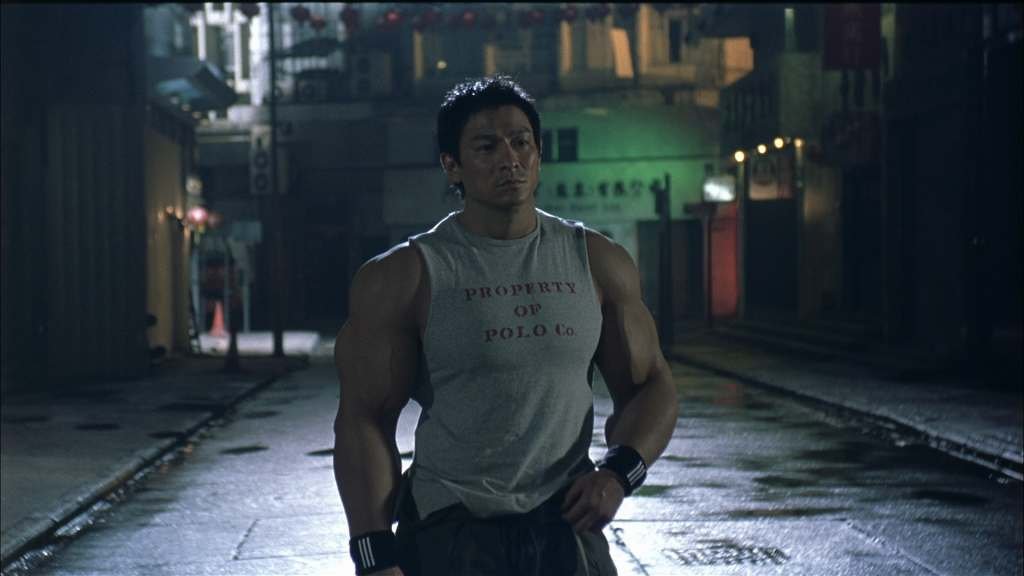
Andy Lau wears an albeit convincing muscle suit in his second role after donning a similar suit for a portly character in Love On A Diet, a 2001 rom-com from the same directing duo. The muscular build for the role Lau plays this time around takes a life on its own as an aspect to the inherently transformative nature of the story To and Wai proffer to viewers.
The long and short? Lau stars along with Cecilia Cheung in the story of Biggie, a Buddhist Monk-turned-fast-living, free-wheeling bodybuilder and stripper thrust into brutal self-reflection following a recent murder. Imbued with the ability to see peoples’ karma, Biggie finds himself reluctantly pairing up with rookie inspector Lee Fung Yee (Cheung).
From this point on, Biggie remains burdened by the fate that awaits Lee due to the karmic since of her past and the consequences that await her. Nontheless, Lee’s kindness compels him to remain pursuant of helping her and her department catch criminals. Their partnership ultimately ensues a friendship, however, one not without the afflicting resonance of karma that has already pre-determined Lee’s fate, forcing Biggie into an explosive, spiritual confrontation for his own peace and resolve.
Running On Karma is an oddball flick if there ever was. It’s a mixture of different genres and tones, culminating a psychological thriller wrapped up in a kung fu crime procedural with Lau as one of the main screenfighting players. To and Wai commit to a gorgeously shot film showcasing Hong Kong’s city-side grit and noir, and the lush greens of the Shaanxi province that serve as the backdrop of Biggie’s origins.
Both Lau and Cheung deliver roles that are ever-evolving in a dark and almost fatalist millieu, which augments the troubling nature of fighting to care for someone. You’re forced to observe a timeline in which the inevitable can’t be helped which, in turn, serves as a challenge to see the film through a Buddhist lens.
Martial arts and stunt sequences are sprinkled modestly throughout, ancillary to Biggie’s progression, between re-enacting a murder scene and later demonstrating his skills using a piece of paper, to catching criminals and fighting a homeless man who looks almost beguilingly like him. Wire fu is also elemental to the film’s action, courtesy of action director Yuen Bun who worked with To on several films prior.
The philosophical and theoretical anchors at the framework of Running On Karma make for a film that presents, admirably, a thinking man’s crime flick that aims its narratives directly toward something humanistic in whole. This critic is no Buddhist, but time and experience have made me amenable to the sensational work the lauded To and Wai bring to the table here, something I would otherwise be missing out on if I still had the mindset I had twenty years earlier.
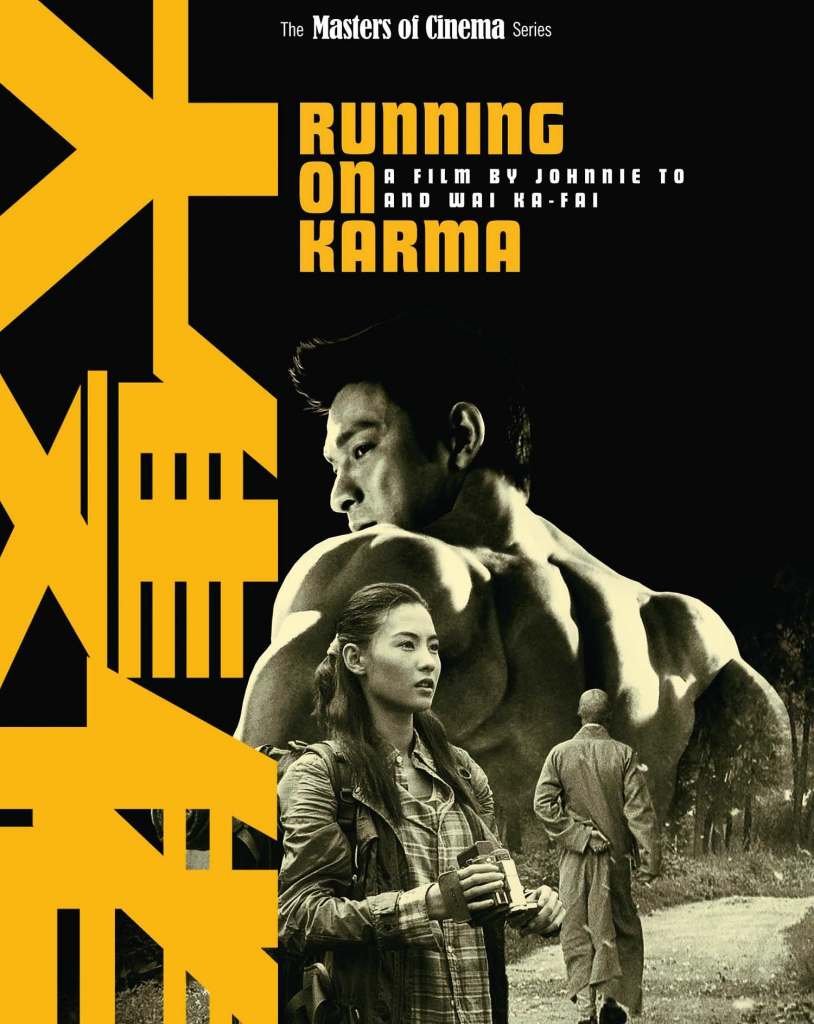
Special Features: Film expert Joe DeSanto rejoins Frank Djeng once again for Eureka’s Masters Of Cinema series diving into Running On Karma. Their commentary goes into the more philosophical elements that comprise the film and the creative direction To and Wai venture on. Some brief cues here and there highlight a little bit of trivia, including the name of the actress whose character – per the story – gets injured during a raid at a bus terminal, and the tragic history etched into Hong Kong’s Mandarin Oriental the year of the film’s release, to name a few.
The second commentary comes supplementary from Djeng; Both commentaries reveal at least one core fact about the film’s production with respect to the on-set impasse between Lau and Cheung. The remainder divulges into a more focused scene-by-scene review of the film, the cast, and many of the thematic and creative aspects about the film, and even goes into the directors’ approach to introducing Buddhism to a market that isn’t all Buddhist.
That last point gets some underscoring by Gary Bettinson per the 25-minute interview segment, “Reap The Whirlwind,” with insight on the film’s delivery in Hong Kong compared to mainland China. Bettinson also delves into the origins of To and Wai’s label, Milkyway Images, and the economic recession of the late 1990s that resulted in the team resorting to a new strategy and formula, partly crediting Wai’s alertness to market tastes and trends.
Bookending the special features are a 17-minute making-of featurette with inserts by the cast and crew, including composer Anthony Wong and Lyricist Albert Leung, and the original theatrical trailer for the movie.
