


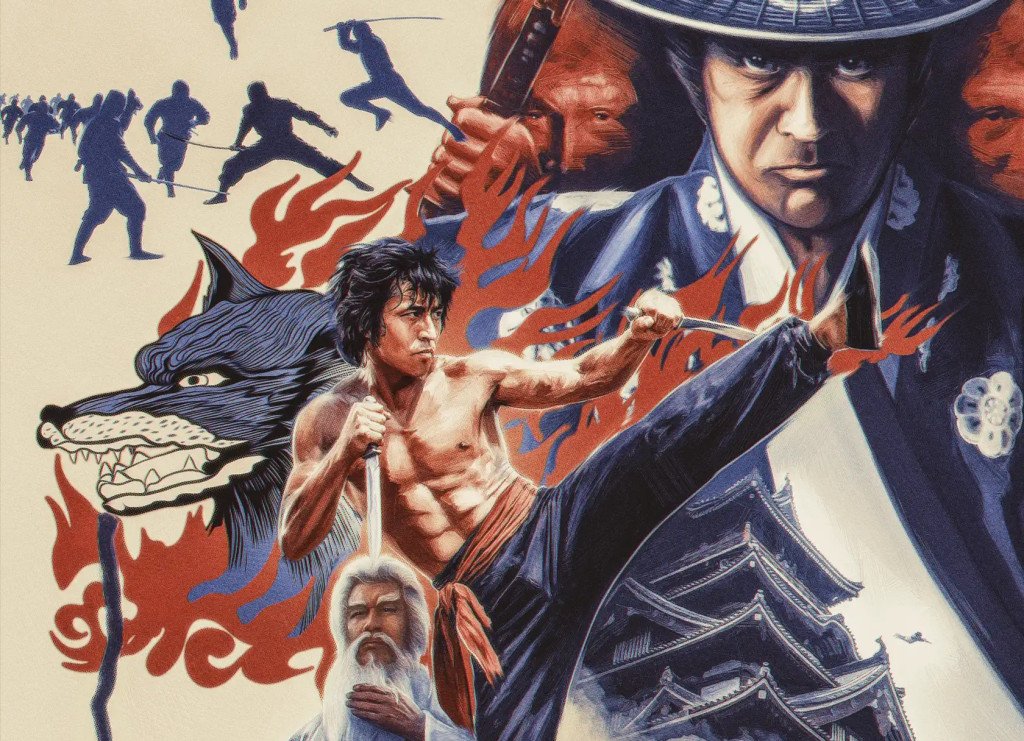
I’ve been a fan of Norifumi Suzuki for years – longer than I actually realized considering he wrote Sister Street Fighter among a number of films throughout his career. As a director, I still need to see some more of his filmography, so I’m pleased that 1980 period adventure, Shogun’s Ninja, is just my latest stop in this journey.
This one is pretty rambunctious effort from Suzuki who stakes his claim in debut leading man Hiroyuki Sanada, opposite Sonny Chiba who plays antagonist as well as the film’s action director; Ryo Nakamura and Osamu Kaneda coordinate the stunts involved in this magnanimous flick which also sees Etsuko Shihomi chiming in for a wonderful role with a peculiar background that otherwise makes for some great chatter.
Scribes Takao Ishikawa, Ichirō Otsu, and Shirō Kannami pen the Warring States epic as Koga operative, Shogen (Chiba) is assigned to infiltrate Iga province and exterminate the Momochi clan. Upon his death, the leader’s only son, Takamatsu (Sanada), is forced into exile retreating to China, and ultimately returning a decade later to reclaim his birthright.
Takamatsu soon reunites with old childhood friends including a band of outlaws, as well as Otsu (Yuki Ninagawa) who was since taken in following the slaughter years ago and raised by Hattori Hanzo (Isao Natsuyagi). As Takamatsu plans his revenge, little does he know that his family heirloom, a dagger possibly containing a secret map to the Momochi clan’s stash of gold, makes him a target. Between this and elements of betrayal in their midst, it’s up to Takamatsu and his friends to stay as far ahead as possible of Shiranui whose ascension into power has made him a formidable foe for the Koga.
The result with Shogun’s Ninja is an absolutely wild ride for anyone exuberant for heyday Japan Action Club throwbacks like this one. One of the first Sanada roles I’d seen other than in The Last Samurai was in Royal Warriors with Michelle Yeoh, which would be years after this film’s release. Sanada oozes charisma and youth in every scene he’s in, firmly augmenting the cast along the way, as does Chiba in a multitude of tasks on this production.
Ninagawa’s role as Otsu takes a slow but graceful turn as a romantic interest to Takamatsu as she’s forced to choose between her allegiances. To this, there’s a blink of curiousity about how things would bode the second Takamatsu is reunited with Ai-Lian, played by Shihomi in a bilingual capacity, and I was especially fond of seeing Natsuyagi once again, here in the role of Hanzo since first catching the Samurai Wolf films.
Everyone gets a stake in the action here. Invariably, and like with a lot of these period films, the best thing you can do is not get attached to too many characters as the story moves forward. The reward here is two hours of compelling story punctuated by great and intense performances, and action sequences characteristic of what you would expect from an OG Japan Action Club assembly: bloody and brutal, with stunning movement and impressive daredevil feats befitting a classic ninja flick from the Far East.
Interestingly, the action comes accompanied by fillers of fusion funk that seem wild for most of the way. Most other films have scores that amplify the story’s overall milleu and ambience, and for a period flick set against a backdrop of darkness and cruelty similar to period films aplenty by the likes of Kurosawa and Kudo to name a few. This one certainly plays to audiences accustomed to modern Japan cinema of the 70s – the crowd pulled into theater seats by Shihomi and Chiba, and other stars like Meiko Kaji.
The same can also be said for a select few of the costume designs, and while it makes for eccentric cinema, these aspects far from hinder the overall viewing experience. Sanada’s performance is enhanced by these aspects, along with that of the cast, action and stunts that make Shogun’s Ninja a favorable throwback to time when Sanada’s star was starting to shine.

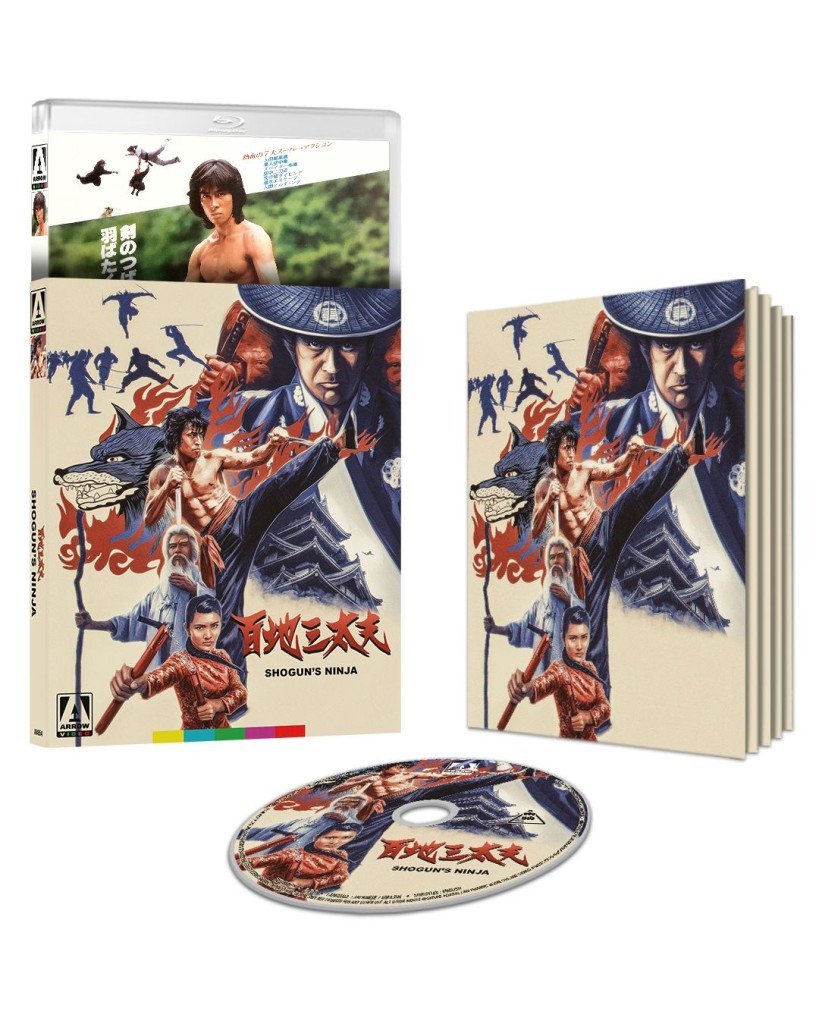
The Arrow Video release has much more to offer to viewers and fans with some history and amazing trivia about Shogun’s Ninja thanks to Japanese cinema expert Clément Rauger whose segment “The Rebirth of Japanese Action Cinema,” goes heavily into how the film came to pass at a time when audiences were increasingly more tuned into TV than the cinema after 1958, forcing theater chains to either shutter or adapt to the times. Rauger also talks about Sanada’s casting at an opportune moment for Japanese cinema, along with the influences that Suzuki and celebrated auteur Kinji Fukasaku had in this film’s fruition, despite its initial failure at the box office. Rauger also goes into the budgeting and bureaucracy behind the film at Toei, as well as its often “schizophrenic” tone which foundate crucial discussions about why many of the film’s brutal and violent scenes are set against such a buoyant soundtrack.
The Arrow Video Blu-Ray disc for Shogun’s Ninja also comes with a commentary by Asian cinema expert Chris Poggiali, double-sided artwork, and a booklet by Earl Jackson, and you can order it right now from MVDshop. This release is surprisingly light on features, so don’t expect this to include a trailer or any cast interviews if you had your hopes up. At any rate, it’s still a worthwhile purchase if you’ve been fascinated by Sanada and Chiba in the last thirty years or more and you don’t mind going down this rabbit hole. It’s a pretty cool one, at that.
