


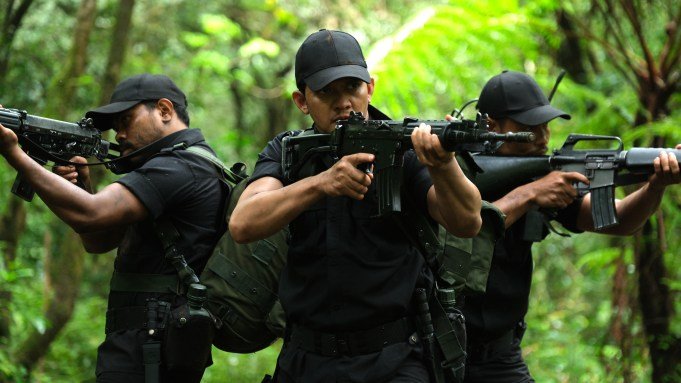
Timur is available in the U.S. to rent or own on Digital from Cineverse.
After nearly fifteen years of putting in the work, actor and martial arts Iko Uwais now shares the mantle of multihyphenate as a producer and director with his own brand. To this end, that his first move would be to take on a real-life hostage situation to adapt to the big screen feels like an ample way to not only kick off a prospective directing career, but to do so in a way that sends up Uwais’s own home region – similar to the vein of what Wu Jing accomplished with Wolf Warrior and its 2017 sequel.
Thus, we get Timur, first out of the gate of Uwais’s eponymous production label as one of several titles rolling out the red carpet for the actor, action choreographer and director. Uwais stars in the title role as well, with a script by Samuel Rustandi and Titien Wattimena that sets our story in 1996, on the precipice of a deadly hostage crisis where a band of armed terrorists – led by Tobias (Arnold Kobogau) – suddenly take six researchers hostage in the dark of night, swarming their cabin with torches, weapons and brute force.
Cue soldier and family man Timur (Uwais) as he is tasked with leading the nation’s elite special forces unit known as the Kopassus, into the remote grounds and rescuing the hostages once and for all. The mission parameters notwithstanding, of course, the timing and circumstances couldn’t be worse here, particularly for Timur and fellow unit member Sila (Jimmy Kobogau) who haven’t seen their adopted brother Apolo (Aufa Assagaf) in years. What follows is a perilous conflict of interest that will force Timur to confront a childhood past shattered by abandonment and tragedy, all while upholding his duty as a soldier.
More to the point, Timur sets its narrative focus prominently on themes of family and brotherhood, firmly placing our protagonist and his co-stars in the spotlight for something with depth and pathos. We have a script that adds layers to the few characters that matter with flashbacks to boot, and performances that do well to light the way forward as the film progresses – a fair strategy for a film that’s basically asking its audience to see Uwais as an actual storyteller and not merely regurgitate past fanfare. Indeed, Uwais leaves plenty of that in the mix, and it’s all to compliment what Timur brings to the table as a hostage thriller more than anything.

Co-star Assagaf brings poignance and nuance to the role of Apolo, one of the trio of adopted brothers among whom Timur shares history, the other being Sila, played in adult form by Jimmy Kobogau as Timur’s fellow Kopassus member. The trio only share a small moments together on screen, but again, these are moments that matter in the scheme of things, with Macho Hungan taking the mantle as Tobias’s menacing lieutenant, Frans.
Far from least is the good stuff which is the action, gory in all the familiar places but modestly delivered as it’s presented for a film with more solemnity. Hungan is fantastic as a semifinal villain pitted against Uwais in the penultimate showdown between the Kopassus and the terrorists, with Uwais promptly putting in the work to give the fans what they want. Needless to say, his eponymous stunt team gets the job done.
Tonally, and for the most part, Timur sits aside a lot of Uwais’ usual festive feats. It’s as you would expect from a docudrama like most others, and it shows Uwais flexing all that he’s learned thusfar in film on both sides of the lens. There are choice moments and aspects in Timur that speak greatly to this analysis, from cinematography and editing to story and aesthetics. Fans of Michael Bay, Oliver Stone and John Woo, and even those of Uwais’s earliest collaborative steward, Gareth Huw Evans, will all have something substantive to takeaway from Timur, albeit incumbent to Uwais’s validity as a freshman who’s safely earned his shot at another.
