

I’ve been fortunate in the last several years to get to cover some areas of Japan cinema dating back to the fifties and sixties. It’s been amazing, really, which makes getting to look at director Kaizo Hayashi’s Maiku Hama trilogy so worthwhile. To this end, I don’t know much about Hayashi, or – regarding The Maiku Hama Trilogy, why he chose to make the first film an entirely black-and-white affair.
That said, you can certainly get the aesthetic Hayashi went for if you’re fond of golden age cinema in the least. For this in his first installment, The Most Terrible Time In My Life, he taps generously into his ubiquitous mix of hard boiled detective noir, action and drama with sprinkles of bustling comedic wit for a franchise that brings actor Masatoshi Nagase rightly into the spotlight for the titular role, tangentially inspired by the late Mickey Spillane’s “Mike Hammer” detective IP.
Penned by Hayashi and co-scribe Daisuke Tengan, The Most Terrible Time In My Life sets the stage in the vibrant and diverse port city of Yokohama where we meet Hama, a reformed bad boy now serving as a private investigator, and supporting his teenage sister, Akane (Mika Ohmine) to send her to college. When Hama saves the life of a Taiwanese immigrant waiter named Hai Ping, it spurs a friendship that compels Hama to step in when Chinese migrant gang warfare unravels an explosive rivalry between brothers.
The second chapter, The Stairway To A Distant Past, rolls out the color palate for Hama’s treacherous investigation into a spate of burglaries at the behest of the city’s unscrupulous Lieutenant, Nakayama (Akaji Maro). This, just as he bitterly reunites with his long lost mother who works as a traveling showgirl, escalates into something even deadlier as aspects of Hama’s past collide with a prevalent and notorious gangster known as “The White Man” (Eiji Okada) who calls the shots along the main ports.
Last and far from least is The Trap, in which Nagase takes on a surprising dual role. Here, our heroic private eye finds love in a compassionate mute woman named Yuriko. As such, when a masked assailant emerges having kidnapped and terrorized young women in Yokohama to appease a mentally deficient young man before killing them, Hama is suddenly framed for the murders and forced to fight and clear his name.
Again, I can’t speak to the reason behind the first film’s black-and-white presentation, but it was a brilliant choice on his part. The film carries a distinct look that easily serves as a tribute to the classic films of Japan, with the sequel popping off the screen in both color and contrast. The third film touts the trilogy’s strongest, most psychological turn yet and lends some exciting dimensions that provenly aid the franchise it its long term depth and creative substance.
There’s an interesting redemption subtext in the writing of Hama that never lets up, between losing a finger at one moment and getting beat up by thugs while spoofing as a door-to-door evangelist in another, to his relationship in the third film, among other things. In light of this, I won’t necessarily deduce the trilogy as religious allegory, but there’s no denying that Hayashi certainly knocks on its door.


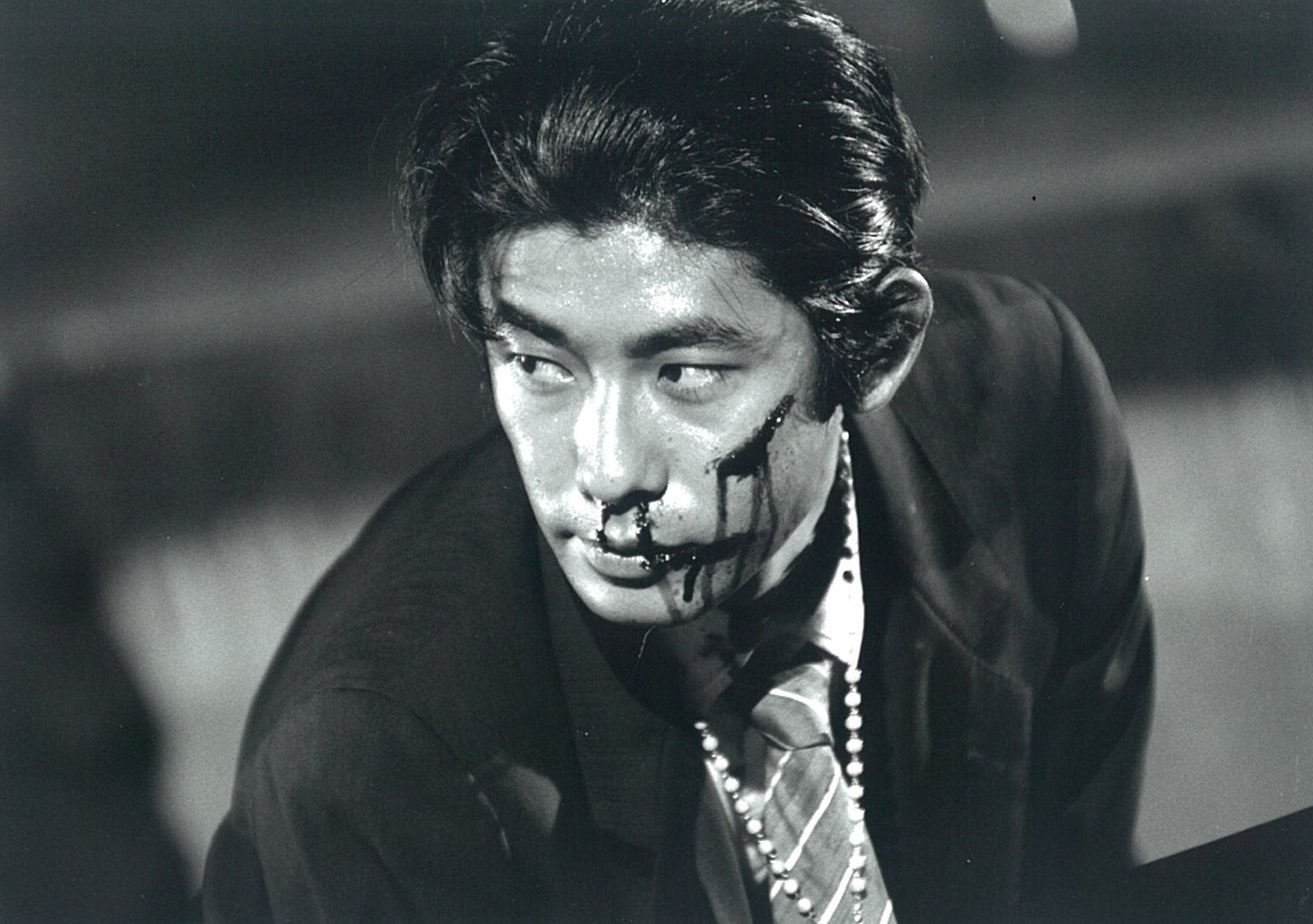


Nagase’s performance is signature as well. His caliber especially surprised me by the third film, and the same goes for the supporting role of Yang Hai-Ping (Yang Hai-Tin) who plays the waiter looking for his brother, De Jian (Hou De Jian), as seen in The Most Terrible Time In My Life. Folks with a sharp eye might even spot celebrated director and actor Shinya Tsukamoto in a small role as a gangster here, although I was quicker to spot Shiro Sano who first landed on my radar years ago in Shinsuke Sato’s The Princess Blade. Here, he plays a crime boss whose character eventually crosses different career paths in the subsequent films after, though his antagonistic fervor never really lets up.
The Stairway To The Distant Past delivers the most personal and poignant look into Hama that we see as it pertains to Hama’s tumultous relationship with his long lost mother, Lily (Haruko Wanibuchi). Co-star Maro keeps things steady in the upheaval as Nakayama, constantly riding Hama until he’s at his wit’s end, whereas Nakayama ultimately shows his true colors in the second film. Other notable stars include Jô Shishido who first hit my radar in the past year in my coverage of Arrow Video’s V-Cinema Essentials. I’ve yet to touch extensively on Shishido’s work on this, but his role here opposite Nagase is fun to watch in its supporting capacity.
The Trap definitely stretches the muscles a little more in terms of pushing the Maiku Hama cineverse boundaries. Actress Tomoko Yamaguchi’s performance pulls you in with Mizuki, a factory worker whose long term schizophrenia adds to the mystique of the story. Trilogy co-star Kiyotaka Nanbara who plays taxi driver and Hama’s purveyor of information, Hoshino, gets a stellar send-up in the threequel as the climax approaches well into the second half.
One other aspect of the trilogy can be attributed to the Yokohama backdrop, and witnessing its transformation throughout the films. Hayashi’s work here packs in something of a time capsule to a city as ripe with its own post-war history as the country it sits in, something that the franchise even plays on with the 2002 TV drama in which Nagase reprises his role.
I’m fascinated by what the future Maiku Hama would be if the franchise continued in some capacity. I wouldn’t say no to a reboot that could bring many of its aspects into focus for a tactful and taut new cinematic venture if its makers so desired… Eh, perhaps it’s right where it belongs as a staple of a bygone era of cinema, but I’m open to opinions of cineastes more knowledgeable in this area.
Either way, The Maiku Hama Trilogy has earned well its place in history, on physical media via Kani Releasing, and on the big screen. Per the latter as recent marketing would have it, I hear the Metrograph in New York City would be a great place to sample it sometime this month.


