


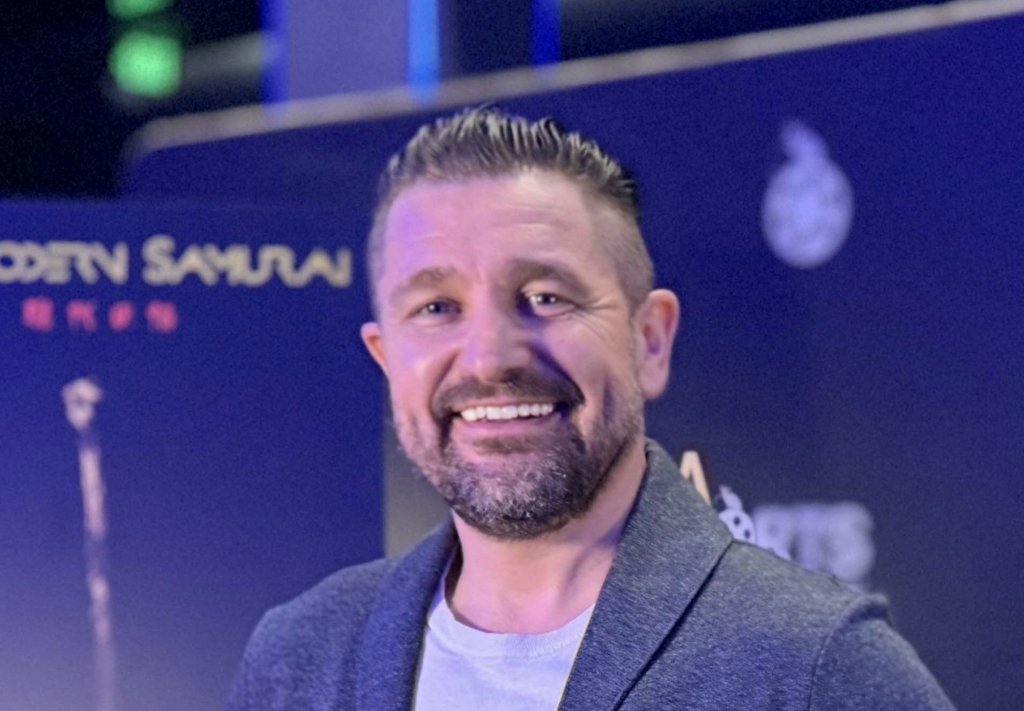
Admittedly, I don’t listen to enough Chamillionaire to know the artist or the song, or the lyrics for that matter. That said, you get all the relevant cool points if the audio hit you mentally. I just thought it would be a great kicker to headline an interview with an actor and director of a shortfilm about a martial artist who drives around LA looking to exact his own brand of justice.
That’s pretty much a quick sum-up of the story we’re offered in The Modern Samurai, directed by – and starring – actor and martial artist – Michael Jacyna and currently making the festival rounds; As it stands, The Modern Samurai just screened for the 14th Urban Action Showcase & Expo in one of its blocks, a few weekends ago, and at the 27th edition of the Polish Film Festival Los Angeles.
I was fortunate to be able to connect with Michael in the last few weeks through PR representatives working on Michael’s behalf, to send questions and help spread the word about Michael’s longstanding passion project. Below, he talks about how he came up with The Modern Samurai, his journey in martial arts, the creative process behind filmmaking, and more. Have a read, and don’t forget to follow Michael Jacinya on Instagram:

Greetings Michael, and congratulations on your film festival movement this year. How has 2026 been for you so far?
Thank you! In terms of The Modern Samurai, 2026 has been a good year so far. We completed the film in May, and in June it was accepted into LA Shorts International Film Festival, an Oscar-qualifying festival, which was a very pleasant surprise. We were subsequently selected for the Urban Action Showcase International Action Film Festival and Expo in New York City, as well as the Polish Film Festival Los Angeles. Interestingly, the two festivals are taking place almost back-to-back, with our screenings scheduled for November 14 in New York City and November 15 in Los Angeles. We have a few more festivals in mind, and we’re also exploring opportunities for screenings beyond the festival circuit. So we’ll see what 2027 brings.
You’ve been at it for about twenty years now based on your IMDb as an actor with a few credits in stunts and writing as well. What made you want to get into film and TV?
When I moved to Los Angeles, I started doing some background work, and after a couple of years, I found myself on the set of Indiana Jones and the Kingdom of the Crystal Skull, which also led to my entry into the Screen Actors Guild, before it became SAG-AFTRA. As it happened, I was portraying a Russian cameraman filming the interrogation of Harrison Ford’s character by Cate Blanchett’s character. It was a featured background role, but spending two weeks on a production of that scale, seeing everyone at work up close, was a really fun experience. Over the years, my involvement in the industry has been somewhat intermittent, with occasional acting gigs, minor stunt work, and other projects along the way. But even during periods when I wasn’t actively working on set, I continued developing ideas and writing. As for what originally drew me to film and television, I don’t think there was one particular reason. Like many people with creative instincts, I felt the need to express myself through some art form. Filmmaking was one of the avenues I wanted to explore, and I decided to give it a chance.
Tell us more about your martial arts background and what inspired you to take up the craft.
Well, I began training martial arts when I was eight years old, starting with karate before transitioning to taekwondo. Shortly afterward, I discovered Aikido and began practicing both disciplines simultaneously. Eventually, I decided to dedicate myself entirely to Aikido, which I continue to practice to this day. Over the years, Budo, and Aikido in particular, have become integral parts of my life, extending well beyond physical training. My experience has also occasionally carried over into a few film and commercial productions. One particularly enjoyable experience was working as a talent and stunt coordinator on Execution, a
commercial for Sonos sound systems produced by Chromista in 2017. My background in Aikido allowed me to work with the performers on choreography and prepare approximately fifty to sixty extras in the proper handling of traditional Japanese weapons, including katanas, ensuring authenticity in their movements and presentation. I’ve also published three instructional volumes titled “Explore Aikido,” each covering a different aspect of the discipline. The first focuses on taijutsu, or unarmed techniques; the second on bokken, the wooden sword; and the third on jō, the wooden staff. Together, they offer a structured exploration of Aikido’s technical foundations.
Your latest project, The Modern Samurai is hitting festivals and also marks your debut. Talk about how you came up with the idea to make this one your first directing venture.
The idea for The Modern Samurai was on my mind for quite some time. It was actually meant to be a comic book first, and then I wanted to transition into a short film. But as I was doing all the research and started working on the comic book and the outlines of the story, I realized how much work it would entail. So I decided to go with the film first. I’ve always felt that Los Angeles is a unique place, with a certain magnetic energy of its own. I wanted to capture that atmosphere while bringing in elements of Japan, but in a more figurative rather than literal way. I’ve always been fascinated with Japan, its history and culture, and I love visiting Japan. I was always intrigued by the combination of both places and wanted to somehow portray these two elements in a film. So I had to come up with a story.
The story itself is pretty straightforward, but visually I wanted to portray Los Angeles at night as a vast, maze-like, spread-out city in a dreamy, almost retro fashion, while paying homage to Japan and the samurai ideals. In a way, the film is a love letter to Los Angeles and an ode to Japan. As far as why it became my first directing project, well, first of all, it was something close to home, so to speak. I felt this was a project I could pull off. It wasn’t crazy overwhelming, and the cast and crew were pretty small. It was rooted in my experience of Los Angeles and my enchantment with Japan. The idea had been with me for a long time, and I just had to get it out of my system. There was an urge to do it. Once I had the story, it was just a matter of execution and getting it done.

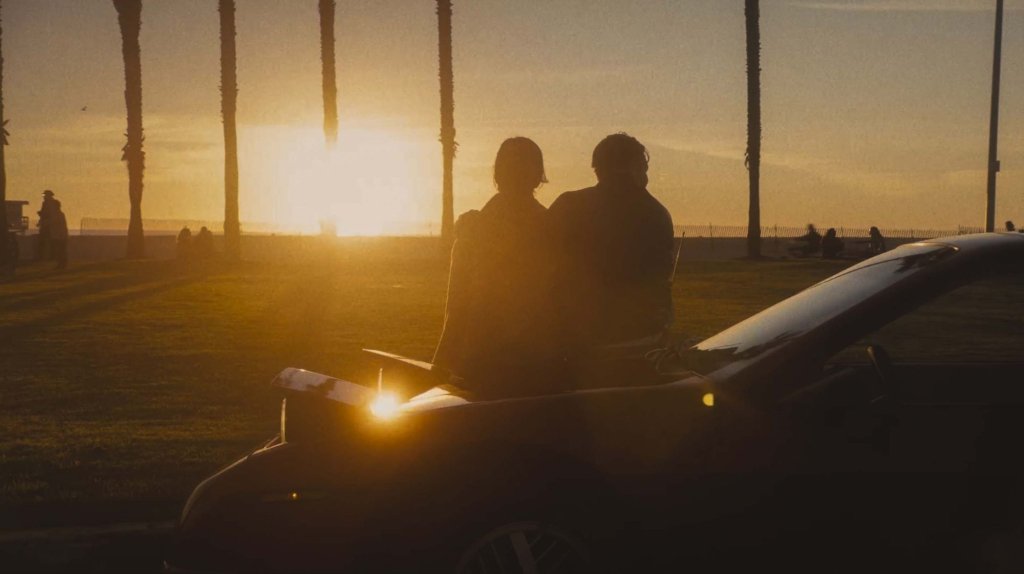
The drone shots especially play a big role in capturing the Los Angeles cityscape from the film’s start to finish at certain points. Tell me more about this aspect of the story, and some of the interesting shots you employ in your film. And to add, I thought the 360 shot during the chase was pretty cool as well, and you shot this film on an iPhone too!
Yes, the film was primarily shot using an iPhone 17 Pro and a DJI drone. The reason for choosing the iPhone was rather practical, mainly because of the limited space inside the cars during the chase sequences, but also for the exterior shots. We wanted to avoid having large camera rigs mounted on the hoods or sides of the cars while shooting throughout Los Angeles.
Using an iPhone also allowed us to work without attracting too much attention. It was particularly useful during interior scenes, such as the bar, where we wanted to avoid disturbing the guests or drawing unnecessary attention to the filming. One thing I insisted on was preserving geographical accuracy throughout the progression of the chase. This was a little challenging because we had to carefully figure out which roads and streets to use and how to edit the different parts of the chase together. The pursuit starts on the west side of Los Angeles, moves through Mid-City, Koreatown, the Sunset and Hollywood areas, Los Feliz, and then through Downtown, eventually ending in an industrial area east of Downtown, beyond the Fashion District. I wanted to capture as many different neighborhoods and architectural elements of Los Angeles as possible, but in a passing way, as the characters move through the city.
Another thing I wanted to achieve was to show the action primarily from the characters’ point of view. We’re seeing the chase from the moving vehicles or through the eyes of one character or another, rather than relying on establishing shots just for the sake of establishing the location. I wanted Los Angeles to slowly reveal itself, almost like peeling an onion, layer by layer, as we follow the characters through the city. And then, with the final pullback shot, we suddenly realize just how vast and spread out Los Angeles really is, and how isolating it can sometimes feel.
As for the 360-degree shot, I simply thought it would be a very cool shot to do. I hadn’t seen anything quite like it before, so I started researching what kind of equipment I would need to achieve it. I visited a few professional camera equipment places, but I was told they didn’t have anything like that, and that what I wanted to do was practically impossible, so I decided to experiment. I bought a few motorized camera heads and other devices online and tried out different configurations. Eventually, I had to build a platform and construct the entire rig from scratch. It was a makeshift contraption, but it worked. We ended up calling it the Samurai Arm. We mounted the iPhone on one end and balanced it with weights on the other, allowing the camera to rotate around the car while the vehicle was moving forward. I specifically wanted to use this shot inside the Second Street Tunnel, during the chase between the red 1985 Pontiac Fiero GT and the Cadillac Escalade. With the tunnel’s graffiti, bright lights, colors and the movement of the cars, I thought the rotating camera would create something visually interesting
What’s also worth mentioning is that the shot was achieved practically. We used a few visual effects elsewhere in the film, but this particular sequence was done without AI or computer-generated camera movement. I spent several weeks during pre-production experimenting with the rig and figuring out how to make it work. We built it specifically for this one shot, and I’m glad we did.
And of course, Marcel Beneš, our cinematographer, did a fantastic job during pre-production, researching the equipment and technical aspects of filming on the iPhone, as well as capturing the footage throughout the entire film. His dedication to the project was exceptional.
I noticed your character teaches Aikido, which is your specialty, and is something I’ve seldom seen in films in the last few decades since Seagal helped popularize it in the West. What is it about Aikido that works so well as a fighting art, in your view?
Well, I wouldn’t necessarily frame Aikido as a fighting art. The answer is multilayered, and it’s not a straightforward one. From my experience, Aikido attracts people for a variety of reasons. A lot of people are drawn to the art because of its philosophy, as it’s often presented as the art of harmony, and because of the teachings of its founder, Morihei Ueshiba, especially during his later years in life. That being said, there are a variety of ways Aikido instructors approach their curriculum and training, and how they pass down the art. Some approach it from a softer, more harmonious and movement-oriented perspective, while others present it in a more physical, robust manner. Others borrow and incorporate elements from different martial arts, all of which, when viewed from a distance, create a very broad spectrum of approaches to Aikido.
With me, I like to view Aikido through a very technical lens, one that applies to both unarmed and weapons techniques. The techniques must make sense from a technical standpoint, but at the same time, Aikido must be preserved as an art form, including its spirit and elegance. It’s not just about practicality, but also about preserving the martial, spiritual and historical aspects of Aikido and its roots, and allowing that spirit to be carried forward through practice.
As for The Modern Samurai, as you mentioned, Aikido has seldom been portrayed in film and television in recent years. In the dojo sequence, I wanted to present very clean, traditional, but at the same time dynamic and elegant Aikido, incorporating both unarmed techniques and weapons, without mixing in elements from other martial arts. The outdoor fight sequence in the alley was approached very differently because it doesn’t incorporate Aikido techniques. This distinction was very important to me. I wanted to showcase Aikido as a traditional art form in the dojo, and then create a contrast with how certain elements of martial arts training might apply in the outside world, if necessary. The editing of these two sequences was also very different. The dojo training consists of short scenes, quick edits and unusual camera angles. I wanted to portray Aikido, including its weapons training, in a way I hadn’t really seen before in film or television.
In contrast, the exterior alley fight was filmed in one continuous take. I made that decision long before pre-production because I wanted to challenge everyone involved, both in front of and behind the camera. I also wanted the fight to feel authentic, without relying on close-up inserts, unnecessary cuts or stitching together different takes. The actors, the cinematographer and the person capturing sound all had to work together. Essentially, the camera itself had to become part of the fight choreography. From the moment the fight sequence begins until the camera pans upward at the very end, everything unfolds in one continuous take.
We spent five weeks rehearsing the alley fight. Some of the actors had no previous martial arts experience, so it was really great to see their progression from the first day of rehearsals to the moment we actually filmed the scene. Everyone involved was incredibly dedicated and put a hundred and ten percent into it. I’m really happy with the result and very proud of what we accomplished. The audience might not necessarily notice the technical challenge involved, but coordinating the camera, the actors, their movements and reactions left very little room for mistakes. It was definitely a memorable evening shooting that scene.
Your character doesn’t use a sword at the end, but a particular type of weapon that also gets the job done. Can you educate me more about it and its history?

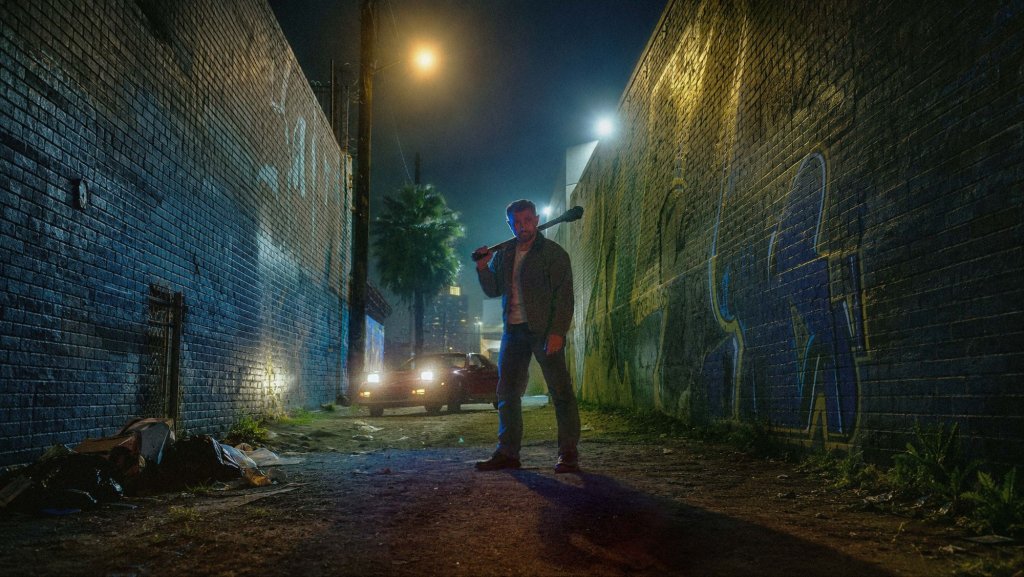
Well, essentially, the weapon you’re asking about is a wooden club. I suppose it’s one of the oldest weapons on planet Earth, perhaps alongside a stone. Just a piece of wood or a branch. Originally, I was thinking of giving Arthur an axe or some other contemporary weapon. But as I progressed with the story and thought more about the whole concept, I felt it would be intriguing for the character to carry something very basic, raw and primal. One interpretation might be that the wooden club represents an ancient world, long before organized systems of law, courts and institutions existed. A world governed more directly by the laws of nature, where survival, instinct and the restoration of balance were fundamental concerns. In that sense, in Arthur’s hands, the club becomes an instrument of justice rooted in something ancient and instinctive, perhaps even a sense of universal balance. It represents something that existed long before the sword, yet finds itself in the hands of a man living in the modern world. But I think that’s also something for the viewer to discover and put into perspective.
The Modern Samurai feels like a concept for something bigger ahead. Is that the plan?
As I mentioned earlier, this project was originally meant to be a comic book, or a series of comic books. So now that it became a short film first, there might be a comic book coming sooner or later. There’s also an original soundtrack composed specifically for the film, which will be released in the future, along with some merchandise. And yes, there are definitely plans and outlines for something bigger, perhaps a feature film, a series or a miniseries. There is more to the story, which I don’t want to reveal too much about at this point. But there is a deeper world of The Modern Samurai that awaits discovery.
What are some key takeaways and lessons you’ve learned from making this project that you feel might help improve your craft going forward?
Making this film was a great experience. We spent over two weeks shooting over a period of two to three months, predominantly at night, with some very long nights. The amount of footage we shot compared to what eventually ended up on screen was quite substantial. There were definitely lessons I learned along the way that I will apply to future projects. One thing that became very clear to me was just how important preparation is, especially when working with a small crew and a limited budget. At the same time, no matter how much you prepare, things don’t always go according to plan, so you have to be able to adapt to the circumstances and find solutions as you go. Filmmaking is definitely a team effort. Everybody involved plays a huge role in the success of a project, and I must say I was pretty lucky with all the people involved in The Modern Samurai. I had known some members of the cast and crew, while others were hired specifically for this project. I was very fortunate to work with such a great and dedicated group of people who were willing and available to work on a limited budget. Another important lesson was the value of maintaining good working relationships. I would very much like to carry those relationships forward into future projects, whenever possible. Of course, every production has its own requirements, but I would be very happy to work with this team again. So, hats off to every single person involved for bringing their talents, dedication and efforts to help bring this little passion project to life.
Thank you so much for taking the time to answer my questions, Michael. On that note, are there any words you’d like to share with readers as we exit this interview?
Thank you so much for this opportunity and for taking the time to conduct this interview. And thank you to all the readers for taking the time to read it. If you’d like to stay in touch and follow the journey of The Modern Samurai, please join us on Instagram
at @themodernsamuraifilm or visit our website at themodernsamurai.com for additional information.
Cheers!