
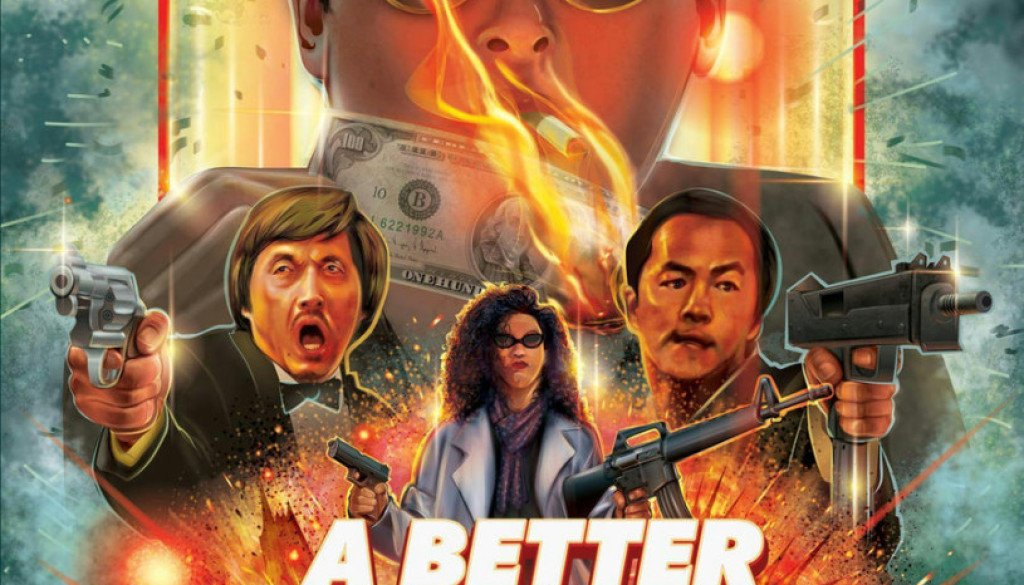
A BETTER TOMORROW – Shout! Review: One Of Hong Kong Cinema’s Finest, Made By One Of Hong Kong Cinema’s Finest
Hong Kong cinema releases on disc are an education if there ever was…
I’ve never seen the 1967 movie The Story of a Discharged Prisoner, and I reckon a plurality of film fans like myself haven’t. Nonetheless, that doesn’t take away from the appreciation there is for John Woo’s A Better Tomorrow, touted as a remake of the Kong Lung-directed flick, and with a production ratified, by any measure, by its own resilience in the face of studio recalcitrance.
Starring Ti Lung, Chow Yun-Fat, Leslie Cheung, Waise Lee and Kenneth Tsang, the 1986 crime thriller contributed to what would become a milestone in Hong Kong movie history. The film follows Tse-ho (Ti) and Mark (Chow), two highly successful triads in the counterfeiting business, and in their line of work, business is good. The only hang up here is the boundary between Tse-ho and brother, Tse-Kit (Cheung) who is well on his way to becoming a cop provided Tse-ho can maintain his lifestyle under the radar. The less Kit knows, the better, right?
Welp, that all changes when a deal in Taipei violently goes south. Accompanied by triad loyal Shing (Lee) and two men, Tse-Ho is ambushed and moves quick to spare Shing in order to take the fall for the deadly shootout as local police descend. In succession, Mark is assigned pointman to settle the score with the gangsters who blew the deal up in Taipei, only to end up wounded and falling on hard times, reuniting three years later with Tse-Ho who is freshly out of Taiwanese prison.
Making matters worse is the rift between Tse-Ho and Tse-Kit, created in part by tragedy, as well as Kit’s own grievances when his newly-discovered relation to Tse-Ho derails his promotional prospects. Additionally, and as if that weren’t bad enough, the once subservient Shing has since replaced Tse-Ho and Mark as the boss of the counterfeiting business, observing a less-amiable work ethic than that of his predecessors.
With law enforcement still investigating the violence from three years ago and Hong Kong police seniors recalcitrant to Tse-Kit’s wishes in order to stave off bad PR over investigations of corruption, Tse-Kit’s mind is squarely focused on bringing Shing down no matter what, even to the point of beleaguring his personal life with girlfriend, Jackie (Emily Chu). Therein lies the trouble Tse-Ho also faces with trying to win back his brother while turning over a new leaf, in addition to catching up with Mark who is itching to take back everything he lost in the last several years. What remains to be seen is just how far Mark, Tse-Ho and Tse-Kit are willing to go in their agendas, resulting in an explosive and bloody showdown that will test the bonds of friendship and brotherhood.
The first time I saw this film was on VHS, dubbed in English and cropped for presentation on standard home televisions. I’d seen Hard Boiled on the same format like a million times by then so I was already sold, especially after being marketed Hard Target, Broken Arrow and Face/Off like crazy, and having taken after Chow’s performance in Antoine Fuqua’s The Replacement Killers. Chow was the one who sold me on these films as I’d never heard of Ti Lung and didn’t follow his early career as a kung fu cinema hero, which effectively makes this either the first or a second film I’ve seen in his resume depending on when it was I saw Drunken Master 2 (or The Legend Of Drunken Master as it was peddled here in the U.S.).
To this, the performances are amazing between Ti and Cheung and their on-screen relationship as brothers on opposite sides of the law, and Chow’s memorable portrayal as Mark, a fallen – albeit principled – gangster much like Tse-Ho. On of the film’s bigger driving forces is Tse-Kit’s marginal disposition to Tse-Ho as a cop, and as someone looking to right a very personal wrong. I loved the pressure it added to Tse-Ho’s character and the weight he faces on multiple fronts, coupled with support from co-star Tsang’s character as Tse-Ho’s employer post-incarceration.
The action, central to any John Woo-directed crime flick, hits the spot. It’s also where Chow shines the most with some of the most raw energy you’ll see in an old-school filmic shootout. The finale is something I truly admire, particularly as one I realized inspired the ending of one other film I’ve been able to screen in the past decade-plus.

The special features are incredible, and go to the heart of my initial line atop this review. Shout! clocks in with two discs, the second of which comes with a 4K scan for 4K home viewers, and with a new commentary by James Mudge of easternKicks for Shout! Studios’ release of the film on both discs. Shout! tops the Blu-Ray further by a little over ninety minutes with Woo in a sit-down interview titled “Better Than The Best” in which he gives praise to his production partner, Tsui Hark, while discussing his career and A Better Tomorrow.
Woo-cohort Terence Chang follows up with “Between Friends: Remembering A Better Tomorrow” in which he shares all with his history and interest in film, Hark and Woo and the industry, followed by “When Tomorrow Comes” in which one of the screenwriters on A Better Tomorrow, Chan Hing-Ka, leans in with a lookback at his own memories working up from TV and into film, working with Woo and getting to know the director as someone he describes in part as “humble” and never once had to rasie his voice.
Director Gordon Chan (who also gets some minutes in for the features on The Jet Li Collection) shares his take in an eight-minute segment dubbed “Thoughts On The Future,” with Havoc and The Raid franchise director Gareth Evans dishes out a hearty hand of memories over his own Woo fandom and more in “Better and Bombastic,” and “Hong Kong Confidential” with author Grady Hendrix lending another ample summary of Hong Kong movie history on the film and its legacy. The Blu-Ray disc rounds out with a trailer bundle, and a slideshow of more than several dozen combined posters and promotional still for the film.
I’m actually pretty impressed with what the A Better Tomorrow trilogy has to offer thusfar. I think I learned more on this release about John Woo and this particular film than I have at any point in the last twenty years or so, and given all the experiences shared here by Woo, Chang and all the historians involved, I have a newfound appreciation for this film, and for Woo as a director.
To think that Woo was nearly written off as a pariah by studio heads who thought this film was going to flop and would have rather seen him wane away in some small office in Taiwan is crazy work to me. Just insane. I’m also keen on giving the 2010 remake a rematch sometime soon just to catch up and see how it compares. I think this would be a discussion worth having somewhere down the line.
I wanted to do a whole physical media rundown like I did with a few other releases but I didn’t have the time, so I’ll be touching back on the other two installments of this propulsive action saga in future reviews, which I’m happy to do. For this, I’ll have more to say as this review miniseries rolls out. In the meantime, be sure to get your A Better Tomorrow Trilogy over at Shout! Studios’s new online store.

Native New Yorker. Been writing for a long time now, and I enjoy what I do. Be nice to me!


A BETTER TOMORROW II – Shout! Review: John Woo’s Fully-Loaded Sequel Maxes Out With Guns Blazing! - Film Combat Syndicate
November 14, 2025 @ 1:28 pm
[…] of the Golden Princess library which includes the (very real) A Better Tomorrow Trilogy. With the first film in our wake, we’re diving into the second film of the bunch, A Better Tomorrow 2, and in quick sum, […]