


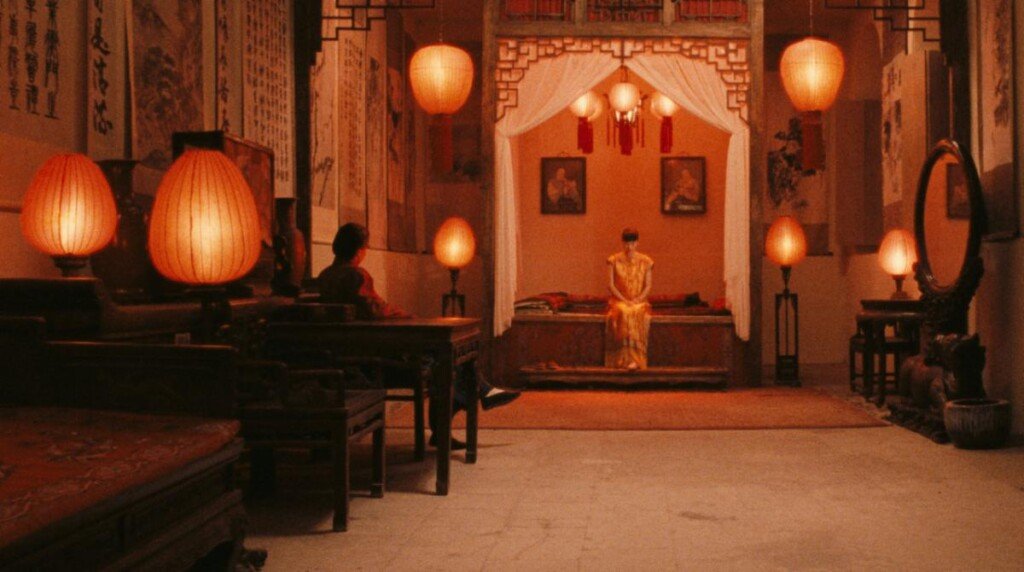
Film Movement Classics is announcing the re-release of three classic films from directors Zhang Yimou and Hou Hsiao-Hsien this year. All three, Zhang’s Raise The Red Lantern and To Live, and Hou’s City Of Sadness, have been given 4K restorations and will all have theatrical and multiple-platform rollouts.
The acquisitions also serve as a nod to producer Chiu Fu-Sheng, who produced all three among a total of five within a decade. Additionally, the titles add to Film Movement’s growing library under its shingle, all which are delineated in the announcement below. Have a read, and then head to the official website for more info.
New York, NY – Following their recent celebrated theatrical releases of Zhang Yimou’s JU DOU and Chen Kaige’s FAREWELL MY CONCUBINE, Film Movement Classics has acquired a trio of landmark Chinese-language films meticulously restored in 4K: RAISE THE RED LANTERN and TO LIVE from iconic director Yimou, starring his muse, Gong Li, and Hou Hsiao-Hsien’s A CITY OF SADNESS, the first Taiwanese film to win the Golden Lion at the 1989 Venice Film Festival. The acquisition spans North American distribution for all three films, as well as the UK & Ireland for RAISE THE RED LANTERN and TO LIVE, and release plans include theatrical roll-outs, followed by release to VOD, all leading digital and streaming platforms and the home entertainment marketplace. The announcement was made by Michael Rosenberg, President of Film Movement, Lan Mainville, Director of Switzerland’s SSNI S.A. and Fu-Sheng Chiu, Chairman of Taiwan’s Era International Films Enterprise Ltd.
Directed by Zhang Yimou and starring Gong Li in one of her most indelible performances, RAISE THE RED LANTERN (1991) is a visually ravishing and psychologically devastating portrait of ritual, power and repression in 1920s China. Adapted from Su Tong’s novel “Wives and Concubines”, the film follows 19-year-old Songlian (Gong Li), who becomes the fourth wife of a wealthy patriarch and is thrust into a rigid household where the lighting of red lanterns signals favor — and fuels rivalry, manipulation and tragedy among the women. A masterwork of color, composition and emotional restraint, the film earned an Academy Award® nomination for Best Foreign Language Film and won the Silver Lion for Best Director at the Venice Film Festival. Frequently cited among the greatest films of the 1990s, it remains, as Roger Ebert wrote, “so compelling that it is almost hypnotic,” while The New York Times hailed it as “one of the year’s most visually arresting films.”
Reuniting Yimou and Li, TO LIVE (1994) is an epic yet intimate chronicle of one family’s endurance across decades of political upheaval in 20th-century China. Spanning the Civil War, the Great Leap Forward and the Cultural Revolution, the film centers on Xu Fugui (Ge You), a once-wealthy gambler reduced to poverty, and his steadfast wife Jiazhen (Gong Li), whose resilience anchors the family through cycles of loss and survival. Balancing sweeping historical canvas with deeply personal storytelling, TO LIVE captured the Grand Prix of the Jury and the Best Actor prize for Ge You at the Cannes Film Festival. Praised for its humanism and emotional power, Variety called it “a deeply affecting saga,” while The Washington Post described it as “a sweeping melodrama of extraordinary emotional force.”
Directed by Taiwanese New Wave master Hou Hsiao-hsien, A CITY OF SADNESS (1989) is a landmark of modern cinema. Set in the turbulent years following Japan’s surrender in 1945, the film traces the fate of the Lin family amid the political repression of the February 28 Incident and the onset of Taiwan’s White Terror. With its elliptical storytelling, painterly long takes and profound sense of historical memory, the film marked a turning point in Taiwanese cinema and solidified Hou’s international stature. The Village Voice hailed it as “a masterpiece of modern historical filmmaking,” while Sight & Sound has repeatedly ranked it among the greatest films ever made.
From 1989 to 1999, within just ten years, Fu-Sheng Chiu produced five highly influential classic Chinese-language films: A City of Sadness (1989), Raise the Red Lantern (1991), The Puppetmaster (1993), To Live (1994), and The Mission (1999). These films helped Chinese-language cinema gain recognition at international film festivals and introduced audiences around the world to the richness of Chinese-language film. In 2024, he was awarded the Golden Mulberry Lifetime Achievement Award at the Far East Film Festival.
“These are not simply important films — they are towering achievements that changed the course of world cinema,” says Rosenberg. “Directors Yimou and Hsiao-hsien expanded the visual and emotional language of film in ways that continue to inspire generations of filmmakers. We are honored to bring these 4K restorations into theaters for the first time, where their scale, beauty and historical resonance can be fully experienced by new audiences and longtime admirers alike. Preserving and re-presenting landmark works like Raise the Red Lantern, To Live and A City of Sadness is central to our mission of championing the very best of international cinema.”
In addition to the acquisition of RAISE THE RED LANTERN, TO LIVE and A CITY OF SADNESS, Film Movement Classics has also recently acquired the new 4K restoration of Idrissa Ouedraogo’s SAMBA TRAORE, slated for re-release later this year; Katsuhito Ishii’s cult favorite THE TASTE OF TEA, opening May 8th at New York’s Metrograph; MY SASSY GIRL, the landmark Korean rom-com, in a 25th anniversary 4K restoration director’s cut coming to theaters later this year; a new 4K restoration of Gabriele Salvatores’ NIRVANA; as well as Claude Chabrol’s VIOLETTE NOZIERE; Andrzej Zulawski’s LA FEMME PUBLIQUE; Tsai Ming-Liang’s THE RIVER, ; and a 4K restoration of Cate Shortland’s SOMERSAULT, starring Sam Worthington and Abbie Cornish, in theaters now. Also coming to the big screen later this year for its 50th anniversary is Luchino Visconti’s final film L’INNOCENTE in a new 4K restoration by Film Movement Classics.