THE RED SPECTACLES Review: Mamoru Oshii’s Fascinating Dystopian Head Trip
My first exposure to the Kerberos Saga was Hiroyuki Okiura animated Jin-Roh: The Wolf Brigade film. It was also my second viewing of any of the works created by Mamoru Oshii over the years, and with so many other of his works I’ve yet to dive into to this day – this is only because I have a thing about watching stuff as chronologically as possible.
Maybe that’s not as important to some and perhaps I’ll get over that eventually. For now, indeed I did see Jin-Roh at a time when it would be years before I would see Kim Jee-woon’s live-action remake which has its merits, in my view. To this, the same goes for Oshii’s 1987 production, The Red Spectacles, which definitely falls on the more odd side of the sci-fi spectrum.
I won’t pretend to be familiar with any of Oshii’s influences or even try to remember some of the possible ones from my cinema upbringing. I’ve seen a lot of films that didn’t weigh as heavily on me as the ones with dudes with big guns spraying a bunch of bad guys, or ripping off their own shirts and kicking each other’s faces, which spoke to me more than anything in my preteens and early teens.
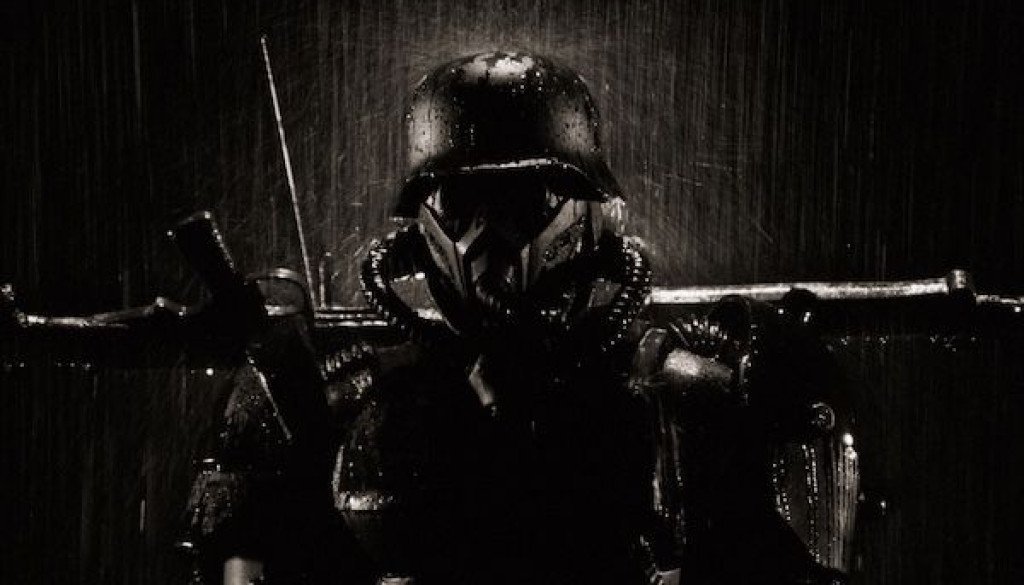
Needless to say, The Red Spectacles easily ropes you in with its first ten minutes as we are introduced to a version of Japan that’s become as dystopian as ever. A special, heavily armored unit called Kerberos is created to combat rising crime, and is lauded until its methods become increasingly violent and cruel, forcing the unit’s disbandment.
We then follow a trio of rogue defectors formerly of Japan’s Kerberos unit awaiting a helicopter before they’re ambushed by bounty hunters, ensuing a firefight in which two of them – Soichiro (Hideyuki Tanaka) and Washio (Machiko Washio) are wounded, resigned to staying and telling their comrade, Koichi (Shigeru Chiba) to flee and promise to come back for them.
Three years later, Koichi returns under the cover of night only to be stalked by Bunmei (Tesshō Genda) and his ruthless assassins. After briefly seeking refuge at a hotel, what ensues is a harrowing odyssey of Truman Show-level proportions when Koichi arrives at a movie theater, resulting in a labyrinthine chase as Koichi turns fugitive in a world that feels as lurid as it does nightmaring.
The real question, however, are more to do with Koichi’s own harrowing introspection, in a story that really ends quicker than the viewer realizes. From that point on, The Red Spectacles is nothing short of intriguing, and even baffling. I love Kenji Kawai’s score and Yosuke Mamiya’s cinematography has a way of capturing the film’s mood which often teeters between pensive and peculiar.
The real crux of The Red Spectacles is certainly more to do with Oshii’s storied psychological focus. His use of various setpieces and tones to different scenes whether they be action, drama, or comedy, are part of the larger formula for the whirlwind he puts his viewers through until the big twist is revealed by the end, and a big key to this approach, I think, is a lot to do with Oshii having as much fun with his script as he wants, and placing it on camera.
I love how engaged his cast is as well. You get the idea that working with Oshii makes you part of something bigger than whatever is the perceived identity of the project on hand. At one point they’re soldiers on color footage, and in another, they are characters almost distant from one another, and from reality in a sense, even though you don’t know this until you keep watching.
What recapitulates with The Red Spectacles is the kind of film that follows its own rules as a cerebral dystopian nightmare tale. The action, comedy and drama each tend to spoof themselves with as much exaggeration as needed, with Oshii and his cast leaning into all of it, not breaking character in the least. Really, the only thing that baffled me was the image of a mysterious young woman (Mako Hyōdō) in a red scarf whose face is nearly plastered all over the city; Her significance feels relative to Jin-Roh but that’s all I can really extrapolate from her appearance in this film apart from whatever potential context there is, symbolic or literal.
I went into The Red Spectacles with a different impression at first, and I come out of it a little wiser with respect to my previous experiences watching Jin-Roh and its Korean live-action remake. And indeed, Oshii’s work is an experience to share if you love sci-fi, or classic auteur gems and oddities that sit tangentially from your preferred purview. It’s definitely educational, and it’s going to baffle you if your head isn’t really into it. That said, this film’s 4K restoration last year really compliments its delivery to audiences being introduced to it for the first time. If you’re new to Oshii and the Kerberos saga and feeling curious, you’re right where you belong.

Native New Yorker. Been writing for a long time now, and I enjoy what I do. Be nice to me!