
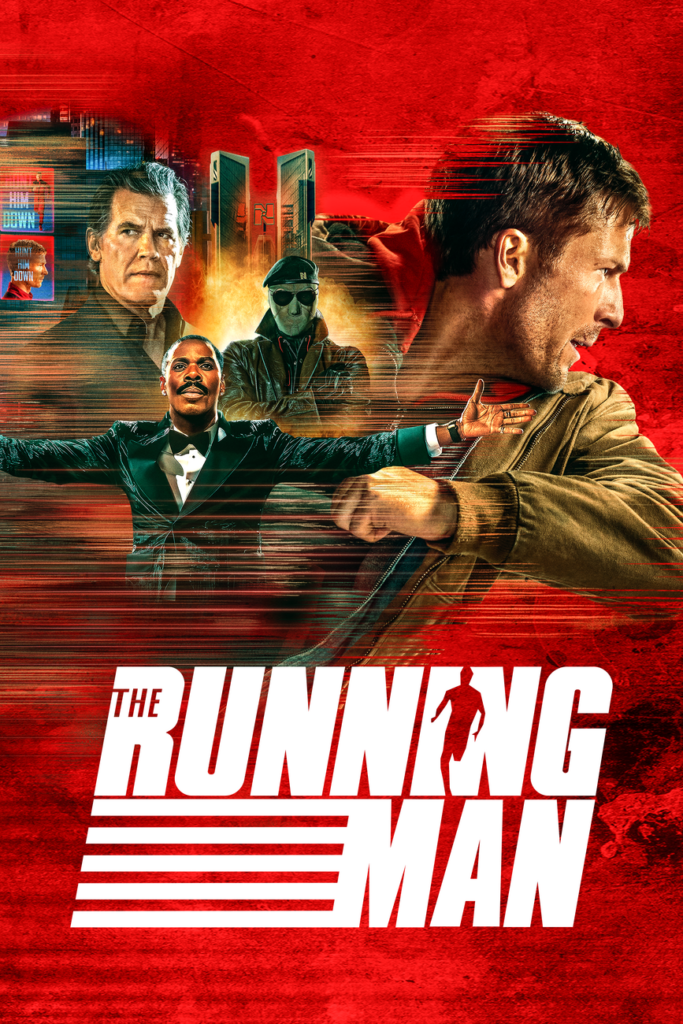
THE RUNNING MAN Review: Glen Powell Leads Edgar Wright’s Steady Action Classic Revamp
I never read any literary works by “Richard Bachman,” so like virtually anyone in my generation, Paul Michael Glaser’s futuristic thriller, The Running Man was my first exposure to the IP, and with the casting of Arnold Schwarzenegger, you can believe it was a seller. It’s enough to be warranted a classic, so there’s no question that any idea there was about revisiting the book in any filmic capacity would draw a mix of prominently skeptic responses.
Leave it to writer/director Edgar Wright to take on the task of proving doubters wrong with his latest trudge with co-writer Michael Bacall, for a brand new reimagining which he at once touted as a story more closer to the novel than the film’s 1987 predecessor. I’ll leave it to the bookworms to make that judgement since I can only gauge the film’s performance on its own merits next to the original, while I will say that after seeing the film, and like with a lot of reboots and remakes, I can see why it hits different for some more than others.
Invariably, the film faltered at the box office, so dispelling the notion that remakes and reboots are a sell for audiences still remains a challenge. That isn’t to say that the film isn’t fun in its own way, aided by a noteworthy cast roster with Glen Powell leading the way as Ben Richards, a disenfranchised blue collar family man with a short-fuse, compelled against the good advice of loving wife, Sheila (Jayme Lawson), to go on TV to win enough money to get their ailing daughter back to health and their family out of the slums if he can help it.
The first real question in the film’s formal layering remains if whether or not Richards can survive the game long enough to make it without being killed by the game’s elite hunters, led by the masked macho mercenary known only as McCone (Lee Pace). Making matters worse upon having been cajoled into playing the notoriously deadly game, Richards also has to contend with the corporate malfeasance of the inner machinations of The Network, as well as the game’s creator, Dan Killian (Josh Brolin), and its buoyant host, Bobby T (Colman Domingo).
Alas, trudging from the heavily-surveilled metropolis, alleyways, and slums to the rural hideouts, Richards’s only repose is the aid of friend Molie (William H. Macy), and a scant network of strangers to help connect him to an underground rebellion aimed at taking down the network, including Bradley (Daniel Ezra), and distant ally, Elton (Michael Cera). Little does he know, however, that the show’s ratings are also a factor in his survival, and with Killian’s eyes on capitalizing off of as much as he can in exploiting Richards’ peril by any dubious means necessary, its up to our protagonist to turn the tide and expose the Network for what it is in front of an impressionable audience, and bring the game to its devastating end, if he’s to reunite with his family once and for all.
Wright’s and Bacall’s take on The Running Man extrapolates as much as it can to bring depth to the upgraded concept. Much like the preexisting materials, the story remains rooted in themes that still age well to this day as they pertain to media criticisms, class warfare and so on. To this, Powell’s lead performance compliments the film handsomely opposite the conniving and duplicitous antagonists played by Brolin and Domingo. The line up is further supported by co-stars like Katy O’Brien who plays neighbor to Richards and who becomes a willing contestant in the game, as well as Emilia Jones who plays a hostage in the film’s second half.
The only real hangup when it comes to these characters is they don’t stick around long enough to leave the kind of protracted impact one might aspire for them to, and so most of their departures feel more shallow than anything. What I did enjoy was how the film tackles the aspect of media manipulation as a modifier for Richards’s motivation to keep fighting, not really knowing what’s real or fake and ultimately resigned to his rage which is what fuels his make-or-break instincts.
It’s not all witless or blunt as the action sets up nicely in between beats of character development and transitions. Some of the standout set pieces include Richards’ daring escape from a drab hotel into the sewer, his explosive scrimmage out of Elton’s booby-trapped home through a high-speed bridge collision, and even a gravity defying fight sequence on a plane near the finish.
The real star in Wright’s delivery of all these is the asterisk he applies to his ambitious revamp of heyday dystopian satire – the kind that once worked with Verhoeven a la Robocop and Total Recall; His execution with The Running Man is a far cry from the critical shortfalls earned by Len Wiseman and José Padilha in recent memory, in that Wright delivers a suitable, R-rated action adventure that tries to course-correct the adverse trend left by putting nostalgic blockbusters through a PG-13 filter for today’s moviegoers.
Chatter over the film’s commercial and critical reception may still bode myopic depending on you are and your tastes if you’ve already seen the film. If not – that is, apart from other critics’ takes along with the original author’s own approval, then I’m happy to help lend my opinion to the table, however which way you value it. Thusly, while films like Wright’s The Running Man won’t be everyone’s cup of tea, that doesn’t cancel out the fun you’ll have from watching Powell carry the torch as a worthwhile action hero to cheer for in the new year.
Tap here to continue reading my product review of The Running Man on disc. The movie arrives on DVD and Blu-Ray/4K UHD/Digital combo pack on March 3.

Native New Yorker. Been writing for a long time now, and I enjoy what I do. Be nice to me!