
THE SWORD – Eureka Blu-Ray Review: A Glimmering Old-School Lesson On Grade-A Wuxia Cinema Through A Subversive Lens

Celebrated television veteran Patrick Tam has only directed a small number of films throughout his career, which spans close to half a century. He’s been a filmmaker in several aspects of the word, and this is undoubtedly signified on one of his earliest pieces, the 1980 wuxia action drama, The Sword.
Lee Mak-Yin (Adam Cheng) is a noble, lone swordsman who has studied martial arts and pugilism under a revered master. He is now on a journey to find a particular master with whom he can share a duel, in order to gauge his own skills and possibly complete his training. Along the way, he meets a rambunctious young woman named Ying-Chi (Jade Hsu) who herself is in pursuit of an enemy one evening.
After a brief scrimmage, Ying-Chi reluctantly joins Mak-Yin on their journey together, arriving at an inn where Mak-Yin just happens to bump into Siu-Yiu (Jo Jo Chan), a childhood sweet heart and old flame from their former village. The respite, bittersweet reunion segues into an abrupt introduction to Lin Wan (Norman Tsui), Siu-Yiu’s seemingly affable husband, and his fast and nimble bodyguard, Tit-Yee (Eddy Ko).
Despite all façades made public, shocking secrets and lies are inbound as Mak-Yin’s journey soon brings him face to face with the master he’s long searched for. What remains to be seen from then on is if whether or not the prize he sought was worth attaining when so much more is at stake, particularly when Lin Wan’s insidious, more evil side surfaces.
Therein lies the predicament presented to our protagonist in The Sword, encapsulating a core prose on the dangerous of pursuing material desires. Symbolic of this is a mysterious pair of swords that encompass film’s oblique themes and character developments. One sword is the Harmonious Sword, beholden to its owner, Fa Chin-Shu, played by venerated screen legend Tien Feng. The other, the Cold Hand Sword, is brought to our attention at the top of the film when Fa shows it to the blacksmith who just completed Fa’s own Harmonious Sword.
Upon examination, the blacksmith concludes that the Cold Hand Sword is a weapon born from pure evil and should be discarded without question. Alas, a movie like this is only as good as its villains, and you can’t have a movie like The Sword without an evil sword. Its trajectory certainly keeps it well within reach of our characters during the film’s progression, more pertinently when after Mak-Yin meets a woman who nurses him back to health following an earlier duel with Tit-Yee that left him wounded.
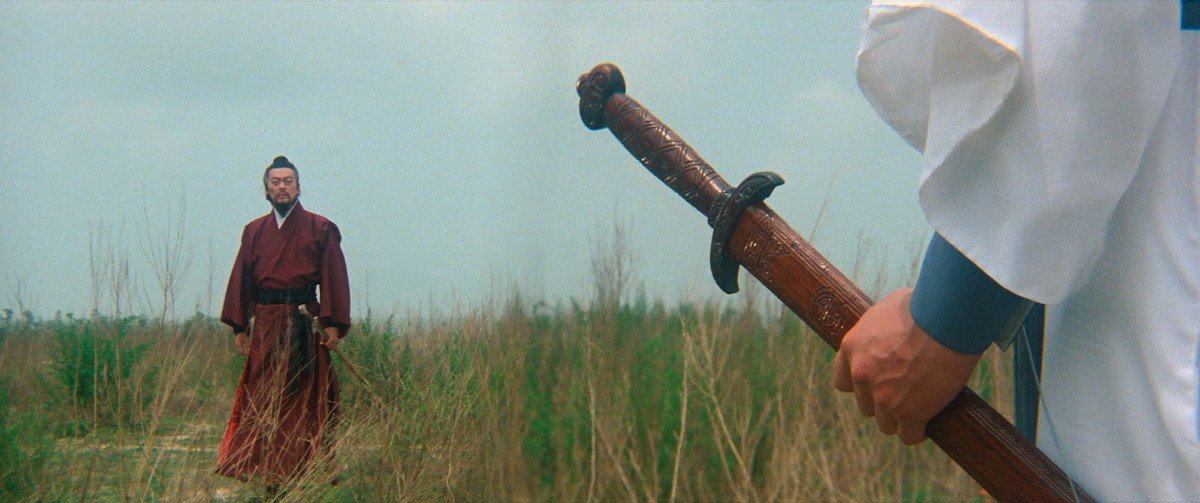
Uniformly, you can neither go without a proper villain to face our hero and recapitulate with to bookend such a film. The Sword accomplishes all these and plenty more, providing a bevy of interesting characters to fuel the story, led by Cheng whose career in TVB has aptly prepared him for the lead part here against longstanding Shaw Brothers vet, Tsui.
Kung fu fans will get a neat little kick out of a few of this film’s other co-stars, namely famed character actor Lee Hoi-Sang who plays the antagonistic Soo Wan crossing blows with Ying-Chi from earlier on, and then with Mak-Yin on two seperate occasions. His role is distinctively smaller compared to others, but it does play a pivotal role in the scheme of things, particularly when Ko’s Tit-Yee enters the frame.
Ko is especially one of the more standout avid leading men in cinema history. You can find references here where I’ve written a little about his previous work, while it’s worth noting his screenfighting gets the full-fledged treatment as the unrelenting assassin, Tit-Yee. Both actors share at least three action sequences, each one increasingly more thrilling than the next, which is to say nothing of just how gory the action gets at select moments of the film.
The very first action scene finds our hero swordsman arriving at an old temple in search of the sword master he wants to duel. The temple’s caretaker, played by Lau Siu-Ming, misidentifies Mak-Yin as Fah and challenges our hero to a duel after waiting twelve years for a match. The victor at the end of this bout notwithstanding is less so the focus, compared to Tam’s use of poetic foreshadowing as we follow Mak-Yin throughout the film.
Actress Hsu gets a few swings in of her own as Ying-Chi, although her work in the action department is moreso minimal than that of her co-stars. Characterwise, she is as cute as she is irksome for much of her screentime. Notably, her impetuousness does gets in the way of her likeability a little bit, which, interestingly, also helps in raising the stakes some, because like many of the supporting characters in this story in some sense, she’s also a victim.
This sort of progression is crucial in a movie like The Sword, as a heroic bloodshed tale in which things happen faster than your sword can parry, intentions are misunderstood, and people die as a result. This is especially important when considering Mak-Yin’s role in all these events, as a protagonists whose actions and psychosis all subvert the kind of straight-laced image, all permeated by his reason for taking the journey he’s been on, and for becoming a talented swordsman to begin with.
The action in The Sword is intense and thrilling as you would expect from a Golden Harvest production. Choreography and direction come by way of Teng Te-Tsiang, and Ching Siu-Tung – both who share a mountain of screen credits as acting and action multihyphenates for years. The latter went on to make his debut at the helm three years later, reuniting with actor Tsui to star opposite Damian Lau in Duel To The Death.
The fight scenes are fantastic in their spectacle and articulation, assembled with seamless editing to showcase our stars and their corresponding doubles in balletic, screenfighting form between both the grounded and mid-air sequences, wired and loose. The bloody portions of the action are a nominal build-up between the beats at times depending on the fight, while the among the more significant kills are the ones you don’t see coming. Those shots are quickly edited for spontaneity, and you might even find yourself skipping back to the sequence if you blink or turn your head, even for a second. And, if you do happen to catch them and accidentally let out a cackle or two, just roll with it. We all know you’re not a sociopath.
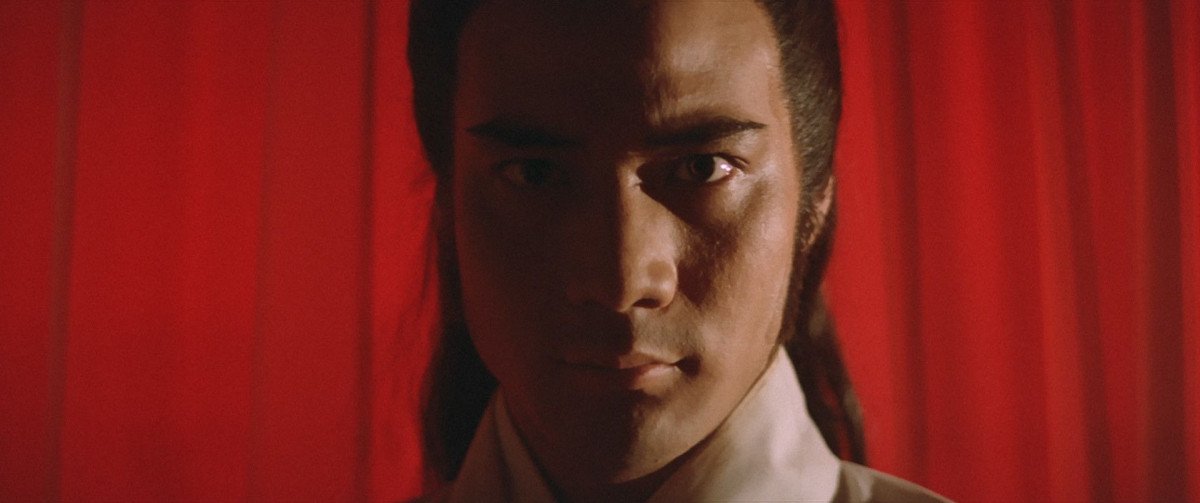
EXTRAS:
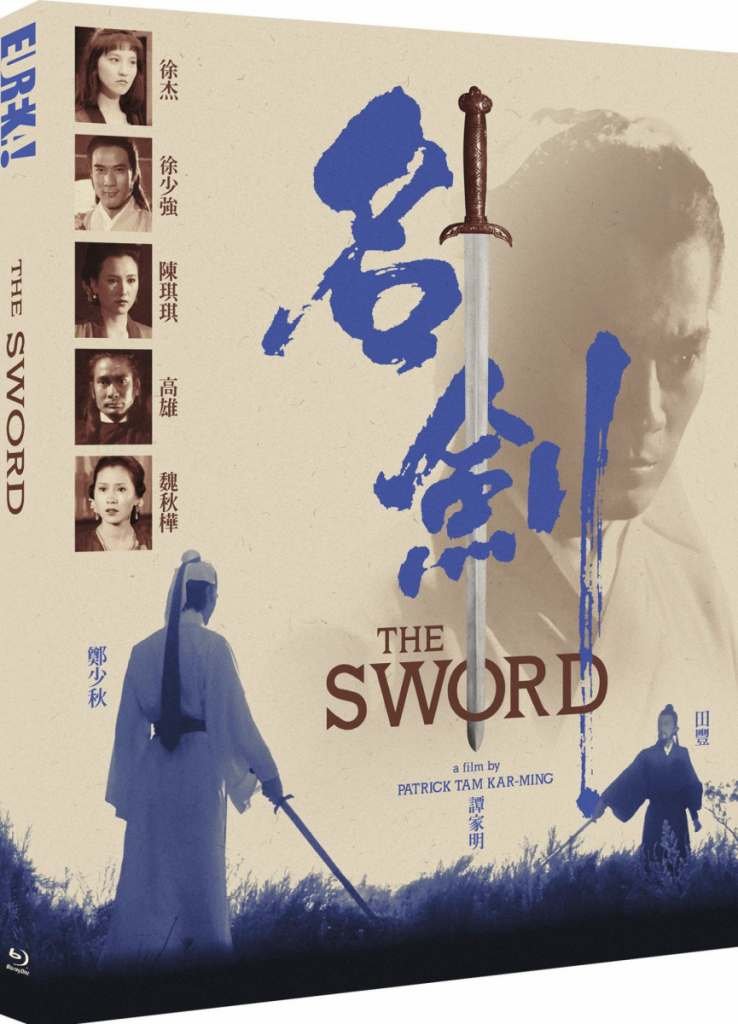
Getting to see The Sword in restored 2K Blu-Ray disc on 1080p reesolution was an worthwhile treat. The same goes for hearing from the film’s corresponding commentators. There are two tracks incumbent on the single disc from Eureka, the first of which comes from film expert and festival programmer Frank Djeng (Enter The Clones Of Bruce) who dials in on all he knows and has collected about The Sword. Talking points on the film range from the usual historical specs, box office numbers to actor and crew resumés and histories.
Central throughout Djeng’s analysis is the film’s impact as part of the inaugural New Wave of Hong Kong Cinema at the time, and the magnificence of having two major TV stars on the set of a big picture together. He also weighs in with a mountain of some cool trivia and story tidbits. Among these, there’s a funny tale he shares about the response time between film’s final shot and the audiences’ departure after “The End” caption, and at least one reason for why the movie took two years to make. Additionally, there’s another interesting theory regarding the death of martial arts novelist Wong Ying who co-wrote the movie, as well as some insight on actor Cheng’s dissenting reaction to the film having not seen the final cut on the big screen and reportedly believing a better film was possible.
Second of the two commentaries goes to Mike Leeder and Arne Venema who, like Djeng, regale a good deal early on about the folkloric relevance to themes about obsession with respect to both Asian and European cinema, with nods to Wong Kar-Wai, Chang Cheh, Peter Jackson and Akira Kurosawa. Adjacent to their observations about the film, their commentary covers a vast bit of ground which goes beyond the film and delves amply into Hong Kong’s history and culture; They share a “tea story,” as well as a “pigeon story,” and expand more on lifestyle and maintenance in Hong Kong, how Hong Kong cinema evolved through several of its waves over the years.
The two even revel a great deal about “ageless” late actor Eddy Ko, and memories about screen legends Brandon Lee and Dick Wei a little later, etc. It’s all great stuff, mostly, and all very consistent conversational energy which ought to make for a fun, enthusiastic listen for anyone who collects these specialty discs. One key thing I want to mention is when Leeder discusses co-star Lee about whom he says is “taking a break,” which alludes to this audio track as a possible late addition to Eureka’s reproduction of the film given the kung fu cinema legend’s screen passing back in early September.
Film historian Wayne Wong continues the disc extras in an eighteen-minute interview by Craig Ian Mann titled “Forging Ahead,” followed by a thirteen-minute segment with film expert Andrew Heskins. They both go over plenty on a lot of what’s been divulged in the commentaries about the film, although Wong does dive a little deeper into some interesting details about the history of the wuxia genre in the twentieth century; He outlines at great length the controversial backlash the genre faced over certain themes until the 1960s as the zeitgeist took to a renewed interest in the genre leading up to Tam’s entry in the arena.
Wong also cites subsequent hits from directors like the aforementioned Wai, as well as Tsui Hark and Zhang Yimou, with respect to Tam’s work and its impact toward audiences on perceptions of action, color and aesthetic concepts, and what contributed to Tam’s vision and messaging, as well as Hong Kong’s identity in the years to come. Heskins dials in with his take on the film for his segment with facts and details about the film, cast and crew, partly including action director Ching and his career before and after The Sword. An original theatrical trailer for the movie finishes out the disc.
I have to say that the commentaries are definitely the best in this package, with especially Djeng pointing to a lot of really cool trivia fans can have fun with. Additionally, the limited edition Blu-Ray of The Sword further contains an exclusive booklet at featuring an archival interview with Tam, as well a new essay by East Asian cinema expert Leung Wing-Fai. I was only sent a check disc to review so I have no feedback on the contents of the booklet. Rest assured though, Wuxia fans will take nicely to Eureka’s latest offering here with Tam’s trendsetting debut in The Sword, cramming in a tale of desire, obsession, and affliction, and coupled with high-octane sword action and violence, and a handy band of estudious industry minds to round things out for the fandom.
The Sword can be purchased at the MVD Shop today. The movie is also streaming in the U.S. on the Hi-YAH! app.

Native New Yorker. Been writing for a long time now, and I enjoy what I do. Be nice to me!