

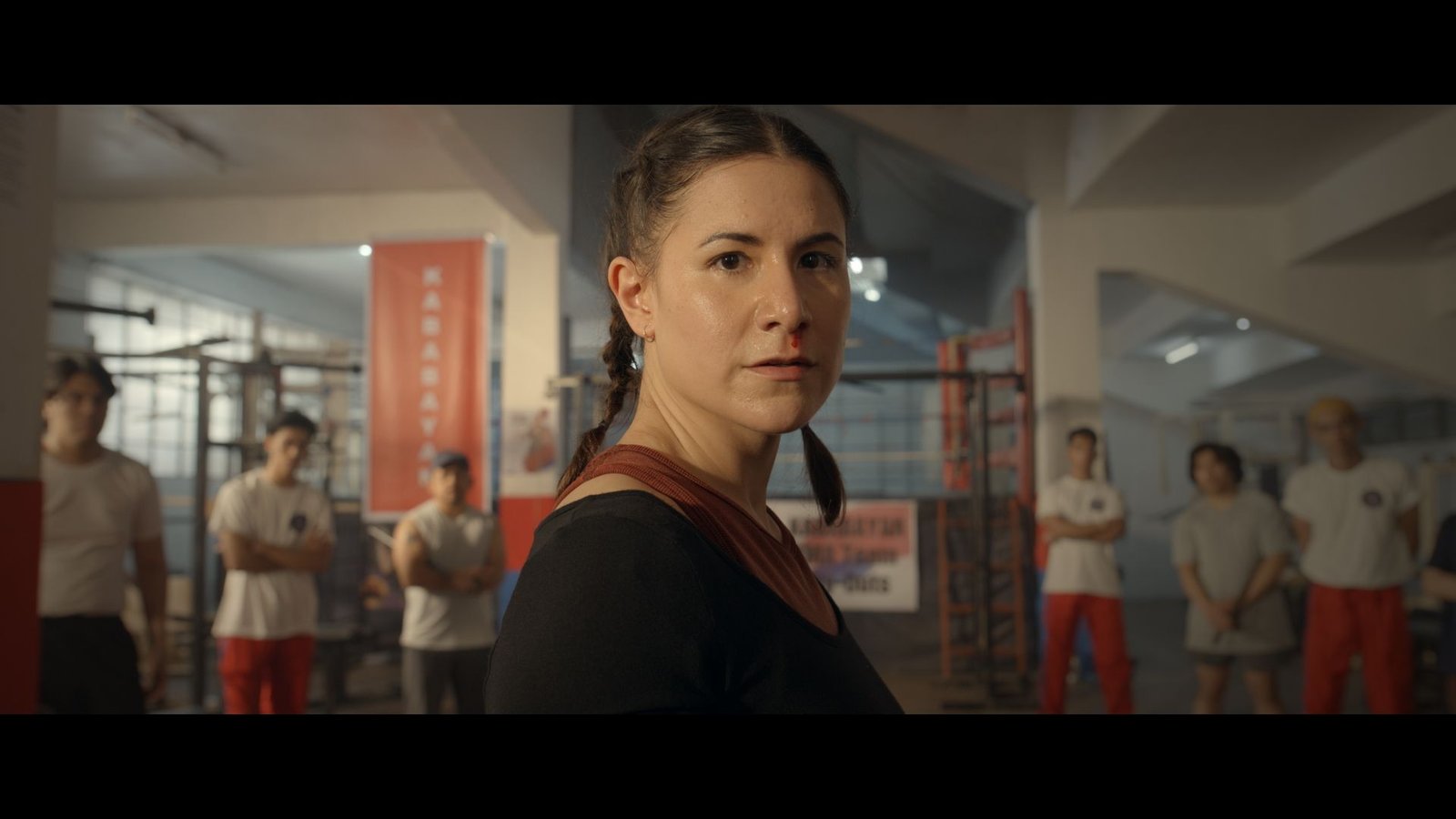
I find myself on the brink of a really busy summer – busy in a good way though as festival season picks up and I can finally get some reviews in for films I’m looking forward to between now and the new year. Of course, part of that stretch was being able to write my first Tribeca Film Festival review (non-press accredited) for a new shortfilm now circulating festivals from the mind and purely capable hands and feet of actress and filmmaker Isabel Lamers with martial arts proof of concept shortfilm, Kaya.
The project centers on a young, aspiring Filipino martial arts athlete who is forced to contend with society’s perceptions of her appearance outside the ring, as well as in. I reviewed the short which you can link to here, while my latest formal interview with Lamers – conducted in the days prior to and following Tribeca – is now available for your reading enjoyment below. Topics pertinent to Kaya and its development and production, as well as Lamers’ influences and experiences in the director’s chair, and more are the ground we cover in this dialogue which I personally hope burgeoning filmmakers and creators alike will take inspiration from.
Read on, and follow @kaya_thefilm on Instagram!




Greetings Isabel and thank you for taking the time to answer some questions for our readers. As of this interview, you’re busy getting ready to premiere your latest project, Kaya, at Tribeca this month. How has the year been for you thusfar?
Post-production for Kaya has been a bit of a rollercoaster. We had been ill-advised during production and so had no more funds left for post. It took a lot of courage to keep going, especially after just having moved to Los Angeles and not knowing many people. I would say the Filipino Community really picked me back up and put me together. They gave me hope to keep going. And then before I knew it, I met people who were willing to give internal support, and here we are!
I was instantly drawn to your campaign back in 2024, but I’d like to share some more about you and your work as an actress and performer. What inspired you to start acting?
Yes, I still remember our first interview during the campaign. Thank you so much for helping spread the work on Kaya even back then. Acting was always my dream profession! I still remember the moment I was watching behind the scenes footage with child actors, and realized that this was an actual job that one could do. I had no idea before that, but always loved performing in general as well as being on stage. My brother and I had a video camera and would film the craziest content. It was fun, but it took me a while to dare to pursue acting as an adult. I didn’t have the support to go to film school, and I needed government financial support to go to college, so pursuing acting didn’t seem an option for a long time.
You’re also athletic in your pursuits as a screenfighter when it comes to stunts and action, so now we segue to martial arts which is kind of my bread and butter for what I cover as it pertains to action films. What are earliest experiences in training? Also, what styles and why?
I very, very originally started with Karate in the Philippines, but I couldn’t relax enough to be interested in the kata. I probably only needed the proper teacher! [laughs] Eventually as a teenager, I went back and trained judo for a couple of years, but again personal circumstances got in the way, and I also felt out of place as there were not many other girls training. Later, I got into kickboxing and it became a regular hobby alongside screen fighting. I loved the idea of being involved in fights but not actually hurting anyone!
What are some of your favorite films in the genre – or other genres, if you will? I’m curious, and I like to ask this because you might throw a title out there that I or my readers have never seen before, or maybe we did! Either way, this is all just homework on our part.
I mean I always like a bit of a genre-crossing film, so I don’t actually know all the classic martial arts films – even though I should, so I just probably need to do some more homework on my part. I enjoy action films like The Old Guard, of course John Wick, but I love when the action is just the result of a great plot, and then gives rise to interesting kinds of fighting, like in The Matrix, Everything Everywhere All at Once or Dune.

Going into influences, I think the most noticeable thing that caught onto me with Kaya, at first, was the name change from ‘Filipino Karate Kid,’ and the characters that co-sign the title of your new film. Can you break down what Kaya means?
Kaya is a Tagalog (Filipino) word that stands for “capability” and “possibility.” It’s the root word that can be used to talk about things like “skill,” “hope,” and “goals,” and it can also mean “might”, or “maybe”. I liked the catchy working title we had, but it’s just tricky in terms of IP since there are the Karate Kid movies, and then in our case, it’s neither about “Karate” nor about a “Kid,” per se, so how do we justify the title, right?! I have received a lot of feedback on the title and this is one of the things I ended up giving in to the majority of opinions informing me not to use it.
Kaya touches prominently on themes of identity and acceptance – both things I could relate to as someone who is also mixed. How important was it for you to make this film in presenting a character like Nia, and spotlighting the kinds of biases that she faces?
I’m so glad it touched upon something for you. This is why I made this project. I think mixed-race people face their own kind of biases and a sense of incongruity – things that are rarely addressed on screen, even though there are more of us by the day. I just felt it was an interesting take to look at through the lenss of someone who’s “white-passing”, because oftentimes it is considered okay to say “you don’t look Asian”, when saying “you don’t look white” and “where are you actually from” is not okay to say anymore – at least most of the time. And, you have to wonder why? From a general standpoint, defining or judging someone by their appearance just shouldn’t be okay anymore, so I believe that highlighting those biases was very important in making this film, as it affects so many of us.
This project also serves as the start of a new path for you as a director. Is filmmaking something you always had in mind, or was this something that came as an urge in the course of telling this story?
It has been a discovery to see just how much filmmaking and storytelling means to me. You know in our lives, we get to know ourselves a bit more everyday, right? And so the more I do in the industry, from starting to write, to producing and directing, the more I connect the dots and see that I was telling stories all along. So, the urge was there even before.
Talk a bit about the talent you brought to the table, working with folks like Lauren Mary Kim who was your action choreographer, and stuntwoman and actress Kayley Carrigan who plays the antagonistic leader of the FMA team you’re training for.
Interestingly enough, I contacted both women through social media. Lauren was a recommendation from our stunt coordinator, Niccolo Ramirez. He mentioned that Lauren was working towards taking on more coordinator roles, so I had originally contacted her to do the stunt coordinating for the film. She also was going to do it until she had a personal medical issue preventing her from continuing her role. This is when Nico – who was up until then functioning as her assistant – stepped in.
It was fantastic working with Lauren. She was so collaborative throughout, really respected my vision as the writer and director, and valued the storytelling aspect greatly in ways that were important for the fight scenes. Since the final fight scene was also the closing scene of the film, it was essential to tell the story through the fighting styles, choices and moves more than anything and Lauren did a fantastic job. We both researched different teachers we had worked with, and I also picked out a move from a documentary I saw on Arnis as we really wanted to showcase FMA and how diverse it is.
With Kayley, I found her on Google and contacted her via socials. I asked for a fight and acting reel and we did a quick audition. She started as a stunt woman who is trying to make the move over into acting so she was also immediately thrilled by this role that combined both aspects, and Kayley was amazing, too. She put in so much work to nail the choreography and we rehearsed it both with each other and with our DP before shooting, so she put it all the extra hours which I’m so grateful for, and it worked out. I just couldn’t stand the idea of making a female-led action film where the action wouldn’t be good!

Making your debut with Kaya as an actress and director, this project was also crowdfunded. Talk a bit for us about the independent film landscape in your view, and some of the lessons you’ve learned in the last several years developing and bringing this project to fruition?
I have not been in the industry long enough to really give a good observation, but what I’m gathering is that independent has a moment right now, especially with the recent successes of Backrooms and Obsession. What I have learned is that it is extremely empowering to make your own content. You circumvent the gatekeepers, you are in full creative control, and you don’t have to let anyone “allow” you to make risky choices, like not include star talent, for instance. People told me the film won’t be successful without name talent, but showing at Tribeca is a huge success!
They say to keep going until you become undeniable – and so I guess, that is true for our industry. Of course, there are so many challenges making your own films, but the opportunities for success and visibility are bigger than ever. Take social media for instance, where filmmakers are releasing mini-shorts or verticals with millions of views. They would have never gotten the platform otherwise and that’s where we can focus our energy on, despite the trend towards AI that is scaring the industry. Our creativity and humanity is still uniquely ours for now.

I’m also fascinated to learn you were a human rights lawyer at one point. Tell us about that experience and how it shaped you as a creator.
It’s interesting that you bring that up, as I don’t believe anyone else has asked me about this yet. I believe that working in human rights has shaped the social justice lens which I ingrained in my world view. As a creator, I want to highlight underrepresented voices and issues that might not be brought to light as such. If you take the post-colonial mindset that is still prominent in our culture for instance, I wanted to use cinema to raise awareness about it without lecturing. In my human rights work, we often would host workshops and training seminars, but I’m not sure I always believed in their effectiveness. I’m hoping that with films and bringing people into other worlds and worldviews, we can actually affect more change, especially if it’s fun and exciting and entertaining.
I’m thankful that you’ve sat down for my questions Isabel. It’s an honor to highlight your work, and on that note and as we make our exit, what is the one thing you hope audiences will take away after screening Kaya?
That things like identity and that our world is more colourful and varied than the eye gives away is something that I hope viewers can extrapolate. I hope they walk away from this screening and think “Huh, I didn’t know someone could feel ostracised by being seen as white when they’re Asian.” I hope to spark discussion, but I also want to excite audiences about martial arts, namely Filipino Martial Arts in particular, and cinematic action made by women. If it sparks curiosity and interest in FMA and training martial arts, I would be thrilled!