


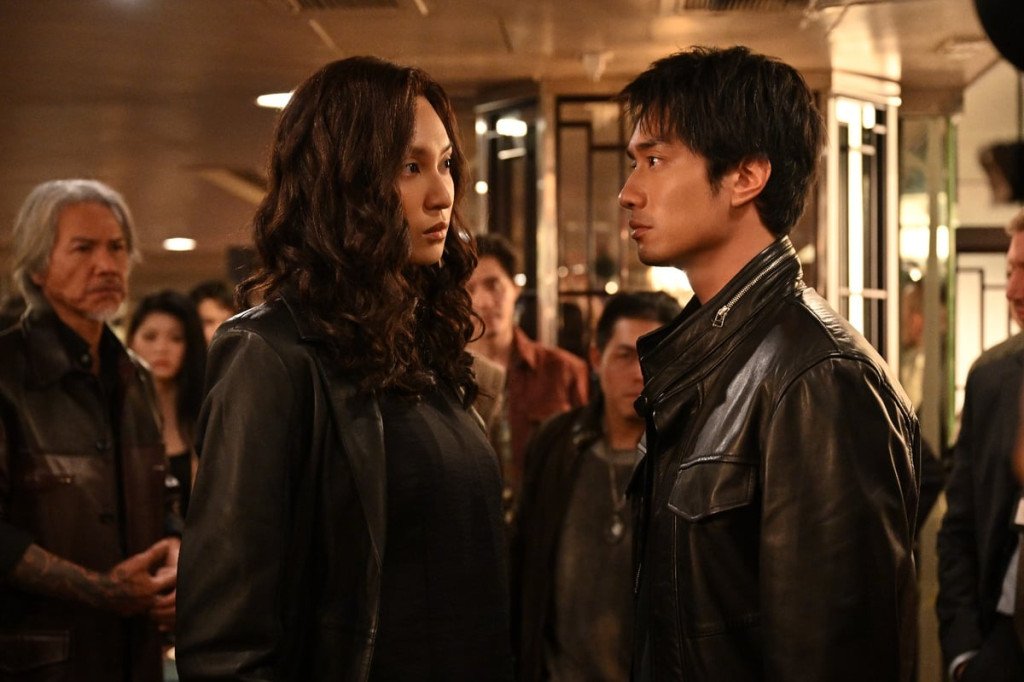
Cold War 1994 enjoyed its Special Screening at the 25th edition of the New York Asian Film Festival.
I remember finally getting into the first two Cold War films a long while back. I don’t remember exactly when I saw them, but what I do know is how much I loved the intrigue and suspense, and kinetic excitement drawn from the minds of directors Sunny Luk and Longman Leung who, at least until about a decade ago, had a fruitful partnership that lasted about five years with plenty of awards in their wake. I also recall there being a third film in the works for the longest time, so much so that with the passage of time came the notion that there might not ever be a “Cold War 3”. Not that I wasn’t open to the idea; Oftentimes, a lot of things factor into whether or not a film gets made regardless of how good the circumstances are, and I was honestly neither here nor there when it came to another chapter in the franchise, so you can imagine my surprise when it turned out that Leung was staking his claim with a solo directing effort for another chapter.
Not just any chapter either, but a story that would chart a course back to an era that would span the timeline of the franchise to an even greater depth than expected, exploring origins of some of our main characters in a way that innovates the intrigue and mystery in the backdrop of an impending transfer of power from British colonial rule back to Hong Kong in 1997. Thus, doing so brings us back to the events of the first two films in a series of flashbacks at the top of Leung’s Cold War 1994, but only enough to warrant our attention as a mysterious and violent incident sets up the sudden disappearance of a major character from the franchise to preamble things. That means a visit by the current Hong Kong Police Commissioner, Sean Lau (Aaron Kwok), paid to the office of a lawyer named Oswald Kan (Chow Yun-Fat) in the wake of an election in Hong Kong where cabinet positions have since become topical subject matter in the news headlines.
Why? Leave it to the writing of scribes Cheung Fei Fan, He Liangyu and Joylon Cheung to delineate events accordingly as Kan’s investigation into the past dealings of former Hong Kong Police Commissioner M.B. Lee (Tony Leung Ka-Fai) take us back a few decades to when a younger M.B. Lee (Terrance Lau) was head of the Organized Crime and Triad Bureau (OCTB) for the Hong Kong Police, and whose investigation of a major drug deal unravels into something entirely bigger, and possibly worse. As it turns out, a major tycoon for the affluent Poon family has been kidnapped by a gangster named Tiger Fong, and when Lee’s happenstance raid goes bust with a body count that extends to one of his own men, it’s only a matter of time before Lee gets roped in by Deputy Commissioner Peter Choi (Daniel Wu) of the Hong Kong Police, seemingly with a proposition to help keep Lee out of harm’s way as the current Commissioner, Hui (Michael Chow) is in need of a scapegoat.
That puts Lee in a major bind that will test his resolve amid a slew of bureaucratic corruption that gamesmanship that now threaten his chances of getting revenge, as the last allies he would expect to have in his corner is the very crime family now looking for Fong, namely Jodie (Louise Wong), the newly-minted in the crossfire as the head of the Lo Yuen crime family. This comes with the teetering landscape of players in this wicked game of corrupt chess to see who moves where and who flinches first, as Lee’s OCTB is compromised and shut down by the police, while the Poon family aim to pay off the demanded ransom, while Choi continues to mitigate and straddle the case from a lateral viewpoint that pits him square in the room opposite Poon family patriarch, William (Tse Kwan-Ho). With the Hong Kong Police Force divided between the Commisioner and the OCTB, and agendas firmly in play, the battle lines are finally drawn for Lee as he wades through a deadly terrain of questionable loyalties to clear his name, solve his case, and make his team whole, which may only be possible at a certain cost…
A prequel to the 2012 and 2016 Cold War films in the hands of a knowledgeable director in Leung makes for an enticing entry into the franchise, capturing an air of unease and tension that lends aptly to the grueling and brutal nature of the explosive crime procedural at hand. The film deals in a lot of players with most of the core appearances going to Lau, Wu, Tse, and Wong to name a few; Casting also sees the addition of Wu Kang Ren in the role of William’s son, Simon, who trots in with an antagonizing allure from the outskirts of things, the lengths to which you’re not quite sure of until things finally unfold. That said, Leung’s work here demands that you pay attention to all the arcs here as they’re woven together from start to finish, and draw your conclusions aptly if you’ve seen your fair share of crime dramas and have a sense of familiarity about how these kinds of plots unfold. If you can do that without being stolen by any modicum of predictability in these areas of the film, then you’re left with the simple task of watching how it all unfolds, and bearing in mind for the most part “when” something is going to happen, as opposed to “if.”

I especially enjoyed the level of thought it took to weave this kind of story together as the first half of a second chapter in the Cold War diptych. Lau is an amazing choice for the role of M.B. Lee after having seen him in Stuntman and Twilight Of The Warriors: Walled In, and his pairing with lead actor Wu provides an outstanding screen presence for both actors. Chow and Kwok are a fascinating duo in their contribution to the narrative, blending two timelines together and adding to the casting caliber of notable veterans among the lot, which also lists Hong Kong action veteran Yuen Biao in a supporting capacity. Requisite gunplay and stunt scenes by Nicky Li and Oh Se-young, and car stunt coordinator Thomson Ng provide ample spectacle to the film’s delivery, barring whatever your stances are on CG in a select handful of high-speed chase sequences and enough smatterings of the red stuff to warrant R-rating by the MPAA.
Going into the expectant sequel, Cold War 1994 achieves what it sets out to for the long haul. Some scores are eventually settled, while others leave ends loose to keep minds in the air as to what will follow next. The cool part is that it all adds up to what will become in the scheme of things leading up to the more contemporaneous ends of the Cold War saga. That said, that I haven’t mentioned Louis Koo shouldn’t be too much cause for concern if you’re a hardline fan of the actor, or even Aidan Gillan who appears in the film as the head of MI6. Whatever Leung’s intentions are, deliberate or otherwise, we’re bound to find out possibly next year, while Cold War 1994 paves the way with something just as smart and outstanding as its predecessors.