NYAFF XXV Review: In SAMURAI VENGEANCE, The Show Must Go On!
Samurai Vengeance enjoyed its North American Premiere at the 25th edition of the New York Asian Film Festival.
If you find yourself coming off an Oceans’ franchise binge going into director Takashi Minamoto’s latest film, I think you’ll be in good hands. Going into Samurai Vengeance, you rightly expect something of a period-set investigatory procedural, particularly based on the logline alone, and with a cast led primarily by Tasuku Emoto and screen laureate Ken Watanabe. That’s about all I can deduce as someone going into Minamoto’s work for the first time, and with a film marking the director’s return to the helm roughly twenty years since helming several pics, the last of which was Children (2006).
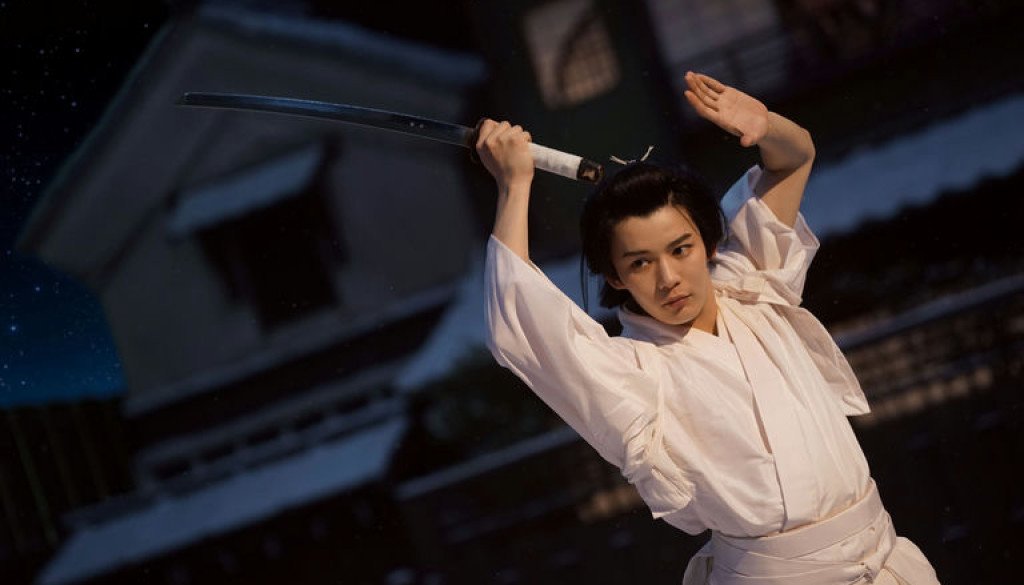
Indeed, Minamoto, who debuted in 2005 with Tokyo Tower, was still working behind the scenes on a number of features, as well as TV movies and dramas, so it is safe to assert that he’s kept his directing muscles warm up to now. Fast forward to this year, and what better way to hail audiences with your return to the chair than with an adaptation of Sayako Nagai’s Naoki Prize and Yamamoto Shugoro Prize-winning 2023 novel? That progression continues with a script by Minamoto which kicks off with a legendary spectacle set in Edo, as a crowd exiting the last show of a kabuki theater’s run corrals before a supposedly notorious thug who is confronted by a swordsman looking to avenge his father’s death.
The duel is fierce and brutal, and unfailingly bloody by the climatic end as the two crash into a barn before a shriek is heard, and the young swordsmanemerges, drenched in red as he trudges the post-battle mood carrying his enemies head, leaving a discerning impression on the sizeable audience that just bore witness to the worse ends of the Bushido code. Bear in mind that this was only the grand opening to a tale laden with intrigue and mystery as the film jumps ahead a year and a half later, and we meet an eccentric ronin named Kase (Emoto) who wanders into Edo with queries of his own about what happened that fateful night. It’s from that point on when things slowly but surely start to piece together for Kase, between acquainting himself with a lowly theater promoter named Ippachi (Koji Seto), and ultimately the town’s playwright and theater owner, Kinji (Watanabe).
For a film like Samurai Vengeance, the devil truly is in the details, and the second half is loaded with them, bringing into focus a story of corruption, greed, tragedy, and the kind of ominous generational trauma that afflicts anyone living by the code of the Samurai, the likes that would have even the interest of the late Tadashi Imai piqued. As the film moves forward, Minamoto’s treatment plays out with abundance, as an unfolding redemption plot that requires the kind of elaborate show that would fool even the most inquisitive onlooker, and bode even remotely surreptitiously to anyone none the wiser.
There’s a scene midway in the movie that features Ippachi secretly meeting with characters Sagara (Kenichi Takito), and a former Onnagata named Hotaru II (Kazuya Takahashi), consorting over Kase’s arrival that would have you believing they were plotting something slightly sinister. The requisite theatrics and allure all come together in these aspects all play a role in this story which speaks poetically to Minamoto’s direction which also proffers one of the most edge-of-your-seat final acts you’ll ever see.
Coupled with Emoto’s bolstering charisma as the inquisitive and peculiar Kase and the mystique of Watanabe’s role who we first meet as one of the witnesses to the introductory duel, and you get a film in Samurai Vengeance, one in which Minamoto leaves a world of room for something beautiful and awe-inspiring in the face of its seemingly binary and fatalistic millieu.

Native New Yorker. Been writing for a long time now, and I enjoy what I do. Be nice to me!