
DON’T PLAY WITH FIRE Review: Tsui Hark’s Stirring Crime Thriller Wrapped In Historical Allegory
Don’t Play With Fire opens for one week exclusively at the Metrograph NYC on September 11. The film is part of the Don’t Play With Fire: The Films of Tsui Hark film series.
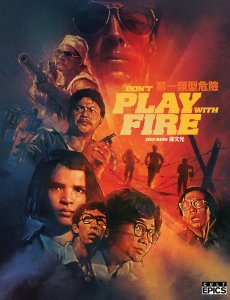
The Hong Kong New Wave continues to prove vital in understanding numerous works in cinema from the 1980s, namely that of celebrated auteur Tsui Hark whose Don’t Play With Fire continues to spark dialogue to this day. Cult Epics has an amazing 2K restoration which they’ve made available on disc with specs and details highlighting the film’s controversial history and delivery, making it a title totally worth the watch even in 2026.
Granted, with OG Hark, you’re bound to stumble upon a few film tropes that have fallen out of fashion over the years, which mainly serve as icing on the cake pertaining to the film’s censorship and evident reshoots that garnered the film its attention and success. Par for the course is the film’s subversive characterizations, centering three young boys named Paul (Albert Au), Lung (Lung Tin Sang) and Ko (Paul Che) who go for a joyride in a car only to end up killing someone, and a woman named Pearl (Lin Chen-Chi) who bears witness to the crime.
The tragedy is the first major event in this film’s development permeating the chaos stirred by Pearl’s encroachment onto the guilt-stricken boys’ lives, following her unceremonious departure from her job. As the film progresses, she commences torturing the boys and blackmailing them by demanding they become friends in exchange for fun, planting explosives around the city just to stir things up provided nobody gets seriously hurt.
This all occurs just as Interpol is investigating the attempted trafficking of weapons through a case of Japanese million-yen bank notes for a gang of ex-U.S. soldiers operating in the region. The resulting catalyst that happens with the bank notes amid a scuffle between one of the gang members transporting the bank notes, and our four protagonists who end up with the bank notes in their possession. What follows is a climactic turning point in a series of bad decisions that adds to the bodycount, just as Pearl’s brother, Tan (Lo Lieh) – a Hong Kong detective, finds his investigation in the bank notes more closer to home than he realizes.
Given the 1967 Hong Kong riots as the root of Hark’s inspiration, there’s a distinct anti-colonial context throughout Hark’s Don’t Play With Fire as it depicts our main characters, through the often reckless actions they commit, and the catastrophic fallout thereafter. Additionally, there’s an implied innocence to these rebellious characters that gets eroded along with virtually any redeeming aspects there might have been beforehand; We meet Pearl just as she’s fired from her job for assaulting another employee, which, for all intents and purposes, isn’t the worst thing she does in the first half of the movie. It’s quite shocking to anyone who doesn’t necessarily have the stomach for it. That she’s holding the actions of the three boys over their heads in her own little twisted game takes nothing away, either, from their complicity in the crime, and their perpetual criminality from then on.
Their efforts to cash in on the Japanese bank notes later find them in the throes of a local triad who tries to extort them with violent means. A footchase gives way splitting the group from Lung in an underground parking lot, forcing him to make a decision preambles the beleagured quartet on matters of what’s more important, amid fighting to survive the city’s underbelly onto which they’ve haphazardly treaded. Moreover, in no uncertain terms do their actions eventually come full-circle in this particular ninety-five minute crime thriller, ensuing an explosive scrimmage that sees the boys on the run from the authorities and hiding in a graveyard of all places.
Hark’s use of violent and sometimes static imagery adds to the poetic messaging between moments in the film leading up to its rhapsodic finale in which few of our mains are left standing; One character falls into a maddening psychosis as he picks up a loaded rifle, firing at nothing as a rapid fire slideshow of the 1967 riots is displayed on the screen just before the credits roll. It’s indicative of the kind of director Hark aspired to be, with a vision that’s chaotic and almost merciless as the story itself in a film like Don’t Play With Fire. I wouldn’t call it “karmic” as that word has since become a term that a lot of people tend to use ad nauseum, but it is a film with a message that finishes strong, with an air of intent that’s as bleak as the world it mirrors.

Native New Yorker. Been writing for a long time now, and I enjoy what I do. Be nice to me!